Archives par mot-clé : Wrong Prediction(s)?

Skeptic German Geologist Interview Goes Viral: Greta Demos “Emotional, Not Based On Fact”…”Selective Media”

by P. Gosselin, April 12, 2019 in NoTricksZone


German climate skepticism may have awakened, and ironically it may in large part be an unintended consequence of the “Greta demonstrations”. Germans may be finally getting fed up with the hysteria that has emptied out schools and turned into an ambush on their industrial jobs.

German geologist Dr. Sebastian Lüning, who together with Prof. Fritz Vahrenholt runs German climate skeptic site Die kalte Sonne, was recently interviewed by the conservative Junge Freiheit TV in Berlin (In German).

While the mainstream media focus almost exclusively on the ultra-alarmist climate scenarios, Lüning takes a far more moderate, non-alarmist view of climate and  man’s impact on it.

In Lüning’s view, natural factors play an as big, or even bigger. role on climate than humans do.

Recent warming “not unusual”

In the interview, Lüning explains how the assumptions made by the CO2 alarmists fall apart when tested against the observations of the past. The experienced German geologist explains why the modern 20th century warming is nothing unusual and that the same has already occurred numerous times over the past 10,000 years.

Start of industrialization coincided with end of Little Ice Age

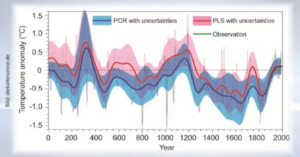
One problem, Lüning says, is that scientists like to begin their temperature charts right before industrialization began in earnest, which happens to coincide near the temperature low point of the Holocene. He says that the term “pre-industrial” has been the source of “lots of confusion”.

End Of Snow Postponed

by Tony Heller, April 12, 2019 in ClimateChangeDispatch


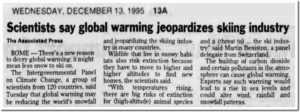
A quarter-century ago, the world’s leading climate experts predicted the end of skiing.

The exact opposite has occurred. Ski areas are receiving record snow and some are staying open all year round.

It wasn’t always like this though.  In 1932, the Winter Olympics almost had to be canceled because of a lack of snow.

13 Dec 1995, Page 13 – The Times at Newspapers.com

Again Reality Goes In Opposite Direction Of Climate Models…”Confidence In Models Correspondingly Low”

by P. Gosselin, March 27, 2019 in NoTricksZone


Real vegetation development in southern Africa takes a very different course than claimed by climate models

By Die kalte Sonne
(German translated by P Gosselin)

Climate models provide answers to all conceivable questions about the future. Political decision-makers are grateful for this information because they can make their plans accordingly.

But are the forecasts derived from models correct at all?

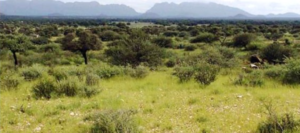
A research team led by Timm Hoffman has now compared the model projections with real vegetation development in southern Africa using historical photos. The sobering result: Nature has mostly developed quite differently than assumed by the models. In contrast to the model assumptions, no significant long-term trend in precipitation could be observed. Vegetation belts, which were supposed to shrink, ended up expanding. Confidence in the models is correspondingly low.

Political planning or even CO2 damage calculations based on the simulations are not possible. Here is the abstract of the work published in the journal Anthropocene in March 2019:

Southern Africa vegetation expanding, images show. Source: here.

Busted Hockey Sticks: 35 Non-Global Warming Papers Have Been Published In 2019

by Kenneth Richard, March 22, 2019 in NoTricksZone


Could a transition in paleoclimate reconstruction be underway? More and more, scientists aren’t hiding statements or graphical depictions of the lack of modern warming or the much-warmer Holocene past.


A compilation of 35 papers from across the globe indicate that modern climate is not unusual, remarkable or unprecedented, and that large regions of the Earth were as warm or warmer than now when CO2 concentrations were much lower (260 to 350 ppm).

This development continues apace with the trends from the last two years, when 253 non-hockey stick papers were published.

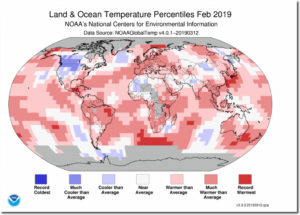
NOAA : “among the eight warmest Februarys on record”

by Tony Heller, March 19, 2019 in TheDeplorableClimSciBLog


NOAA says last month was “among the eight warmest Februarys on record” in much of the Earth.

According to NCEI’s Regional Analysis, South America, Europe and Oceania had a February temperature that ranked among the eight warmest Februarys on record.

There is no such word as “Februarys” – plural for February is Februaries. But besides the fact they are illiterate, they are also lying

It looks like the world is burning up, with just a few slightly cool areas. It has an official government seal on it, so it must be accurate, right?

The map below shows where NOAA actually had surface temperatures in February.

Circular reasoning with climate models

by Dr. Wojick, March 1, 2018 in CFact


Climate models play a central role in the attribution of global warming or climate change to human causes. The standard argument takes the following form: “We can get the model to do X, using human causes, but not without them, so human causes must be the cause of X.” A little digging reveals that this is actually a circular argument, because the models are set up in such a way that human causes are the only way to get change.

The finding is that humans are the cause of global warming and climate change is actually the assumption going in. This is circular reasoning personified, namely conclude what you first assume.

This circularity can be clearly seen in what many consider the most authoritative scientific report on climate change going, although it is actually just the most popular alarmist report. We are talking about the Summary for Policymakers (SPM), of the latest assessment report (AR5), of the heavily politicized UN Intergovernmental Panel on Climate Change (IPCC). Their 29 page AR5 SPM is available here.

40387018 – the raging whirlpool

Global-scale multidecadal variability missing in state-of-the-art climate models

by S. Kravstov et al. 2018, in Nature


Reliability of future global warming projections depends on how well climate models reproduce the observed climate change over the twentieth century. In this regard, deviations of the model-simulated climate change from observations, such as a recent “pause” in global warming, have received considerable attention. Such decadal mismatches between model-simulated and observed climate trends are common throughout the twentieth century, and their causes are still poorly understood. Here we show that the discrepancies between the observed and simulated climate variability on decadal and longer timescale have a coherent structure suggestive of a pronounced Global Multidecadal Oscillation. Surface temperature anomalies associated with this variability originate in the North Atlantic and spread out to the Pacific and Southern oceans and Antarctica, with Arctic following suit in about 25–35 years. While climate models exhibit various levels of decadal climate variability and some regional similarities to observations, none of the model simulations considered match the observed signal in terms of its magnitude, spatial patterns and their sequential time development. These results highlight a substantial degree of uncertainty in our interpretation of the observed climate change using current generation of climate models.

Our Planet Is Beautiful But Far From Fragile

by W.E. William, March 7, 2019 in ClimateChangeDispatch


Rep. Alexandria Ocasio-Cortez claims that “the world is going to end in 12 years if we don’t address climate change.”

The people at the Intergovernmental Panel on Climate Change agree, saying that to avoid some of the most devastating impacts of climate change, the world must slash carbon emissions by 45 percent by 2030 and completely decarbonize by 2050.

Such dire warnings are not new. In 1970, Harvard University biology professor George Wald, a Nobel laureate, predicted, “Civilization will end within 15 or 30 years unless immediate action is taken against problems facing mankind.”

Also in 1970, Paul Ehrlich, a Stanford University biologist, predicted in an article for The Progressive, “The death rate will increase until at least 100-200 million people per year will be starving to death during the next ten years.”

The year before, he had warned, “If I were a gambler, I would take even money that England will not exist in the year 2000.”

Warming Predictions Defied: Japan Winters Cool, Great Lakes Ice Grows And Cal Snow Pack Hits Record

by P. Gosselin, March 2, 2019 in NoTricksZone


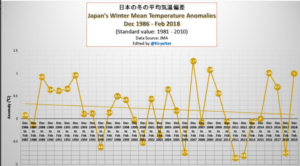
Japan winters are cooling

The Pacific island nation of Japan refuses to obey climate scientists’ forecasts of warming and ignore climate alarmists and their chorus of doomsday shrieks. Climate trends are moving the other way.

Now that February has ended, the 2018/19 winter is now in the books. We’ve tabulated the winter temperature data for Japan going back 32 years. The following chart tells a story that was not supposed to happen:

Japan’s mean winter temperature has been falling for more than 30 years, according to the data from the Japan Meteorology Agency (JMA).

While alarmists insist it’s heating up everywhere, the reality is actually just the opposite, and not just in Japan.

Finland is cooling

The Scandinavian country of Finland, which extends up into the Arctic, also shows no signs of warming at all since December, 1988.

GWPF Call For Insect Decline Paper To Be Withdrawn

by P. Homewood, February 11, 2019 in NotaLotofPeopleKnowThat


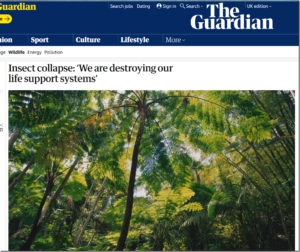
London, 11 February: The scientific paper behind newspaper claims that insect populations were threatened with extinction was based on data known to be unreliable. That’s according to the Global Warming Policy Foundation, which today called for the paper to be withdrawn.

The paper, by US scientists Bradford C Lister and Andres Garcia, claimed that a rapid decline in insect populations in a rainforest in Puerto Rico was the result of rising temperatures. The Washington Post called the study “hyperalarming”, while the Guardian discussed climate change causing “insect collapse”.

However, the authors’ evidence that temperatures had, in fact, risen turns out to be based on a single weather station, which was known to be unreliable because of undocumented changes to equipment and location resulting in a substantial and abrupt increase in recorded temperatures in September 1992.

Since 1992, temperatures at this station have actually declined.

Encore des observations n’allant pas dans le sens de la théorie!

by Jean, N. 25 janvier 2019 in ScienceClimatEnergie


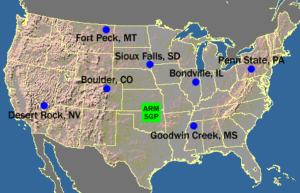
En octobre 2017 un article signé Carl Brehmer[1] et traitant de la théorie de l’effet de serre radiatif était publié sur le site web de l’association anglaise Principia Scientific International[2]. Dans cet article, l’auteur utilisait des données fournies par les stations météorologiques SURFRAD et démontrait que la théorie de l’effet de serre ne pouvait pas expliquer les observations. Si l’auteur a raison, il s’agit encore d’un sérieux problème pour la théorie. Dans le présent article nous allons suivre les pas de Carl Brehmer mais nous allons faire nos propres calculs en employant une autre méthodologie. Arriverons-nous aux mêmes conclusions?

.

Figure 1. Les stations SURFRAD de la NOAA aux Etats-Unis

Study Claiming Insect Decline Due To Global Warming Is Based On Faulty Temperature Data.

by P. Homewood, January 20, 2019 in NotaLotofPeople KnowThat


Clearly the whole study is worthless, and the paper should be withdrawn.

There are some alarming facts about all of this:

1) Why did the researchers not suspect that the temperature data looked hopelessly wrong at the outset?

2) Why did peer review not do the basic checks that I did?

3) The study carries out some mindbendingly complex statistical analysis, linking arthropod decline to rising temperatures. But how can this analysis have been robust, when the temperature data was hopelessly wrong?

The conclusion is that the faulty temperature data matched the researchers’ expectations of climate warming, and consequently they never bothered to crosscheck. It would after all have been extremely simple to have asked the people who maintain the data.

Whether or not arthropods are in decline I have no idea. But by blaming non existent climate warming, there is a very real danger that the true cause is being missed. Indeed, looking at those graphs, it may well be climate cooling that is responsible.

I plan to contact PNAS, who published the paper, to request that it be withdrawn.

Simplest climate model yet – a bathtub

by Charles the moderator, January 18, 2019 in WUWT


Climate change: How could artificial photosynthesis contribute to limiting global warming?

Scientists calculate areas needed for forestation and artificial photosynthesis.

After several years during which global emissions at least stagnated, they rose again somewhat in 2017 and 2018. Germany has also clearly missed its climate targets. In order to keep global warming below 2 degrees Celsius, only about 1100 gigatonnes of CO2 may be released into the atmosphere by 2050[1]. And In order to limit global warming to 1.5 degrees, only just under 400 gigatonnes of CO2 may be emitted worldwide. By 2050, emissions will have to fall to zero even. Currently, however, 42 gigatonnes of CO2 are added every year.

Almost all the various scenarios require “negative emissions”

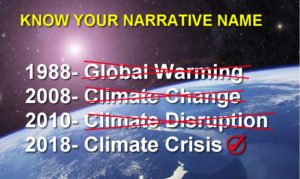
Hump day hilarity – the progression of climate narrative names

by Anthony Watts, January 16, 2019 in WUWT


I had a predictable and laughable Twitter dialog today with the editor of the bought and paid for climate activist site known as “The Carbon Brief”. He was bent out of shape because I pointed out that while he thought the reason for the stepping down of Lord Lawson at The Global Warming Policy Foundation in the UK was due to the lack of traffic and interest in the organization, it [the lowered traffic] really is because of two reasons:

  1. The public is getting bored with it, possibly due to all the fear-mongering promoted by irresponsible journalists.

  2. There’s been a shift from the use of the term “global warming” to other terms, perhaps in a desperate bid to “keep it fresh”. …

    .

New GWPF Paper Shows Hurricanes Are Not Getting Worse

by P. Homewood, January 14, 2019 in NotaLotofPeopleKnowThat


https://www.thegwpf.org/content/uploads/2019/01/Homewood-Hurricanes.pdf

I am pleased to report that the GWPF have now published my latest paper on hurricane trends.

It demonstrates that, contrary to popular myth, hurricanes are not getting more frequent or more powerful.

The paper is based throughout on official data, scientific papers and IPCC reports.

Here is the Executive Summary:

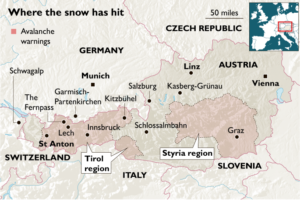
HEAVIES SNOWFALLS IN 100 YEARS BRING CHAOS TO ALPINE SKI RESORTS

by The Times, January 12, 2019 in GWPF


Thousands of British holidaymakers face travel chaos in Austria today after the country experienced the heaviest snowfalls in a century and was bracing for another round of storms.

Three metres of snow fell in the space of 48 hours in some parts of the country and more than a metre is forecast to fall today and tomorrow. Yesterday the army was drafted in to help with the clear-up and to deliver supplies to towns and villages that were cut off.

According to Dr David Viner, a senior research scientist at the climatic research unit (CRU) of the University of East Anglia, within a few years winter snowfall will become “a very rare and exciting event”. “Children just aren’t going to know what snow is,” he said.The Independent, 20 March 2000

Is the forecasted El Niño for this year fading away? It sure looks that way.

by Anthony Watts, January 8, 2019 in WUWT


In late 2018, there were some predictions that there would be a significant El Niño event in 2019. There were strong hints of an El Niño event in both SST data and forecasts. In an April 6th 2018 essay, Bob Tisdale suggested  “Looks like one may be forming right now.”

But if we look at the animation provided by NOAA’s Climate prediction center, it sure looks like it has been fading:

“Terrifying Sea-Level Prediction Now Looks Far Less Likely”… But “marine ice-cliff instability” is “just common sense”

by David Middleton, January 5, 2019 in WUWT


Marine ice cliff instability (MICI) “has not been observed, not at such a scale,” “might simply be a product of running a computer model of ice physics at a too-low resolution,” ignores post glacial rebound, couldn’t occur before ” until 2250 or 2300″… Yet “the idea is cinematic,” “it’s just common sense that Antarctic glaciers will develop problematic ice cliffs” and something we should plan for…

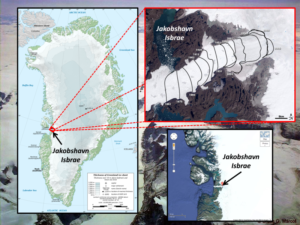
“Our results support growing evidence that calving glaciers are particularly sensitive to climate change.”  Greenland’s climate is always changing… Always has and always will change… And the climate changes observed over the last few decades are not unprecedented. The Greenland ice sheet is no more disappearing this year than it was last year and it is physically impossible for the ice sheet to “collapse” into the ocean.

Figure 6. Jakobshavn Isbrae. (Wikipedia and Google Earth)

TOP 12 DEBUNKED CLIMATE SCARES OF 2018

by GWPF, December 31, 2018


January 2018:  Worst-case global warming scenarios not credible: Study

PARIS (AFP) – Earth’s surface will almost certainly not warm up four or five degrees Celsius by 2100, according to a study released Wednesday (Jan 17) which, if correct, voids worst-case UN climate change predictions.

A revised calculation of how greenhouse gases drive up the planet’s temperature reduces the range of possible end-of-century outcomes by more than half, researchers said in the report, published in the journal Nature.

February:  ‘Sinking’ Pacific nation Tuvalu is actually getting bigger, new research reveals

The Pacific nation of Tuvalu — long seen as a prime candidate to disappear as climate change forces up sea levels — is actually growing in size, new research shows.

A University of Auckland study examined changes in the geography of Tuvalu’s nine atolls and 101 reef islands between 1971 and 2014, using aerial photographs and satellite imagery.

It found eight of the atolls and almost three-quarters of the islands grew during the study period, lifting Tuvalu’s total land area by 2.9 percent, even though sea levels in the country rose at twice the global average.

 March …. April… etc.

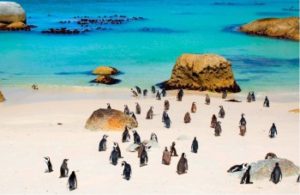
BBC Confirms: Fake African Penguin Climate Claim ‘Was Misleading’

by Dr. Penny Peiser, December 17, 2018 in ClimateChangeDispatch


You may recall the BBC’s news story a couple of months ago, claiming that African penguin populations were declining because of climate change.

The report from South Africa, which then followed, made no mention of climate change at all but instead laid the blame fairly and squarely on overfishing.

This is not an isolated instance of false claims being made about climate change by the BBC. They now seem to be making a habit of it. — Paul Homewood, Not A Lot Of People Know That, 15 December 2018


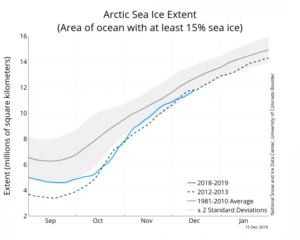
Ten years ago, @AlGore predicted the North polar ice cap would be gone. Inconveniently, it’s still there

by Antony Watts, December 16, 2018 in WUWT


On December 14, 2008, former presidential candidate Al Gore predicted the North Polar Ice Cap would be completely ice free in five years. As reported on WUWT, Gore made the prediction to a German TV audience at the COP15 Climate Conference:


The clever ruse of rising sea levels

by J.  Lehr & T. Harris, December 6, 2018 in WUWT


For the past 50 years, scientists have been studying climate change and the possibility of related sea level changes resulting from melting ice and warming oceans. Despite the common belief that increasing levels of carbon dioxide (CO2) in our atmosphere could result in catastrophic sea level rise, there is no evidence to support this fear. Tax monies spent trying to solve this non-existent problem are a complete waste.

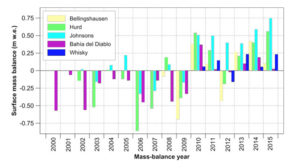
The Increasing Surface Mass Balance of Two Antarctic Glaciers

by Engel, Z.  et al., December 6, 2018 in CO2Sci/J.ofGlaciology


The polar regions of the Earth have long been depicted as canary-in-the-coal-mine sentinels of climate change, given that climate models project that CO2-induced global warming will manifest itself here, first and foremost, compared to other planetary latitudes. Consequently, researchers are frequently examining the Arctic and Antarctic for evidence of recent climate change.

Clearly, as demonstrated here and in other studies (see, for example, The Antarctic Peninsula: No Longer the Canary in the Coal Mine for Climate Alarmists and the references therein) there is a canary in the Antarctic alright, but it is alive and well. And these counter-observations do not bode well for climate models and their projections of CO2-induced global warming.

Figure 1. Surface mass-balance records for glaciers around the northern Antarctic Peninsula. Source: Engel et al. (2018).

Man-Made Global Warming? Where’s The Evidence

by H. Schreuder, November 28, 2018 in ClimateChangeDipsatch


After decades of alarm calls over the impact of human emissions of carbon dioxide (CO2) on global temperatures and climate change, a glaring lack of factually demonstrated and scientifically proven evidence remains.

The evidence presented has been based on computer modeling of temperatures from global weather stations, a larger percentage of which are sited in towns and cities and no data, numerous studies show.

For the 70% of oceans, seas, and lakes, satellite measurements are routinely adjusted to take account of anomalies and sea level rise alarm, expressed in measurements of millimeters per century, does not quantify in that tidal gauges are subjected to landmass upheavals and/or subsidence, none of which can be taken to represent empirical evidence. See Also: New study shows coastlines gaining land despite sea level alarmism