Tous les articles par Alain Préat

Full-time professor at the Free University of Brussels, Belgium apreat@gmail.com apreat@ulb.ac.be • Department of Earth Sciences and Environment Res. Grp. - Biogeochemistry & Modeling of the Earth System Sedimentology & Basin Analysis • Alumnus, Collège des Alumni, Académie Royale de Sciences, des Lettres et des Beaux Arts de Belgique (mars 2013). http://www.academieroyale.be/cgi?usr=2a8crwkksq&lg=fr&pag=858&rec=0&frm=0&par=aybabtu&id=4471&flux=8365323 • Prof. Invited, Université de Mons-Hainaut (2010-present-day) • Prof. Coordinator and invited to the Royal Academy of Sciences of Belgium (Belgian College) (2009- present day) • Prof. partim to the DEA (third cycle) led by the University of Lille (9 universities from 1999 to 2004) - Prof. partim at the University of Paris-Sud/Orsay, European-Socrates Agreement (1995-1998) • Prof. partim at the University of Louvain, Convention ULB-UCL (1993-2000) • Since 2015 : Member of Comité éditorial de la Revue Géologie de la France http://geolfrance.brgm.fr • Since 2014 : Regular author of texts for ‘la Revue Science et Pseudosciences’ http://www.pseudo-sciences.org/ • Many field works (several weeks to 2 months) (Meso- and Paleozoic carbonates, Paleo- to Neoproterozoic carbonates) in Europe, USA (Nevada), Papouasia (Holocene), North Africa (Algeria, Morrocco, Tunisia), West Africa (Gabon, DRC, Congo-Brazzaville, South Africa, Angola), Iraq... Recently : field works (3 to 5 weeks) Congo- Brazzaville 2012, 2015, 2016 (carbonate Neoproterozoic). Degree in geological sciences at the Free University of Brussels (ULB) in 1974, I went to Algeria for two years teaching mining geology at the University of Constantine. Back in Belgium I worked for two years as an expert for the EEC (European Commission), first on the prospecting of Pb and Zn in carbonate environments, then the uranium exploration in Belgium. Then Assistant at ULB, Department of Geology I got the degree of Doctor of Sciences (Geology) in 1985. My thesis, devoted to the study of the Devonian carbonate sedimentology of northern France and southern Belgium, comprised a significant portion of field work whose interpretation and synthesis conducted to the establishment of model of carbonate platforms and ramps with reefal constructions. I then worked for Petrofina SA and shared a little more than two years in Angola as Director of the Research Laboratory of this oil company. The lab included 22 people (micropaleontology, sedimentology, petrophysics). My main activity was to interpret facies reservoirs from drillings in the Cretaceous, sometimes in the Tertiary. I carried out many studies for oil companies operating in this country. I returned to the ULB in 1988 as First Assistant and was appointed Professor in 1990. I carried out various missions for mining companies in Belgium and oil companies abroad and continued research, particularly through projects of the Scientific Research National Funds (FNRS). My research still concerns sedimentology, geochemistry and diagenesis of carbonate rocks which leads me to travel many countries in Europe or outside Europe, North Africa, Papua New Guinea and the USA, to conduct field missions. Since the late 90's, I expanded my field of research in addressing the problem of mass extinctions of organisms from the Upper Devonian series across Euramerica (from North America to Poland) and I also specialized in microbiological and geochemical analyses of ancient carbonate series developing a sustained collaboration with biologists of my university. We are at the origin of a paleoecological model based on the presence of iron-bacterial microfossils, which led me to travel many countries in Europe and North Africa. This model accounts for the red pigmentation of many marble and ornamental stones used in the world. This research also has implications on the emergence of Life from the earliest stages of formation of Earth, as well as in the field of exobiology or extraterrestrial life ... More recently I invested in the study from the Precambrian series of Gabon and Congo. These works with colleagues from BRGM (Orléans) are as much about the academic side (consequences of the appearance of oxygen in the Paleoproterozoic and study of Neoproterozoic glaciations) that the potential applications in reservoir rocks and source rocks of oil (in collaboration with oil companies). Finally I recently established a close collaboration with the Royal Institute of Natural Sciences of Belgium to study the susceptibility magnetic signal from various European Paleozoic series. All these works allowed me to gain a thorough understanding of carbonate rocks (petrology, micropaleontology, geobiology, geochemistry, sequence stratigraphy, diagenesis) as well in Precambrian (2.2 Ga and 0.6 Ga), Paleozoic (from Silurian to Carboniferous) and Mesozoic (Jurassic and Cretaceous) rocks. Recently (2010) I have established a collaboration with Iraqi Kurdistan as part of a government program to boost scientific research in this country. My research led me to publish about 180 papers in international and national journals and presented more than 170 conference papers. I am a holder of eight courses at the ULB (5 mandatory and 3 optional), excursions and field stages, I taught at the third cycle in several French universities and led or co-managed a score of 20 Doctoral (PhD) and Post-doctoral theses and has been the promotor of more than 50 Masters theses.

A voracious Cambrian predator, Cambroraster, is a new species from the Burgess Shale

by Royal Ontario Museum, July 31, 2019 in ScienceDaily


Fossils of a large new predatory species in half-a-billion-year-old rocks have been uncovered from Kootenay National Park in the Canadian Rockies. This new species has rake-like claws and a pineapple-slice-shaped mouth at the front of an enormous head, and it sheds light on the diversity of the earliest relatives of insects, crabs, spiders, and their kin.

Reaching up to a foot in length, the new species, named Cambroraster falcatus, comes from the famous 506-million-year-old Burgess Shale. “Its size would have been even more impressive at the time it was alive, as most animals living during the Cambrian Period were smaller than your little finger,” said Joe Moysiuk, a graduate student based at the Royal Ontario Museum who led the study as part of his PhD research in Ecology & Evolutionary Biology at the University of Toronto. Cambroraster was a distant cousin of the iconic Anomalocaris, the top predator living in the seas at that time, but it seems to have been feeding in a radically different way,” continued Moysiuk.

Hockey Stick Groundhog Day

by P. Homewood, August, 1, 2019 in NotaLotofPeopleKnowThat


Some ancient history

Fifteen to twenty years ago, Michael Mann and colleagues wrote a few papers claiming that current warming was unprecedented over the last 600 to 2000 years.  Other climate scientists described Mann’s work variously as crap, pathetic, sloppy, and crap.  These papers caught the interest of Stephen McIntyre and this led to the creation of his Climate Audit blog and the publication of paperspointing out the flaws in these hockey stick reconstructions. In particular, Mcintyre and his co-author Ross McKitrick showed that the method used by Mann and colleagues shifted the data in such a way that any data sets that showed an upward trend in the 20th century would receive a stronger weighting in the final reconstruction.  With this method, generation of a hockey-stick shape in the temperature reconstruction was virtually guaranteed, which M&M demonstrated by feeding in random numbers to the method.

Net Zero Natural Gas Plant — The Game Changer

by James Conca, July 31, 2019 in Forbes


An actual game changing technology is being demonstrated as we sit in our air-conditioned abodes reading this. And it is being demonstrated by North Carolina–based Net Power at a new plant in La Porte, Texas.

The process involves burning fossil fuel with oxygen instead of air to generate electricity without emitting any carbon dioxide (CO2). Not using air also avoids generating NOx, the main atmospheric and health contaminant emitted from gas plants.

Former Award-Winning NOAA scientist Dr. Rex Fleming declares his climate dissent

by Marc Morano, July 30, 2019 in Climate Depot,


Former NOAA Award-Winning Atmospheric Scientist Dr. Rex Fleming joins many former UN IPCC and U.S. government scientists publicly dissenting on man-made climate change. Fleming declares that “CO2 has no impact on climate change.”

“Past climates have been warm and cold and warm and cold with no changes in carbon dioxide. How can that be a cause when there’s no correlation.”

Fleming 8:10 on AMS, AGU, AAAS: “all 3 of those organizations will not support a “denier”..I could not get published in any of those organizations..as a denier..I had to go to Europe to publish a paper..it was peer-reviewed in Europe, it got thru, & it has been very successful”
Quote Tweet

Fleming’s work here: The Rise and Fall of the Carbon Dioxide Theory of Climate Change (2019)


‘Hidden’ NOAA temperature data reveals that 6 of the last 9 months were below normal in the USA – and NOAA can’t even get June right

by Anthony Watts, July 30, 2019 in WUWT


A review of state-of-the-art climate data tells a different story than what NOAA tells the public.

While media outlets scream “hottest ever” for the world in June and July (it’s summer) and opportunistic climate crusaders use those headlines to push the idea of a “climate crisis” the reality is for USA is that so far most of 2019 has been below normal, temperature-wise.

Little known data from the state of the art U.S. Climate Reference Network (which never seems to make it into NOAA’s monthly “state of the climate” reports) show that for the past nine months, six of them were below normal, shown in bold below.

201810 -0.18°F
201811 -2.56°F
201812 2.39°F
201901 0.63°F
201902 -3.15°F
201903 -2.81°F
201904 1.55°F
201905 -1.13°F
201906 -0.14°F

Above: Table 1, U.S. average temperature anomaly from October 2018 to June 2019. Full data file here

Fake “Heatwave for Greenland” Claims

by P. Homewood, July 30, 2019 in NotaLotofPeopleKnowThat


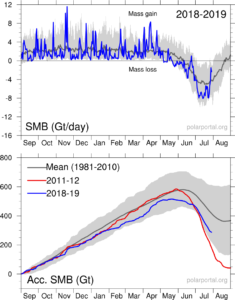
And that Greenland ice? The Surface Mass Balance has been well below normal throughout the winter, because of the dry weather. The rate of summer melt, however, has been pretty much normal, contrary to the fake claims of Ms Nullis.

With only a couple of weeks of melt left, it seems extremely unlikely that, even with the sunshine forecast, that the ice will dip below the 2012 figure (which incidentally is only a “record low” since records began in 1981).

http://polarportal.dk/en/greenland/surface-conditions/

New Record Temperature–But How Much Of It Is Due To UHI?

by P. Homewood, July 30, 2019 in NotaLotofPeopleKnowThat


Cambridge University Botanic Garden measured 38.7C (101.7F) on Thursday beating the previous UK record of 38.5C (101.3F), set in Kent in 2003.

A Met Office official was sent to check the equipment before verifying the new record on Monday.

Staff working at the garden on Thursday tweeted: “No wonder we all felt as if we’d melted.”

Daily temperatures have been measured by the weather station at the site in the south of the city since 1904.

Cambridge University Botanic Garden director, Beverley Glover, said: “We are really pleased that our careful recording of the weather, something that we’ve been doing every day for over 100 years at the Botanic Garden, has been useful to the Met Office in defining the scale of this latest heatwave.

“Our long history of weather recording is very important to researchers analysing climate change.

“However, we can’t help but feel dismay at the high temperature recorded and the implication that our local climate is getting hotter, with inevitable consequences for the plants and animals around us.”

https://www.bbc.co.uk/news/uk-49157898


In fact, Cambridge’s new record tells us very little about “climate change”, but an awful lot about the Urban Heat Island Effect, or UHI.

Shockingly Thick First-Year Ice In Mid-July Between Barents Sea And North Pole

by S.J. Crockford, July29, 2019 in ClimateChangeDispatch


In late June, one of the most powerful icebreakers in the world encountered such extraordinarily thick ice on-route to the North Pole (with a polar bear specialist and deep-pocketed, Attenborough-class tourists onboard) that it took a day and a half longer than expected to get there.

A few weeks later, in mid-July, a Norwegian icebreaker also bound for the North Pole (with scientific researchers onboard) was forced to turn back north of Svalbard when it unexpectedly encountered impenetrable pack ice.

Apparently, the ice charts the Norwegian captain consulted showed ‘first-year ice‘ – ice that formed the previous fall, defined as less than 2 m thick (6.6 ft) – which is often much broken up by early summer.

However, what he and his Russian colleague came up against was consolidated first-year pack ice up to 3 m thick (about 10 ft). Such thick first-year ice was not just unexpected but by definition, should have been impossible.

Ice charts for the last few years that estimate actual ice thickness (rather than age) show ice >2 m thick east and/or just north of Svalbard and around the North Pole are not unusual at this time of year.

This suggests that the propensity of navigational charts to use ice ‘age’ (e.g. first-year vs. multi-year) to describe ice conditions could explain the Norwegian captain getting caught off-guard by exceptionally thick first-year ice.

New Attempts To Erase The MWP & LIA

by P. Homewood, July 29, 2019 in NotaLotofPeopleKnowThat


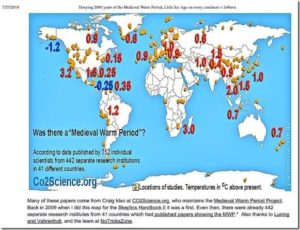
There have been many attempts to get rid of the Medieval Warming Period and Little Ice Age, and here’s another one:

The science teams reconstructed the climate conditions that existed over the past 2,000 years using 700 proxy records of temperature changes, including tree rings, corals and lake sediments. They determined that none of these climate events occurred on a global scale.

https://www.bbc.co.uk/news/science-environment-49086783

As with the other failed attempts, this latest one claims that the MWP and LIA were only localised phenomena. But nothing could be further from the truth.

These three new studies rely on proxies, but time and again hockey stick studies based on proxies are proven to be fake, based on cherry picked proxies and dodgy statistics.

In fact, we have no need to rely on proxies, because the actual evidence of warm and cold periods is very real and substantial across the world.

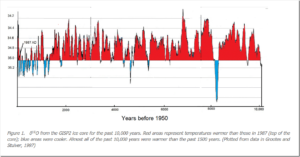
We are all familiar with the evidence from Greenland ice cores, which clearly show both the MWP and LIA:

http://www.kaltesonne.de/temperatures-over-the-past-10000-years/


Anti science L. A. Times hypes propaganda denying global wide Medieval Warm Period and Little Ice Age

by Larry Hamlin, July 28, 2019 in WUWT


The Los Angeles Times is at it again hyping anti science climate alarmist propaganda trying to conceal the global wide Medieval Warm Period and the Little Ice Age that are supported and justified by hundreds of scientific studies.

This climate alarmist propaganda Times article cites a new “study” that ridiculously attempts to deny these clearly established warm and cool periods in our past.

This alarmist hyped new “study” is addressed in a superb article at the JoNova website demonstrating the complete lack of scientific veracity of this studies claims.

There is nothing I can add to show how politically contrived and inane the claims are from this new “study” beyond the excellent presentation in the JoNova article.

Provided below are excerpts from this excellent article which demonstrate the lack of scientific credibility of the new “study” as well as the politically driven anti science climate alarmism bias of the Times.


‘Hidden’ NOAA temperature data reveals that 6 of the last 9 months were below normal in the USA – and NOAA can’t even get June right

by Anthony Watts, July 30 2019 in WUWT


A review of state-of-the-art climate data tells a different story than what NOAA tells the public.

While media outlets scream “hottest ever” for the world in June and July (it’s summer) and opportunistic climate crusaders use those headlines to push the idea of a “climate crisis” the reality is for USA is that so far most of 2019 has been below normal, temperature-wise.

Little known data from the state of the art U.S. Climate Reference Network (which never seems to make it into NOAA’s monthly “state of the climate” reports) show that for the past nine months, six of them were below normal, shown in bold below.


201810 -0.18°F
201811 -2.56°F
201812 2.39°F
201901 0.63°F
201902 -3.15°F
201903 -2.81°F
201904 1.55°F
201905 -1.13°F
201906 -0.14°F

Above: Table 1, U.S. average temperature anomaly from October 2018 to June 2019. Full data file here

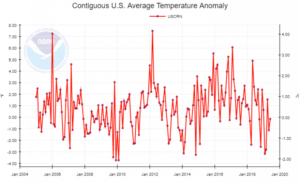
Note the below average value for June, 2019 at -0.14°F

Figure 1, U.S. average temperature anomaly from January 2005 to June 2019. Source of graph, NOAA, available here

The pause in global warming shows CO2 may be *more* powerful! Say hello to Hyperwarming Wierdness.

by JoNova, July 24, 2019


It’s all so obvious. If researchers start with models that don’t work, they can find anything they look for — even abject nonsense which is the complete opposite of what the models predicted.

Holy Simulation! Let’s take this reasoning and run with it  — in the unlikely event we actually get relentless rising temperatures, that will imply that the climate sensitivity of CO2 is lower. Can’t see that press release coming…

Nature has sunk so low these days it’s competing with The Onion.

The big problem bugging believers was that global warming paused, which no model predicted, and which remains unexplained still, despite moving goal posts, searching in data that doesn’t exist, and using error bars 17 times larger than the signal. The immutable problem is that energy shalt not be created nor destroyed, so The Pause still matters even years after it stopped pausing. The empty space still shows the models don’t understand the climate — CO2 was supposed to be heating the world, all day, everyday. Quadrillions of Joules have to go somewhere, they can’t just vanish, but models don’t know where they went. If we can’t explain the pause, we can’t explain the cause, and the models can’t predict anything.

In studies like these, the broken model is not a bug, it’s a mandatory requirement — if these models actually worked, it wouldn’t be as easy to produce any and every conclusion that an unskeptical scientist could hope to “be surprised” by.

The true value of this study, if any, is in 100 years time when some psychology PhD student will be able to complete an extra paragraph on the 6th dimensional flexibility of human rationalization and confirmation bias.

Busted climate models can literally prove anything. The more busted they are, the better.

More sensitive climates are more variable climates

University of Exeter

A decade without any global warming is more likely to happen if the climate is more sensitive to carbon dioxide emissions, new research has revealed.

China is warming fastest where the cities are, not where the models predicted – classic UHI

by JoNova, July 24, 2019


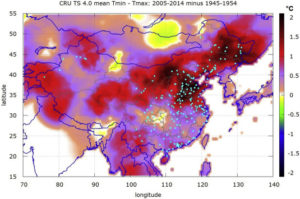
The biggest changes in temperature (“divergence” in dark red brown Fig 6) occurred where the most people lived (blue dots). In the 60 years to 2010 China was reported to have warmed by 0.79 ± 0.10 °C. However Scafetta et al calculate at most, China could have experienced a real warming of only 0.46 ± 0.13 °C.

Somehow the combined might and supercomputers at NOAA, NASA, Hadley and the Bureau of Met experts all missed this.

It’s another third of a degree gone from the Glorious CO2 Narrative. Just like that.


Is there a  more perfect nation to study the Urban Heat Island effect than China?

The worlds most populous nation has made a blistering transformation in two decades. As recently as 1995 the population was 75% rural. Now it’s approaching 60% urban. Shenzhen, which is near Hong Kong, grew from 3000 people in 1950 to more than 10 million in 2010. Around Beijing, thousands of towns have been built in a networked carpet, each a mere 2km apart (zoom in on Google satellite view). The stations in these areas are effectively not rural anymore.

See also here

China Still Expanding Coal Power Capacity

by P. Homewood, July 23, 2019 in NotaLotofPeoppleKnowThat


SANHE, China (Reuters) – China Energy Group, the country’s biggest power generator, will add more than 6 gigawatts (GW) of new ultra-low emission coal-fired capacity this year as it bids to meet growing electricity demand, a senior official with the firm said on Thursday.

The company also expected to build another 5 GW of low-emission capacity next year, Xiao Jianying, the head of the state-run firm’s coal-fired power department, told Reuters.

“China still has quite a big demand for electricity. The government now supports regions with poor wind and solar resources to use coal-fired power … it’s a more practical measure, as gas is still too expensive,” said Xiao.

China Energy operated coal-fired plants with a total capacity of 175 GW at the end of 2018, 77.4% of its total capacity and about 10% of the entire country’s capacity.

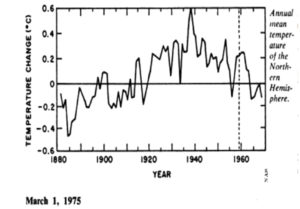
1970s: Earth Warmed 0.6°C From 1880-1940 And Cooled -0.3°C From 1940-1970. Now It’s 0.1°C And -0.05°C.

by K. Richard, July 25, 2019 in NoTricksZone


About 45 years ago, the “consensus” in climate science (as summarized by Williamson, 1975) was quite different than today’s version.

1. The Medieval Warm Period was about 1°C warmer than present overall while the “largely ice-free” Arctic was 4°C warmer, allowing the Vikings to navigate through open waters because there was “no or very little ice” at that time.
2. The island of Spitsbergen, 1237 km from the North Pole and home to over 2000 people, “benefited” because it warmed by 8°C between 1900 and 1940, resulting in 7 months of sea-ice free regional waters. This was up from just 3 months in the 1800s.
3. Central England temperatures dropped -0.5°C between the 1930s to the 1950s.
4. Pack-ice off northern and eastern iceland returned to its 1880s extent between 1958 and 1975.
5. In the 1960s, polar bears were able to walk across the sea (ice) from Greenland to Iceland for the first time since the early 1900s. (They had somehow survived the 7 months per year of sea-ice-free waters during the 1920s-1940s).


Image Source: National Academy of Sciences,  Understanding Climatic Change

Lingen Cheated: Germany’s New All-Time Record High Resulted From DWD Weather Service Lousy Station Siting

by P. Gosselin, July 28, 2019 in NoTricksZone


During last week’s record-setting European heat wave, Germany’s previous record of 40.3C was impressively shattered by the measurement station located at the northwest city of Lingen, near the Dutch border, some 50 kilometers from where I live. The German DWD weather service and media loved it!

Controversial siting

Yet, controversy now swirls about the new record setting measurement since it has come to light that the measurement is fraught with some considerable siting issues.

As the photo published by T-online here shows, the station is located right near a DWD office building, is shielded from the wind by grown trees and is located not far from a public swimming pool.

Meteorologist Michael Theusner told t-online.de: “The monthly average of the daily highs in Lingen has been deviating more and more upwards from the average of the highs in Lower Saxony since 2010.” The station has become increasingly shielded and thus tends to heat up more.

Swiss veteran meteorologist Jörg Kachelmann wrote the extra heat possibly could be heating the station by up to another 3 degrees!

DWD accepts overheated reading

12 New Papers Provide Robust Evidence The Earth Was Warmer During Medieval Times

by K. Richard, July 29, 2019 in NoTricksZone


Claims that modern temperatures are globally warmer than they were during Medieval times (~800 to 1250 A.D.) have been contradicted by a flurry of new (2019) scientific papers.

Southern Ocean/SE Pacific (SSTs)

The Medieval Warm Period (1100 years BP) was 1.5°C warmer than today (14°C vs. 12.5°C) in the SE Pacific or Southern Ocean.


See also here

SUMMER COLD GRIPS RUSSIA: TEMPERATURE RECORDS TUMBLE — HARD FROSTS REPORTED

by Cap Allon, July 28, 2019 in Electroverse


Arctic air has plunged into ALL of transcontinental Russia this week, from east to west, north to south. In fact, average temperatures have been holding at least 8C below normal for vast swathes of the 17,125,200 km2 nation ALL MONTH.

And, over the past few days, a large number of new all-time record-low temperatures were set in the Magadan region, located to the east of the country, in northeast Yakutia (Sakha Republic).

I’ve listed a few of them below (data courtesy of (http://www.hmn.ru):

  • On July 24, in Susuman, a record breaking -4.1C (24.6F) was observed — busting the previous daily record of -3.5C set back in 1973 (solar minimum of cycle 20).
  • In Seimchan, -2.9C (26.8F) beat the previous record for the date of -2.4C (27.7F) from 1991.
  • In Brokhovo, the new record low for July 24 is now 4C (39.2F), which surpasses the 4.6C (40.3F) from 1973 (solar minimum of cycle 20).
  • The -1.4C (29.5F) in Talon comfortably ousted the -0.6C (30.9F) from 1973 (solar minimum of cycle 20).
  • Tompo’s -0.3C (31.5F) bumped-off the previous all-time record 0.3C (32.5F) from 1977 (again, solar minimum of cycle 20).
  • While in Zyryanka, the mercury fell to 2.7C (36.9F), busting 1956’s 2C (35.6F).

What the Climate Change Models Actually Say

by R. Murphy, July 20, 2019 in FoundationEconomicEducation


An Earth scientist’s recent article making the rounds on social media highlights a terrifying conversation he had with “a very senior member” of the IPCC, which is the UN’s body devoted to studying climate science. The upshot of their conversation was that millions of people will die from climate change, a conclusion that leads the author to lament that humans have created a consumption-driven civilization that is “hell-bent on destroying itself.”

As with most such alarmist rhetoric, there is little to document these sweeping claims—even if we restrict ourselves to “official” sources of information, including the IPCC reports themselves. The historical record does not justify panic, but instead should lead us to expect continued progress for humanity, so long as the normal operation of voluntary market interactions continues without significant political interference to sabotage it.

Here is the opening hook from James Dyke’s article, in which he grabs the reader with an apocalyptic conversation:

Why Climate Change Wasn’t Behind Paris’s Record-High Temperature

by Chris Martz, July 27, 019 in ClimateChangeDispatch


It’s summer, temperatures are hot - sometimes record hot - and as usual, climate alarmism reaches record highs as climate activists have a field day with fearmongering rather than with facts and data.

Every week, various weather events end up getting caught in the spokes of the wheel of climate; it’s an endless cycle. Rinse, wash, repeat.

This time, it’s the [second] European heatwave this summer.

A Bit of Historical Perspective

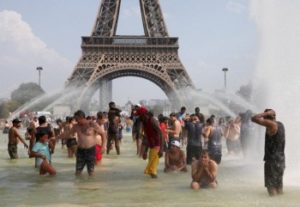
While countries like the Netherlands, Germany, and Belgium have recorded their hottest temperatures on record this week, Paris’s record high of 108.7°F (42.6°C) on Thursday, July 25, made international headlines and consequently sparked climate insanity.¹

The graph below (Figure 1) shows the maximum temperature in Paris, France for each year since 1900.² As indicated by the red trendline, there has been a noticeable increase in the annual maximum temperature in Paris over the long run, however, the trend is not alarming.

Paris’s previous hottest temperature record stood for nearly 72 years.³

On July 28, 1947, the city reached 104.7°F (40.4°C).³ Paris’s high of 108.7°F (42.6°C) on Thursday broke the old record by 4°F (2.2°C), an incredible feat by any stretch of the imagination.

To break an all-time temperature record by 4°F in summer, let alone tie it, is extremely difficult to do, even with global warming.

GLOBAL TEMPERATURE FALLING AGAIN

by Clive Best, July 27, 2019 in GWPF


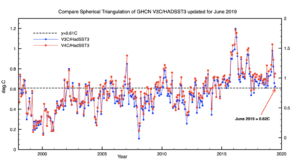
The global averaged surface temperature for June 2019 was 0.62C, back down to where it was before the 2015/16 El Nino.

The global averaged surface temperature for June 2019 was 0.62C using my spherical triangulation method merging GHCNV3 with HadSST3. This is a further drop of 0.04C from May 2018. The discrepancy with GHCNV4 is however growing. V4C calculated in exactly the same way gives a June temperature of 0.75C, a rise of 0.03C,  and 0.13C warmer than V3. This difference is statistically significant.

COLD PERU: “WE ARE GOING THROUGH ONE OF THE MOST INTENSE WINTERS IN 50 YEARS”

by Cap Alon, July 26, 2019 in Electroverse


Lima, the capital of Peru, is going through one of its coldest winters in almost 50 years, according to the National Service of Meteorology and Hydrology, with this year even surpassing the truly brutal 2018 season.

“Lima is currently recording minimum temperatures around 14.7C,” said climatology expert Lourdes Menis Álvarez of Senamhi. “As for maximum temperatures, we are around 17.5C.”

Comparing these temperatures to the 2018 season, which itself was one of the coldest winters on record, Álvarez found that this year has been significantly cooler to date, with temps ranging on average between 1C to 1.5C colder.

According to Álvarez, these types of cold winters were once common-place in Lima. Of late, however, strong El Niños have brought “long summers and warm winters” to the region.

Though the tide is clearly now turning. Álvarez: “The winter of 2018 was one of the coldest in almost 50 years. However, the winter of 2019 has already surpassed it in intensity.”

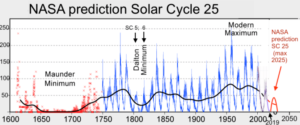
The cold times are returning, in line with historically low solar activity:


See also here (Russia)

UK Record Temperature Stays Intact

by P. Homewood, July 26, 2019 in NotaLotofPeopleKnowThat

The Met Office have been desperate to declare a new UK temperature record this week, but the weather gods said no!

The Cambridge temperature fell well short of the all time record of 38.5C set at Faversham in 2003.

They feebly claim that the Cambridge temperature is still a record for July. Climatologically July is a warmer month than August, when the Faversham record was set, so by all accounts the 2003 heatwave was more extreme than yesterday’s.

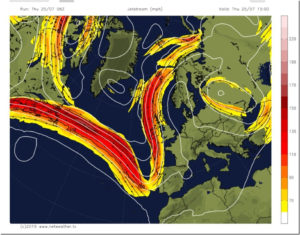
The cause of the high temperatures is very clear. Not only was hot air being drawn up from Spain, but a deep area of low pressure to the west powered up the jet stream to bring that hot air north very quickly, before the heat had a chance to dissipate.

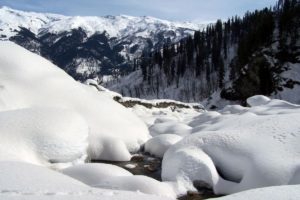
FOR THE FIRST TIME IN TWO DECADES, THICK SNOW LINGERS ON HIMALAYAN MOUNTAIN PASSES IN JULY

by Cap Alon, July 26, 2019 in Electroverse


Crazed environmentalists take note, the Himalayan mountain passes of Rohtang, Baralacha, Kunjum, Shikula are STILL blanketed in deep snow, in July!

Snow holding on until the end of July is incredibly rare on these passes, reports the The Statesman — in fact, it’s the first time in 20 years that it’s occurred, the packs are usually all-gone by the end of May.

Furthermore, heavy and record-breaking snow has been falling this week actually adding to the pack.

“The heavy accumulation of snow up to 4-5 feet on Rohtang, Baralacha, Kunjum, Shikula passes is certainly good for the environment in the Himalayas,” said Senior Scientific Officer at State Centre on Climate Change, Dr SS Randhawa.


A view of Solang Nullah from where the Rohtang tunnel connecting Kullu to Lahaul and Spiti is proposed
photo by Birbal Sharma