Full-time professor at the Free University of Brussels, Belgium
apreat@gmail.com
apreat@ulb.ac.be
• Department of Earth Sciences and Environment
Res. Grp. - Biogeochemistry & Modeling of the Earth System
Sedimentology & Basin Analysis
• Alumnus, Collège des Alumni, Académie Royale de Sciences, des Lettres et des Beaux Arts de Belgique (mars 2013). http://www.academieroyale.be/cgi?usr=2a8crwkksq&lg=fr&pag=858&rec=0&frm=0&par=aybabtu&id=4471&flux=8365323
• Prof. Invited, Université de Mons-Hainaut (2010-present-day)
• Prof. Coordinator and invited to the Royal Academy of Sciences of Belgium (Belgian College) (2009-
present day)
• Prof. partim to the DEA (third cycle) led by the University of Lille (9 universities from 1999 to 2004) - Prof. partim at the University of Paris-Sud/Orsay, European-Socrates Agreement (1995-1998)
• Prof. partim at the University of Louvain, Convention ULB-UCL (1993-2000)
• Since 2015 : Member of Comité éditorial de la Revue Géologie de la France http://geolfrance.brgm.fr
• Since 2014 : Regular author of texts for ‘la Revue Science et Pseudosciences’ http://www.pseudo-sciences.org/
• Many field works (several weeks to 2 months) (Meso- and Paleozoic carbonates, Paleo- to Neoproterozoic carbonates) in Europe, USA (Nevada), Papouasia (Holocene), North Africa (Algeria, Morrocco, Tunisia), West Africa (Gabon, DRC, Congo-Brazzaville, South Africa, Angola), Iraq... Recently : field works (3 to 5 weeks) Congo- Brazzaville 2012, 2015, 2016 (carbonate Neoproterozoic).
Degree in geological sciences at the Free University of Brussels (ULB) in 1974, I went to Algeria for two years teaching mining geology at the University of Constantine. Back in Belgium I worked for two years as an expert for the EEC (European Commission), first on the prospecting of Pb and Zn in carbonate environments, then the uranium exploration in Belgium. Then Assistant at ULB, Department of Geology I got the degree of Doctor of Sciences (Geology) in 1985. My thesis, devoted to the study of the Devonian carbonate sedimentology of northern France and southern Belgium, comprised a significant portion of field work whose interpretation and synthesis conducted to the establishment of model of carbonate platforms and ramps with reefal constructions.
I then worked for Petrofina SA and shared a little more than two years in Angola as Director of the Research Laboratory of this oil company. The lab included 22 people (micropaleontology, sedimentology, petrophysics). My main activity was to interpret facies reservoirs from drillings in the Cretaceous, sometimes in the Tertiary. I carried out many studies for oil companies operating in this country.
I returned to the ULB in 1988 as First Assistant and was appointed Professor in 1990. I carried out various missions for mining companies in Belgium and oil companies abroad and continued research, particularly through projects of the Scientific Research National Funds (FNRS).
My research still concerns sedimentology, geochemistry and diagenesis of carbonate rocks which leads me to travel many countries in Europe or outside Europe, North Africa, Papua New Guinea and the USA, to conduct field missions.
Since the late 90's, I expanded my field of research in addressing the problem of mass extinctions of organisms from the Upper Devonian series across Euramerica (from North America to Poland) and I also specialized in microbiological and geochemical analyses of ancient carbonate series developing a sustained collaboration with biologists of my university. We are at the origin of a paleoecological model based on the presence of iron-bacterial microfossils, which led me to travel many countries in Europe and North Africa. This model accounts for the red pigmentation of many marble and ornamental stones used in the world. This research also has implications on the emergence of Life from the earliest stages of formation of Earth, as well as in the field of exobiology or extraterrestrial life ...
More recently I invested in the study from the Precambrian series of Gabon and Congo. These works with colleagues from BRGM (Orléans) are as much about the academic side (consequences of the appearance of oxygen in the Paleoproterozoic and study of Neoproterozoic glaciations) that the potential applications in reservoir rocks and source rocks of oil (in collaboration with oil companies).
Finally I recently established a close collaboration with the Royal Institute of Natural Sciences of Belgium to study the susceptibility magnetic signal from various European Paleozoic series. All these works allowed me to gain a thorough understanding of carbonate rocks (petrology, micropaleontology, geobiology, geochemistry, sequence stratigraphy, diagenesis) as well in Precambrian (2.2 Ga and 0.6 Ga), Paleozoic (from Silurian to Carboniferous) and Mesozoic (Jurassic and Cretaceous) rocks. Recently (2010) I have established a collaboration with Iraqi Kurdistan as part of a government program to boost scientific research in this country.
My research led me to publish about 180 papers in international and national journals and presented more than 170 conference papers. I am a holder of eight courses at the ULB (5 mandatory and 3 optional), excursions and field stages, I taught at the third cycle in several French universities and led or co-managed a score of 20 Doctoral (PhD) and Post-doctoral theses and has been the promotor of more than 50 Masters theses.
It is far too early to judge this year’s global temperature developments and their significance regarding the long-term warming trend.
The United Nations climate change conference, held in Bonn this year, is always the cue for press releases from the World Meteorological Office and the UK Met Office in which they give their assessment of the year based on 9-10 months of data.
Dealing with the El Nino of recent years (and don’t forget the ‘Pacific Blob’ before that) they have had difficulty with explaining what part of the record temperature was due to El Nino and natural, and what was anthropogenic.
An asteroid, also known as the Chicxulub Impactor, hit Earth some 66 million years ago, causing a crater 180 km wide. The impact of the asteroid heated organic matter in rocks and ejected it into the atmosphere, forming soot in the stratosphere.
According to the study, soot from hydrocarbon-rich areas caused global cooling of 8-11°C and cooling on land of 13-17°C. It also caused a decrease in precipitation by approximately 70-85 percent on land and a decrease of approximately 5-7°C in seawater temperature at a 50-m water depth, leading to mass extinction of life forms including dinosaurs and ammonites
The plots attached here are taken from the MOYHU blog maintained by Nick Stokes here. The software on the blog allows the global temperature anomaly data for each month for the last several years, it also allows the mesh showing the temperature measurement points to be turned on and off.
by Freeman Dyson, November 10, 2017 in WUWTFREEMAN DYSON is professor of physics at the Institute for Advanced Study, in Princeton. His professional interests are in mathematics and astronomy
My first heresy says that all the fuss about global warming is grossly exaggerated. Here I am opposing the holy brotherhood of climate model experts and the crowd of deluded citizens who believe the numbers predicted by the computer models. Of course, they say, I have no degree in meteorology and I am therefore not qualified to speak.
But I have studied the climate models and I know what they can do.
In addition, we consider temperature dependent natural emission and absorption rates, by which the paleoclimatic CO2 variations and the actual CO2 growth rate can well be explained. The anthropogenic contribution to the actual CO2concentration is found to be 4.3%, its fraction to the CO2 increase over the Industrial Era is 15% and the average residence time 4 years.”
by Tony Heller, November 9, 2017 in ClimateChangeDispatch
The animation below shows the extent of 5+ foot thick sea ice at present vs. the same date ten years ago. Ice thinner than five feet thick has been masked out.
Though advocates of the dangerous anthropogenic global warming (AGW) narrative may not welcome the news, evidence that modern day global warming has largely been driven by natural factors – especially solar activity – continues to pile up.
Much of the debate about the Sun’s role in climate change is centered around reconstructions of solar activity that span the last 400 years, which now include satellite data from the late 1970s to present.
Study Bolsters Theory of Heat Source Under West Antarctica
A new NASA study adds evidence that a geothermal heat source called a mantle plume lies deep below Antarctica’s Marie Byrd Land, explaining some of the melting that creates lakes and rivers under the ice sheet. Although the heat source isn’t a new or increasing threat to the West Antarctic ice sheet, it may help explain why the ice sheet collapsed rapidly in an earlier era of rapid climate change, and why it is so unstable today.
by Ron Clutz, November 8, 2017, in ClimateChangeDispatch
The graph [after the jump] is noisy, but the density is needed to see the seasonal patterns in the oceanic fluctuations. Previous posts focused on the rise and fall of the last El Nino starting in 2015.
This post takes a longer view, encompassing the significant 1998 El Nino and since. The color schemes are retained for Global, Tropics, NH and SH anomalies.
Despite the long time frame, I have kept the monthly data (rather than yearly averages) because of interesting shifts between January and July.
President, Europäisches Institut für Klima und Energie (EIKE)
US Climate and Energy Policy after 10 Months Trump
Zero Hour for Climate Alarmists?
Marc Morano
Editor in Chief www.climatedepot.com and Director of Communication CFACT
The German Energiewende – Germany’s Green Path, between Illusion and Reality,
by Deming Kong et al., November 30, 2017 in Quaternary International
High-resolution surface temperature records over the last two millennia are crucial to understanding the forcing and response mechanism of Earth’s climate. Here we report a bidecadal-resolution sea surface temperature (SST) record based on long-chain alkenones in a gravity sediment core retrieved from the northern South China Sea. SST values varied between 26.7 and 27.5 °C, with a total variability ∼1 °C over the last 2000 years.
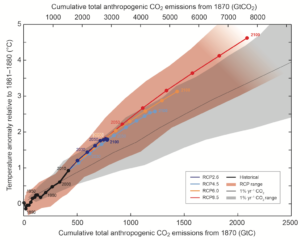
It started as a nice simple idea: There is a finite amount of Carbon that humanity can burn before the planet warms above 2C. This idea was based on AR5 Earth Systems Models (ESMs) ‘showing’ that the relationship between global temperatures and cumulative emissions was linear. At last the IPCC had something easy for world leaders to understand! This was all nicely summarised in Figure SPM-10, shown below. The Paris accord is essentially derived from this one figure.
Radical environmentalists continue to claim that CO2 emissions cause climate change and that global warming, aka, climate change, will bring more severe storms.
Every year, the facts prove them wrong: Storms are not getting more severe or more frequent.
Climate change is back on the agenda with a global climate conference kicking off Monday in the German city of Bonn.
Who’s coming, what are the key debates about and how green will this meeting be? Five things to know about the U.N. conference known as COP23, which runs from Nov. 6-17.
by Paul Homewood, November 5, 2017, NotLotPeopleKnowThat
The Federal Climate Science Special Report from the US Global Change Research Program, mandated under the U.S. Global Change Research Act of 1990, has now been published.
As with the draft, which I reported on in August, it is the usual mix of half truths, exaggerations, omissions and outright lies
At Dr. Roy Spencer’s site, regular commenter Des posted a very interesting analysis with respect to September 2017 on UAH6 and the Top 10 first-9-months-of-the-year. Des has graciously allowed me to use their work. Everything that appears below is from Des until you see the statement “Written by Des.” below:
Top 10 Septembers on the record:
1. 2017 (+0.54)
2. 2016 (+0.45) … EL NINO
3. 1998 (+0.44) … EL NINO
4. 2010 (+0.37) … EL NINO
5. 2009 (+0.27) … EL NINO
6. 2005 (+0.25) … EL NINO
7. 2015 (+0.25) … EL NINO
8. 1995 (+0.22) … EL NINO
9. 2012 (+0.22)
10. 2013 (+0.22)
‘Scars’ left by icebergs record West Antarctic ice retreat ten thousand years ago – occurred under climate conditions that were relatively similar to those of today.
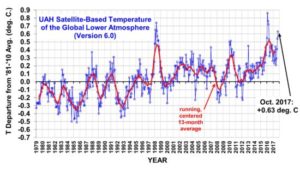
The Version 6.0 global average lower tropospheric temperature (LT) anomaly for October, 2017 was +0.63 deg. C, up from the September, 2017 value of +0.54 deg. C (click for full size version).
18O is a rare isotope of oxygen. The ratio of 18O to the normal 16O in foraminifera fossils (“forams”) can be used to estimate paleo-ocean temperatures. Higher values mean lower temperatures. A recent article on geologypage.com (here) led me to Bernard, et al., 2017, which has experimental data that suggest 18O concentrations can be altered in fossils by solid-state diffusion after fossilization. This can corrupt the measurement and the resulting calculated temperature
When it comes to climate change, there are worlds apart between Germany’s aspiring Jamaica Coalition partners. It is all about coal and it is not certain the divide can be bridged.
Under the U.S. Global Change Research Act of 1990, the federal government has been charged with producing large National Climate Assessments (NCA), and today the most recent iteration has arrived. It is typical of these sorts of documents–much about how the future of mankind is doomed to suffer through increasingly erratic weather and other tribulations. It’s also missing a few tidbits of information that convincingly argue that everything in it with regard to upcoming 21st century climate needs to be taken with a mountain of salt.
by Paul Homewood, November 2, 2017 in NotLotPeopleKnowThat
European mean sea-level records are among the best time series data available globally by which to detect the presence of necessary accelerations forecast by physics-based projection models to elevate current rates of global sea-level rise (≈3 mm/y) to anywhere in the vicinity of 10–20 mm/y by 2100. The analysis in this paper is based on a recently developed analytical package titled “msltrend,” specifically designed to enhance estimates of trend, real-time velocity, and acceleration in the relative mean sea-level signal derived from long annual average ocean water level time series
Biases in climate model simulations introduce biases in subsequent impact simulations. Therefore, bias correction methods are operationally used to post-process regional climate projections. However, many problems have been identified, and some researchers question the very basis of the approach.
La géologie, une science plus que passionnante … et diverse