Archives de catégorie : climate-debate

MOVING THE GOALPOSTS, IPCC SECRETLY REDEFINES ‘CLIMATE’

by David Whitehouse, October 29, 2018 in GWPF


The IPCC appears to have secretly changed the definition of what constitutes ‘climate’ by mixing existing and non-existing data

The definition of ‘climate’ adopted by the World Meteorological Organisation is the average of a particular weather parameter over 30 years. It was introduced at the 1934 Wiesbaden conference of the International Meteorological Organisation (WMO’s precursor) because data sets were only held to be reliable after 1900, so 1901 – 1930 was used as an initial basis for assessing climate. It has a certain arbitrariness, it could have been 25 years.

For its recent 1.5°C report the IPCC has changed the definition of climate to what has been loosely called “the climate we are in.” It still uses 30 years for its estimate of global warming and hence climate – but now it is the 30 years centred on the present.

Une Pensée Unique pour Jacques Duran

by Prof. dr. Paul Berth, 29 octobre 2018 in ScienceClimatEnergie


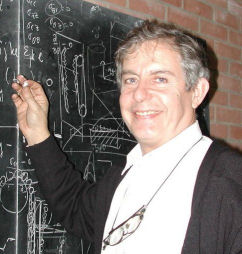
Le physicien Jacques Duran, fondateur du célèbre site Pensée Unique et pionnier du climato-réalisme en France, est décédé ce vendredi 26 octobre 2018.

Son site internet est toujours online. Si vous ne le connaissez pas, allez vite le voir. Copiez le et diffusez le. Il est vraiment Unique! Il est abondamment documenté et illustré, et représente une véritable mine de connaissances sur le climat. Son site, créé en 2006 sous le pseudonyme de Jean Martin, est dédié à tous ceux qui ont conservé un esprit critique et qui se refusent à absorber sans réfléchir une grande partie des nouvelles de toutes sortes qui nous parviennent chaque jour.

500 Million Years of Unrelatedness between Atmospheric CO2 and Temperature

by Davis W.J., 2017 in CO2Science


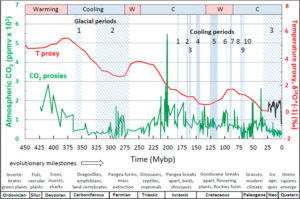
Davis, W.J. 2017. The relationship between atmospheric carbon dioxide concentration and global temperature for the last 425 million years. Climate 5: 76; doi: 10.3390/cli5040076.

Writing by way of introduction to his work, Davis (2017) notes that “a central question for contemporary climate policy is how much of the observed global warming is attributable to the accumulation of atmospheric CO2 and other trace greenhouse gases emitted by human activities.” If you talk to a climate alarmist, the answer you receive from such an inquiry will likely be “almost all.” A climate skeptic, on the other hand, will likely respond that the answer is “likely none.”

Hoping to provide some crucial information on this topic, Davis analyzed the relationship between historic temperature and atmospheric CO2 using the most comprehensive assemblage of empirical databases of these two variables available for the Phanerozoic period (522 to 0 million years before present; Mybp). In all, 6680 proxy temperature and 831 proxy CO2 measurements were utilized, enabling what Davis described as “the most accurate quantitative empirical evaluation to date of the relationship between atmospheric CO2concentration and temperature.” Multiple statistical procedures and analyses were applied to the proxy records and the resultant relationship is depicted in the figure below.

Egalement voir ici

View From German Scientists On The U Of Arizona’s Coming Release Of The Hockey Stick Chart E-Mails

by P. Gosselin, October 26, 2018 in NoTricksZone


A Piece Of Climate Science History: Hockey Stick Emails Soon To Be Published

By Dr. Sebastian Lüning and Prof. Fritz Vahrenholt
(Text translated by P Gosselin)

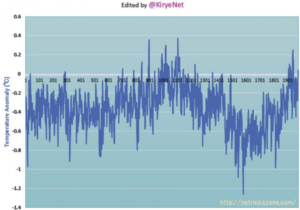
The hockey stick controversy over a temperature reconstruction of the past 2000 years represents an important stage in the climate debate. At around the turn of the millennium, the authors of the “hockey stick chart” suggested that the pre-industrial climate was monotonous and uneventful. The Medieval Warm Period and Little Ice Age described in many parts of the world climatically must have been very similar. But that’s hard to understand if you look at the wide variety of case studies.

Cover-up absurdity, then forced to correct

Later, the authors improved and presented a corrected version, which again showed stronger climatic fluctuations. Quite a science story. You can read about it here.

In addition to this scientific rush job, the debate about the hockey stick also showed that climate data really must be made publicly available. This is all the more important if the science is used for far-reaching policies. Data and results obtained thereof must be verifiable. At the time no one wanted the data to be released. Today in retrospect that was quite an absurdity — similar to smoking in a large open office.

Observations: Polar Bears Continue To Thrive, Grow In Number, Shredding Forecasts Of Climate Doom

by K. Richard, October 25, 2018 in NoTricksZone


Ten years ago, polar bears were classified as an endangered species due to model-based assumptions that said the recession of Arctic sea ice would hamper the bears’ seal-hunting capabilities and ultimately lead to starvation and extinction.

The Inuit, who have observed these bears catch seals in open water for generations, disagree.  At least this is what scientists have found upon investigation.

There is no evidence that the fast reduction of sea-ice habitat in the area has yet led to a reduction in population size.” (Aars et al., 2017 )
Inuit observations: “… back in early 80s, and mid 90s, there were hardly any bears … there’s too many polar bears now.  Bears can catch seals even—even if the—if the ice is really thin … they’re great hunters those bears … they’re really smart … they know how to survive.” (Wong et al., 2017)

See also here


Some Failed Climate Predictions

by Andy May, October 30, 2018 in WUWT


Here, for the first time in public, is Javier’s entire collection of massive, “consensus” climate science prediction failures. This collection is carefully selected from only academics or high-ranking officials, as reported in the press or scientific journals. Rather than being exhaustive, this is a list of fully referenced arguments that shows that consensus climate science usually gets things wrong, and thus their predictions cannot be trusted.

To qualify for this list, the prediction must have failed. Alternatively, it is also considered a failure when so much of the allowed time has passed that a drastic and improbable change in the rate of change is required for it to be true. Also, we include a prediction when observations are going in the opposite way. Finally, it also qualifies when one thing and the opposite are both predicted.

A novelty is that I also add a part B that includes obvious predictions that consensus climate science did not make. In science you are also wrong if you fail to predict the obvious.

A. Failed predictions

PAGES2K: North American Tree Ring Proxies

by Steve McIntyre, October 24, 2018 in ClimatAudit


The PAGES (2017) North American network consists entirely of tree rings. Climate Audit readers will recall the unique role of North American stripbark bristlecone chronologies in Mann et al 1998 and Mann et al 2008 (and in the majority of IPCC multiproxy reconstructions).  In today’s post, I’ll parse the PAGES2K North American tree ring networks in both PAGES (2013) and PAGES (2017) from two aspects:

Conclusions

  • ex post screening based on recent proxy trends necessarily biases the resulting data towards a Hockey Stick shape – a criticism made over and over here and at other “ske;ptic” blogs, but not understood by Michael (“I am not a statistician”) Mann and the IPCC paleoclimate “community”;

  • the PAGES 2017 North American tree ring network has been severely screened ex post from a much larger candidate population: over the years, approximately 983 different North American tree ring chronologies have been used in MBH98, Mann et al 2008, PAGES 2013 or PAGES 2017. I.e. only ~15% of the underlying population was selected ex post – a procedure which, even with random data, would impart Hockey Stick-ness to any resulting composite

  • despite this severe ex post screening (in both PAGES 2013 and PAGES 2017), the composite of all data other than stripbark bristlecones had no noticeable Hockey Stick-ness and does not resemble a temperature proxy.

Climate Book By Japanese Physics Professor: “The Globe Isn’t Warming Anymore”…IPCC “Scientifically Immoral”

by Kirye, October 23, 2048 in NoTricksZone


Dr. Fukai also points out that global vegetation coverage increased by 11% in 29 years, from 1982 to 2010, as increasing CO2 has helped the greening of the Sahel and Sahara Desert. He contradicts the often heard media claims that drought is spreading globally, writing: “The media spread the word that desertification is progressing globally, but practically the desert is greening through CO2.” […] “Everyone should be aware that increasing CO2 concentrations in atmosphere is not in itself harmful, but it’s a good thing.”

No correlation

Dr. Fukai also shows that the earth’s temperature change is not simple and does not correlate at all with CO2. He shows graphs from D. M. Etheridge et al., Mauna Loa Observatory and the temperature data from Moberg et al. (2005).

Chart: ftp://ftp.ncdc.noaa.gov/pub/data/paleo/contributions_by_author/moberg2005/nhtemp-moberg2005.txt 

The retired Japanese professor writes that at around 1000 A.D. — the Medieval Warm Period — there were no signs showing CO2 concentration was higher. A temperature graph using data from Moberg et al. (2005) shows the Medieval Warm Period appears clearly and that CO2 was in fact around 280 ppm at that time.

DEFRA VERSUS MET OFFICE Fact-checking the state of the UK climate

by Paul Homewood, October 2018, in GWPF


This paper (.pdf 17 pages) reports the results of a detailed analysis carried out using published UK Met Office data up to 2017. These show:

  • UK temperatures rose during the 1990s and early 2000s. This rise is associated with a similar increase in near-coastal sea surface temperatures. There has been no rise in the last decade.
  • Seasonal temperatures have followed a similar pattern: a rise during the 1990s, but a levelling off since.
  • This sudden rise in UK land temperature is not unprecedented, with the Central Eng- land Temperature series (CET) showing a similar occurrence in the early 18th century.
  • Analysis of CET shows that despite the rise in average summer temperatures, there has been no increase in the highest daily temperatures, or the frequency of extreme high temperatures, in recent years. In fact the opposite is true. Heatwaves were far more intense in 1975 and 1976, when there were thirteen days over 30◦C. By contrast, between 2007 and 2017 there have only been two such days. (Note that there was also only been one day over 30◦C in the summer of 2018). The highest daily temperature on CET was 33.2◦C, set in 1976 and equalled in 1990.

President “Trump thinks scientists are split on climate change”… He’s right, Dana Nuccitelli is wrong

by David Middleton, October 23, 2018 in WUWT


Scientists are very divided on climate change

Much of my rebuttal was put together from prior WUWT posts on this subject, there’s at least one new addition to the vast evidence of scientific division (Stenhouse et al., 2017).

Stenhouse et al., 2014   told us that atmospheric scientists are very divided on climate change over the past 150 years.


89% × 59% = 52%… A far cry from the oft claimed 97% consensus.

Why Some Scientists Say Global Warming Is Out And Global Cooling Is In

by J. Haskins & H.S. Burnett, October 23, 2018 in ClimateChangeDispatch


In a world riddled with climate-change doomsday predictions, a small but growing number of scientists are saying the highly touted climate models predicting steadily increasing global temperature due to humans’ carbon-dioxide emissions are wrong and that Earth could soon face something even direr: global cooling.

One such climate scientist is Valentina Zharkova, an astrophysicist at Northumbria University in the United Kingdom.

Zharkova and her team of researchers say that based on mathematical models of the Sun’s magnetic activity, it’s likely Earth will experience decreasing magnetic waves over a 33-year period beginning in 2021.

Zharkova is not alone.

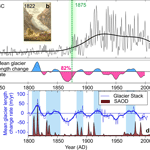
19th century glacier retreat in the Alps preceded the emergence of industrial black carbon deposition on high-alpine glaciers

by M. Sigl et al., October 16, 2018 in TheCryosphere


Abstract. Light absorbing aerosols in the atmosphere and cryosphere play an important role in the climate system. Their presence in ambient air and snow changes the radiative properties of these systems, thus contributing to increased atmospheric warming and snowmelt. High spatio-temporal variability of aerosol concentrations and a shortage of long-term observations contribute to large uncertainties in properly assigning the climate effects of aerosols through time.

Starting around AD1860, many glaciers in the European Alps began to retreat from their maximum mid-19th century terminus positions, thereby visualizing the end of the Little Ice Age in Europe. Radiative forcing by increasing deposition of industrial black carbon to snow has been suggested as the main driver of the abrupt glacier retreats in the Alps. The basis for this hypothesis was model simulations using elemental carbon concentrations at low temporal resolution from two ice cores in the Alps.

Why CO2 Is Not A Climate Control Knob

by A. Bright-Paul, October 22, 2018 in ClimateChageDispatch


As the Earth rotates on its own axis, one-half of the Earth is cooling while the other half is warming up.

So the Earth is warming and cooling daily and the temperature is changing 3,600 times every hour in every location all over the world, as there are 3,600 seconds in every hour.

As the Earth is traveling around the Sun in an ellipse at 66,000 miles per hour and is tilted and wobbling as it spins, so the Earth has seasons, as the angle to the Sun varies.

So the temperatures in the spring and summer are usually warmer than in the autumn and winter when temperatures decline.

So there is a massive number of different temperatures over the whole Earth, constantly changing and always in flux.

Weak sun and El Nino events may create a colder and snowier than normal winter season in much of the eastern half of the USA

by Anthony Watts, October 22, 2018 in WUWT


The fast approaching solar minimum and its potential impact on the upcoming winter season

By Meteorologist Paul Dorian

Overview

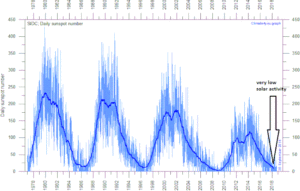
In the long term, the sun is the main driver of all weather and climate and multi-decadal trends in solar activity can have major impacts on oceanic and atmospheric temperatures. In addition, empirical observations have shown that the sun can have important ramifications on weather and climate on shorter time scales including those associated with the average solar cycle of around 11-years. For example, there is evidence that low solar activity during solar minimum years tend to be well-correlated with more frequent “high-latitude blocking” events compared to normal and this type of atmospheric phenomenon can play an important role in the winter season.

his plot shows the daily observations of the number of sunspots during the last four solar cycles back to 1 January 1977 according to Solar Influences Data Analysis Center (SIDC). The thin blue line indicates the daily sunspot number, while the dark blue line indicates the running annual average. The current low sunspot activity is indicated by the arrow at the lower right of the plot. Last day shown: 30 Sep 2018. Data source: climate4you.com.

Evidence of the Medieval Warm Period in Australia, New Zealand and Oceania

by S. Lüning, January 9, 2018 in WUWT


The climate of the pre-industrial past is of greatest importance to the ongoing climate discussion. Current climate can only be understood when interpreting it in the paleoclimatological context of the past few thousand years. Until not too long ago it was thought that the pre-industrial climate was monotonous and constant. This idea was e.g. promoted by Mann et al. whose famous hockey stick curve featured prominently in the IPCC report of 2001. Over the last 15 years, however, a large number of studies changed this view by providing robust evidence for the existence of significant natural climate variability. Of particular interest are the past 1000 years which commenced with the generally warm ‘Medieval Climate Anomaly’ (MCA, aka ‘Medieval Warm Period’, MWP), that eventually passed into the ‘Little Ice Age’ (LIA), before returning to the warm climate of the current ‘Modern Warm Period’ of the 20th and early 21st centuries.

There have been controversial debates about the existence of the MWP, …

Le réchauffement climatique pour les deux cultures

by Richard Lindzen, 21 octobre 2018, Conférence GWPF, in Skyfall


Traduction par Volauvent.

Il y a plus d’un demi-siècle, C.P. Snow (romancier et physicien anglais qui a également occupé plusieurs postes importants dans la fonction publique britannique et brièvement au sein du gouvernement britannique) a examiné de manière célèbre les implications de « deux cultures » :

Bien des fois, j’ai assisté à des rassemblements de personnes qui, selon les normes de la culture traditionnelle, sont considérées comme très éduquées et qui ont exprimé leur incrédulité face à l’analphabétisme des scientifiques. Une ou deux fois, j’ai été provoqué et j’ai demandé à la compagnie combien d’entre eux pourraient décrire la deuxième loi de la thermodynamique. Ils répondaient froidement : c’était aussi toujours négatif. Pourtant, je demandais quelque chose qui était l’équivalent scientifique de : avez-vous lu un ouvrage de Shakespeare ?

Je crois maintenant que si j’avais posé une question encore plus simple – telle que : que voulez-vous dire par masse ou accélération, qui est l’équivalent scientifique de : pouvez-vous lire ? – pas plus d’un diplômé sur dix aurait eu l’impression que je parlais la même langue que lui. Ainsi, le grand édifice de la physique moderne se construit, et la majorité des personnes les plus intelligentes du monde occidental en ont à peu près le même aperçu que leurs ancêtres néolithiques en auraient eu.

Je crains que peu de choses n’aient changé depuis l’évaluation de Snow, il y a 60 ans. Certains pourraient soutenir que l’ignorance de la physique n’a pas d’incidence sur la capacité politique, mais elle a très certainement une incidence sur la capacité des politiciens non scientifiques à traiter des problèmes théoriquement fondés sur la science. Le manque de compréhension est également une invitation à l’exploitation malveillante. Compte tenu de la nécessité démocratique pour les non-scientifiques de prendre position sur des problèmes scientifiques, la croyance et la foi remplacent inévitablement la compréhension, même si des récits simplifiés à outrance de façon triviale rassurent les non-scientifiques sur le fait qu’ils ne sont pas totalement dénués de « compréhension scientifique ». Le sujet du « réchauffement global » offre de nombreux exemples de tout cela.

Je voudrais commencer cette conférence par une tentative visant à forcer les scientifiques du public à se familiariser avec la nature réelle du système climatique et à aider les non-scientifiques motivés de ce public susceptibles de faire partie du groupe « Un sur dix » de Snow à aller au-delà des simplifications excessivement triviales.

New Science: Arctic AND Antarctic Sea Ice More Extensive Today Than Nearly All Of The Last 10,000 Years

by K. Richard, October 18, 2018 in NoTricksZone


It is often claimed that modern day sea ice changes are “unprecedented”, alarming, and well outside the range of natural variability.  Yet scientists are increasingly finding that biomarker proxies used to reconstruct both Arctic and Antarctic sea ice conditions since the Early Holocene reveal that today’s sea ice changes are not only not unusual, there is more extensive Arctic and Antarctic sea ice during recent decades than there has been for nearly all of the last 10,000 years.

Trump s’interroge sur les causes du changement climatique

by Tom Harris & Jay Lehr, 20 octobre 2018 in Contrepoints


Le 14 octobre dernier, durant une interview sur la chaine de télévision CBS, le président américain a exprimé à juste titre son scepticisme concernant le rôle de l’homme sur le changement climatique.

Contrairement à l’affirmation d’Al Gore daté du 12 octobre selon laquelle seuls « quelques rares marginaux » dans la communauté scientifique ne partageraient pas l’avis du GIEC, de nombreux chercheurs sont en désaccord avec les conclusions faites par l’agence internationale.

En effet, c’était un euphémisme pour le président américain de déclarer durant l’interview « qu’il y a des scientifiques qui réfutent cela », en parlant d’un lien entre la fonte de glace au Groenlandet du changement climatique anthropique.

Le 8 octobre dernier, durant sa conférence devant la Global Warming Policy Foundation (GWPF) située à Londres, le professeur Richard Lindzen a mentionné « la découverte faite conjointement par la NOAA (la National Oceanic and Atmospheric Administration) et l’Institut Météorologique Danois, à savoir que la masse de glace du Groenland a effectivement augmenté ».

CNN: “Climate change endangers dozens of World Heritage sites”… Unmitigated horst schist

by David Middleton, October 19, 2018 in WUWT


Holocene Sea Level

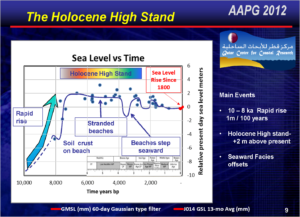
I didn’t take the time to look up the dates of these World Heritage sites… But I’m going to guess they’re OLD.  Many of them probably date back to the Early to Mid-Holocene.  [My bad… That was a bad guess.  The Late Holocene (Meghalayan Age) begins in 4200 BP (2250 BC)]  Here’s a Holocene sea level reconstruction for the Arabian Gulf, with a recent reconstruction of global sea level since 1800 (Jevrejeva et al., 2014) and the satellite sea level trend from CU…

September 2018 Global Surface (Land+Ocean) and Lower Troposphere Temperature Anomaly Update

by Bob Tisdale, October 18, 2018 in WUWT


This post provides updates of the values for the three primary suppliers of global land+ocean surface temperature reconstructions—GISS through September 2018 and HADCRUT4 and NOAA NCEI (formerly NOAA NCDC) through August 2018—and of the two suppliers of satellite-based lower troposphere temperature composites (RSS and UAH) through September 2018. It also includes a few model-data comparisons.

This is simply an update, but it includes a good amount of background information for those new to the datasets. Because it is an update, there is no overview or summary for this post. There are, however, simple monthly summaries for the individual datasets. So for those familiar with the datasets, simply fast-forward to the graphs and read the summaries under the headings of “Update”.

THE UN’S DOOMSDAY CLIMATE CLOCK

by GWPF, October 18, 2018 TheWallStreetJournal


In case you hadn’t heard we’re all doomed, yet the world mostly yawned. This is less complacency than creeping scientific and political realism.

The U.N. panel says the apocalypse is nigh—literally. According to its calculations, global carbon emissions must fall 45% by 2030—twice as much as its earlier forecasts—and the world must wean itself entirely off fossil fuels over three decades to prevent a climate catastrophe that will include underwater coastlines and widespread drought and disease.

These reductions are “possible within the laws of chemistry and physics,” said the report’s co-author Jim Skea, and that’s a relief. But he added: “Doing so would require unprecedented changes,” and the report said some methods “are at different stages of development and some are more conceptual than others, as they have not been tested at scale.”

Le catastrophisme climatique des années 60 à 80 à l’épreuve des faits

by Cédric Moro, 15 octobre 2018 in MythesMancies&Mathématiques


Les discours alarmistes sur le climat ne datent pas d’hier. Grâce à la numérisation des archives audio-visuelles et à leur mise en ligne sur internet, il est possible aujourd’hui de démentir les prévisions climato-catastrophistes assénées de manière très officielle dans la deuxième moitié du siècle dernier. Beaucoup des déformations de nos discours sur la réalité tendent à puiser leurs racines dans nos représentations mentales du monde. Nous verrons donc que ces représentations alarmistes naissent dans un contexte idéologique nouveau : mutation de l’eugénisme, collapsologisme et décroissance.