Archives de catégorie : better to know…?

Wind Power Did Cause The Texas Blackouts!

by P. Homewood, Feb 22, 2021 in NotaLotofPeopleKnowThat


There has been a marked lack of data made public about last week’s blackouts in Texas, which has allowed all sorts of misinformation to fly around. I suspect this is quite deliberate.

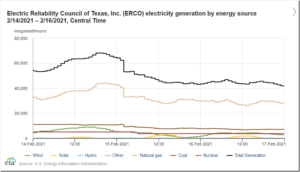
I have however found hourly data on the US EIA website. This is what happened on those crucial couple of days:

https://www.eia.gov/beta/electricity/gridmonitor/expanded-view/electric_overview/US48/US48/GenerationByEnergySource-4/edit

Climate Facts or Leaps of Faith? Governments Can’t Tell the Difference

by Donna Laframboise, Feb 17, 2021 in BigPicturesNews


We have no hard evidence of a crisis. Only expert opinion and best estimates.

Governments are currently fighting climate change to the tune of billions. For this to make sense, each idea in the following chain of reasoning needs to be bulletproof:

#1 – scientists know there’s a climate crisis
#2 – scientists know it’s humanity’s fault
#3 – scientists know we can alleviate the crisis by changing our behaviour

But each of these amounts to a leap of faith. Let’s start with the conviction that something unusual is going on. This planet is more than 4 billion years old. The climate was marching to its own drummer long before humans appeared. It has changed numerous times – sometimes gradually, sometimes violently. Twenty thousand years ago, much of North America was covered by ice.

Because humans weren’t recording and analyzing those billions of years of climatic history, today’s scientists have no way of knowing if anything unusual is going on now.

They can surmise. They can speculate. They can extrapolate. But they have no smoking gun. I’ve written two books about the UN’s Intergovernmental Panel on Climate Change (IPCC). That organization says it’s “extremely likely that more than half” of the global warming between 1951 and 2010 was caused by human activity. It talks about its “best estimate.”

Southeast Greenland Sea Surface Temperature 1° – 2°C Warmer In 1940 Than Today, New Study Shows

by P. Gosselin, Feb 14, 2021 in NoTricksZone


A team of Danish scientists led by David Wangner published a paper a year ago about the results of a Greenland sediment core from Skjoldungen Fjord, near the Thrym Glacier, which allowed sea surface temperatures to be reconstructed.

The core covers the past 200 years (1796–2013). The scientists find that the SST record compares well with other alkenone‐based reconstructions from SE‐Greenland and thus features regional shelf water variability.

Today some scientists like claiming the present is warmer than at any time in the past 1000 years and suggest the Greenland ice sheets are rapidly melting. But the results of the core reconstruction show that it was warmer in the past, some 80 years ago

Biden’s climate ‘fix’ is fantastically expensive and perfectly useless

by B. Lomborg, Feb 9, 2021 in NewYorkPost


Across the world, politicians are going out of their way to promise fantastically expensive climate policies. President Biden has promised to spend $500 billion each year on climate — about 13 percent of the entire federal revenue. The European Union will spend 25 percent of its budget on climate.

Most rich countries now promise to go carbon-neutral by mid-century. Shockingly, only one country has made a serious, independent estimate of the cost: New Zealand found it would optimistically cost 16 percent of its GDP by then, equivalent to the entire current New Zealand budget.

The equivalent cost for the US and the EU would be more than $5 trillion. Each and every year. That is more than the entire US federal budget, or more than the EU governments spend across all budgets for education, recreation, housing, environment, economic affairs, police, courts, defense and health.

Tellingly, the European Commission Vice President Frans Timmermans recently admitted that climate policies would be so costly, it would be a “matter of survival for our industry” without huge, protective border taxes.

More trees do not always create a cooler planet, Clark University geographer finds

by Clark University, Feb 14, 203221 in WUWT


WORCESTER, Mass. — New research by Christopher A. Williams, an environmental scientist and professor in Clark University‘s Graduate School of Geography, reveals that deforestation in the U.S. does not always cause planetary warming, as is commonly assumed; instead, in some places, it actually cools the planet. A peer-reviewed study by Williams and his team, “Climate Impacts of U.S. Forest Loss Span Net Warming to Net Cooling,” published today (Feb. 12) in Science Advances. The team’s discovery has important implications for policy and management efforts that are turning to forests to mitigate climate change.

It is well established that forests soak up carbon dioxide from the air and store it in wood and soils, slowing the accumulation of greenhouse gases in the atmosphere; however, that is not their only effect on climate. Forests also tend to be darker than other surfaces, said Professor Williams, causing them to absorb more sunlight and retain heat, a process known as “the albedo effect.”

“We found that in some parts of the country like the Intermountain West, more forest actually leads to a hotter planet when we consider the full climate impacts from both carbon and albedo effects,” said Professor Williams. It is important to consider the albedo effect of forests alongside their well-known carbon storage when aiming to cool the planet, he adds.

China Facing Winter Blackouts

by P. Homewood, Dec 23, 2020 in NotaLotofPeopleKnowThat


There’s an interesting story emerging from China:

BEIJING: Tens of millions across China are facing power shortages in below-freezing winter temperatures, as three provinces impose curbs on electricity use due to surging demand and a squeezed coal supply.

Residents, factories and businesses in Hunan, Zhejiang and Jiangxi provinces have been ordered to ration electricity with some areas citing a shortfall in coal supplies, according to local media reports and government notices.

China’s rebound from the Covid-19 pandemic has been driven by energy intensive industries such as construction, heaping pressure on the power grid and coal supplies, said Lauri Myllyvirta, lead analyst at the Centre for Research on Energy and Clean Air.

Earlier this month, Hunan authorities ordered all billboards and outdoor lighting on buildings to power off for long periods each day and a temperature cap on indoor heating at entertainment venues.

Hunan faces a shortfall of 3-4 million kilowatts of electricity this winter, local officials admitted last week, as demand soars due to unusually cold weather that will hit as low as -10°C.

Office workers in provincial capital Changsha complained on social media about being forced to climb dozens of flights of stairs and freezing indoor temperatures as a result of frequent power outages.

“My office heating has already been stopped, and there were blackouts on Dec 1, 3 and 5. Temperatures will drop to -8°C around New Year’s Day, will I freeze to death in Hunan?” one Weibo user wrote last week.

Meanwhile in Zhejiang province, factories in the manufacturing hub of Yiwu have been told to stop operations and streetlights have been turned off at night as part of an emissions-saving drive by the local government, according to media reports and photos circulated on Weibo.

“Climate Adaptation Summit” turns out to be a fundraising event

by D. Wojick, Fab 6, 2021 in CFACT/CLINTEL


The recent Climate Adaptation Summit 2021 was not about helping nations against the effects of climate change. It was all about finding huge amounts of money. Even worse, it was about planning on finding money, not actually finding it. Even more embarrassing, in some cases it was just about thinking about planning. In fact its primary product was an Agenda. Climate Summits are like that. However, world leaders call it thinking big’.

Climate adaptation is proactive and that is its big strength. It is proactive to the combination of gradual changes (think of the gradually increasing sea level) and excessive events (think of all types of extreme weather). Using Darwin, if mankind does not adapt to these changes in his environment, extinction will be his fate as happened so often to other species in the past.

Climate is a long term statistic, typically 30 years, or more. In this case it is mostly the long term frequency of various extreme weather events, the usual litany of floods, droughts, heat waves, etc., plus there is the usual sea level rise.

The real thing is that adaptation is not about preventing these extreme events, but it is about adapting to those events. For instance, dont build houses in flood planes or build dikes to keep them dry. Keep in mind that with any form of climate adaptation, the cause of climate change is of no importance.

What does matter, in a very bad way, is that humans are being blamed for all bad weather. This supports the nonsensical thing called mitigation, where human well being is sacrificed in a foolish attempt to end bad weather.

Our friends at the Climate Intelligence Foundation (CLINTEL) have made it a central policy that adaptation is the way to go. In commenting on CAS 2021 they point out that adaptation is actually very profitable, increasing the prosperity and safety of nations.

Here is what they say: “The world should focus much more on climate adaptation and much less on mitigation. This is the conclusion of the global CLINTEL following the international climate summit that took place in the Netherlands over the past two days. Adaptation has already amply proven its value, while mitigation turns out to be inefficient and expensive.

The spiralling environmental cost of our lithium battery addiction

by A. Katwala, Aug 5, 2018 in Wired


Here’s a thoroughly modern riddle: what links the battery in your smartphone with a dead yak floating down a Tibetan river? The answer is lithium – the reactive alkali metal that powers our phones, tablets, laptops and electric cars.

In May 2016, hundreds of protestors threw dead fish onto the streets of Tagong, a town on the eastern edge of the Tibetan plateau. They had plucked them from the waters of the Liqi river, where a toxic chemical leak from the Ganzizhou Rongda Lithium mine had wreaked havoc with the local ecosystem.

There are pictures of masses of dead fish on the surface of the stream. Some eyewitnesses reported seeing cow and yak carcasses floating downstream, dead from drinking contaminated water. It was the third such incident in the space of seven years in an area which has seen a sharp rise in mining activity, including operations run by BYD, the world’ biggest supplier of lithium-ion batteries for smartphones and electric cars. After the second incident, in 2013, officials closed the mine, but when it reopened in April 2016, the fish started dying again.


The Rational Climate e-Book, By Patrice Poyet

P. Homewood, Jan 27, 2021 in NotaLotofPeopleKnowThat


I am delighted to give a plug to Patrice Poyet’s new e-Book, The Rational Climate e-Book.

It can be downloaded for free on the link below:

https://www.researchgate.net/publication/347150306_The_Rational_Climate_e-Book/link/5fe21ddb92851c13feb1763d/download

Patrice is a geologist, a geochemist and an applied computer scientist with an interest in various domains like Earth and Planetary Sciences, Astronomy, Finance and Trading, Integration in Manufacturing and Design, Simulation and Defense Systems, etc The development of computer systems has given him the chance to take part in a wide variety of projects in very different areas of expertise. Patrice published 37 articles mostly in peer-reviewed scientific journals, 6 books jointly-reviewed with colleagues, 6 peer-reviewed chapters in books, 64 papers in peer-reviewed conferences, one D.Sc. thesis (1986), and 32 scientific and technical reports for demanding public and private clients (e.g. French Navy, EC-funded R&D projects, CIEH, etc.) and acted as an expert reviewer for several EC R&D projects. He is now using his initial training as a geochemist and his passion for Earth and Space sciences to completely revisit the subject of climate and paleo-climates. The result is this free 431 pages e-Book that addresses all aspects of the subject.

Does “global warming” mean it’s warming everywhere?

by C. Kennedy, Oct 29, 2020 in NOAAClimate.gov


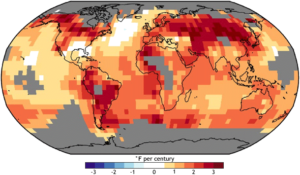
No, “global warming” means Earth’s averageannual air temperature is rising, but not necessarily in every single location during all seasons across the globe.  It’s like your grades. If one semester you get all Bs and Cs, and the next you get all As and Cs, your grade point average rises, even though you didn’t improve in every class.

That’s the way it is with Earth’s near-surface temperature as atmospheric greenhouse gas levels climb. Temperature trends across the entire globe aren’t uniform because of the diverse geography on our planet—oceans versus continents, lowlands versus mountains, forests versus deserts versus ice sheets—as well as natural climate variability. When you’re zoomed in on a particular place, you may not be able to see the overall trend.

It is only when scientists calculate the average of temperature changes from every place on Earth over the course of a year to produce a single number, and then look at how that number has changed over time that a very clear, global warming trend emerges. In other words, it’s only when we “zoom out” to the planet-wide scale that the trend is obvious: despite a few, rare areas experiencing an overall cooling trend, the vast majority of places across the globe are warming.


The reason a “zoomed out” view makes the long-term trend so clear is that Earth’s annual average temperatures from year to year are found to be very stable when nothing is forcing it to change. Today, though, every decade since 1960 has been warmer than the last, and the last three decades each have been the warmest on record. Relative to geologic time, the warming that has occurred—1.8°F (1°C) over a span of about 120 years—is an unusually large temperature change in a relatively short span of time.

“DO NOT TRAVEL” WARNINGS ISSUED AS HEAVY SNOW BLANKETS MAJORITY OF BRITAIN

by Cap Allon, Jan 25, 2021 in Electroverse


According to the UK Met Office, snowfall in Britain will be a thing of the past by 2040-2060 — a ludicrous, fear-mongering prophesy, and one almost as stupid as the claims made by senior climatologist Dr David Viner of the Climate Research Unit (CRU) of the University of East Anglia.

Back in 2000, and as reported by the Telegraph (since deleted), Viner said: within a few years winter snowfall will become “a very rare and exciting event,” adding that “children just aren’t going to know what snow is.”

Frustratingly, these hacks are never called to task, their mistakes and dud-research seldom analysed or investigated. Instead, the cycle is simply one of rinse and repeat: the global warming cabal call-up their next set of “higher-educated” brainwashees who go on to use the exact same flawed upside down pyramid built on the work of just a few climate modelers to make the exact same tired-old doomsday predictions–such as “the end of snow”.

Just yesterday, January 25, a severe weather warning was in place across a large portion of the UK as heavy snow threatened.

The pow-pow duly arrived early Sunday morning with some regions, particularly those in central England and Wales, registering accumulations of 5+ inches (13+ cm) in just an hour and a half.

Elon Musk Drilling Gas Wells in Texas!

by D. Middleton, Jan 25, 2021 in WUWT


Guest “I was wrong about this guy” by David Middleton

SpaceX Plans to Drill for Natural Gas Near Texas Launchpad
Sergio Chapa
Jan 23 2021

(Bloomberg) — Elon Musk recently moved to Texas, where he launches some of his rockets and is building a battery factory. Now, for good measure, he plans to drill for natural gas in the state.

The billionaire’s SpaceX intends to drill wells close to the company’s Boca Chica launchpad, it was revealed during a Friday hearing before the Railroad Commission of Texas, the state’s energy regulator.

Production has yet to start because of a legal dispute between the SpaceX subsidiary Lone Star Mineral Development and another energy company. Tim George, an attorney representing Lone Star, said at the hearing that SpaceX plans to use the methane it extracts from the ground “in connection with their rocket facility operations.”

While it’s unclear what exactly the gas would be used for, SpaceX plans to utilize super-chilled liquid methane and liquid oxygen as fuel for its Raptor engines. The company’s Starship and Super Heavy vehicles are tested at Boca Chica, and orbital launches are planned for the site.

[…]

Bloomberg

Failing Computer Models

by P. Homewood ,Jan 21, 2021 in NotaLotofPeopleKnowThat


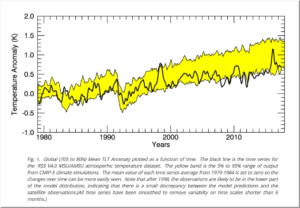
If anybody tries to tell you that the computer models are accurately predicting global warming, show them this:

http://www.remss.com/research/climate/#:~:text=The%20RSS%20merged%20lower%20stratospheric%20temperature%20data%20product,in%20well-mixed%20greenhouse%20gases%20causes%20by%20human%20activity.

It comes from RSS, who monitor atmospheric temperatures via satellite observation. They are ardent warmists, and here us what they have to say:

….

ANTARCTICA SUFFERING COLDEST JANUARY SINCE 1978 + GLOBAL SEA ICE GROWING EXPONENTIALLY

by Cap Allon, Jan 20, 2021 in Electroverse


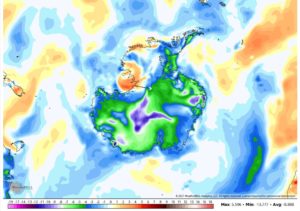
The start of 2021 in Antarctica has been an unusually chilly one. In fact, the first half of January has been the coldest since 1978, according to data compiled by @LpdlcRamirez and @peikko763 on Twitter.

As of Jan. 19, the month-to-date temperature anomaly across Antarctic is approx. -0.5C, making this the continents coldest first 3-or-so-weeks of Jan. since 1978 (solar minimum of cycle 20), according to research conducted by @peikko163 on Twitter, who also notes that the Southern Hemisphere as a whole is suffering anomalous January chills not seen since 2012.

But this chill of solar minimum isn’t just confined to the Southern Hemisphere either, the mercury ACROSS the planet is tumbling. In one month global temperatures dropped by a whopping 0.26C: from 0.53C above the 1981-2010 avg. in Nov. 2020 to just 0.27C above the avg. in Dec. 2020 (UAH). This drop was in spite of a warming Arctic–a region expected to “heat” during times of otherwise “global” cooling (more on that below).

The Sun appears to be sliding into its next Grand Solar Minimum cycle–a multidecadal spell of reduced solar output where the solar disc can be devoid of sunspots for months or even years at a time. The result on Earth’s climate will be one of violent swings between extremes due to a weakening of the jet streams: intense bursts of heat will linger in one area, while a teeth-chattering chill will dominate nearby, and then the regions will “switch” — it is this unpredictable chopping and changing that will hasten the failure of our modern food production systems: crops will fail, on a large scale, and famine could quickly ensue.

Overall, Earth’s temperature trends colder during a Grand Solar Minimum, as the Sun’s output sinks lower and lower (increased cloud nucleation being one likely forcing). However, not ALL regions experience the chill: as with the previous GSM (the Maunder Minimum 1645-1715), areas such as the Arctic, Alaska, and S. Greenland/N. Atlantic actually warmed while the rest of the planet cooled — NASA reveals the phenomenon in their Maunder Minimum temperature reconstruction map:

AT LEAST 13 DEAD, HUNDREDS HOSPITALIZED AS RECORD SNOWSTORMS SWEEP JAPAN

by Cap Allon, Jan 23, 2021 in Electroverse


Following the historic snowstorms of the past few weeks, Japan has been hit again: at least 13 people died and more than 250 were injured as record snowfall blanketed regions along the Sea of Japan coast, according to the latest report by the nation’s Disaster Management Agency.

Among those to have lost their lives were three people in Fukui Prefecture, and four in Niigata Prefecture, all reportedly while trying to remove the snow which topped a whopping 3.13 meters (10.3 feet) in some areas.

According to Japan’s Meteorological Agency (JMA), at least 10 monitoring stations along the Sea of Japan set new all-time 72-hour snowfall records late on Jan. 10, and many more busted all-time low temperature records, including in Furue, Kamigoori, and Kuzakai–with the latter logging a bone-chilling -24C (-11F).


Distorting the view of our climate future: The misuse and abuse of climate pathways and scenarios

by R. Pielke & J. Richtie, 2020 in EnergyRes&SocScience


Abstract

Climate science research and assessments under the umbrella of the Intergovernmental Panel on Climate Change (IPCC) have misused scenarios for more than a decade. Symptoms of misuse have included the treatment of an unrealistic, extreme scenario as the world’s most likely future in the absence of climate policy and the illogical comparison of climate projections across inconsistent global development trajectories. Reasons why such misuse arose include (a) competing demands for scenarios from users in diverse academic disciplines that ultimately conflated exploratory and policy relevant pathways, (b) the evolving role of the IPCC – which extended its mandate in a way that creates an inter-relationship between literature assessment and literature coordination, (c) unforeseen consequences of employing a temporary approach to scenario development, (d) maintaining research practices that normalize careless use of scenarios, and (e) the inherent complexity and technicality of scenarios in model-based research and in support of policy. Consequently, much of the climate research community is presently off-track from scientific coherence and policy-relevance. Attempts to address scenario misuse within the community have thus far not worked. The result has been the widespread production of myopic or misleading perspectives on future climate change and climate policy. Until reform is implemented, we can expect the production of such perspectives to continue, threatening the overall credibility of the IPCC and associated climate research. However, because many aspects of climate change discourse are contingent on scenarios, there is considerable momentum that will make such a course correction difficult and contested – even as efforts to improve scenarios have informed research that will be included in the IPCC 6th Assessment.

Record Low Temperature In Spain Today

by P. Homewood, Jan 6, 2021 in NotaLotofPeopleKnowThat


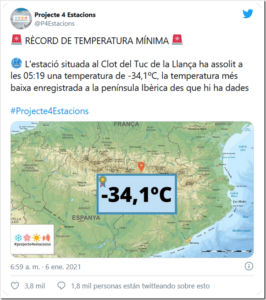
The storm ‘Filomena’ leaves the lowest temperature ever recorded in the Iberian Peninsula: –34.1C

Temperatures in Spain this winter are reaching maximum levels. This week has been very cold, with frosts in much of Spain even in areas very close to the coast. The early morning of this Wednesday was marked by intense cold and snowfall. The thermometers show such low figures that the temperature at the Clot de la Llança (Alto Aneu) weather station stands out: – 34.1 degrees.

It is the lowest temperature in the Iberian Peninsula since there are records. Information provided by the Parc Natural de l’Alt Pirineu (managed by Meteo Pirineo and Meteo Valls d’Àneu). And it has also been confirmed by AEMET. This temperature, 34.1 degrees below zero, is a record since the last time something similar was recorded was on February 2, 1956 with -32.0ºC in Estany-Gento, in the province of Lleida,

https://www.20minutos.es/noticia/4533488/0/borrasca-filomena-record-temperatura-minima-34-1-grados/


See also here

Just How Accurate Are Weather And Climate Measurements?

by Dr J. Lehr & T. Ciccone, Jan 5, 2021 in ClimateChangeDispatch


The accuracy and integrity of weather and climate measurements have always been a concern. However, errors and omissions were not as consequential in the past as they are now.

A hundred or even fifty years ago, our major weather concerns were more limited to local weather. When we have a flight from NYC to LAX, we need to know more detailed and reliable weather information, like is it snowing in St. Louis where we have a layover?

Or the farmer in Nebraska who needs to see the spring wheat production forecast in Ukraine. He needs the best possible information to better estimate the number of acres of winter wheat he should plant for today’s global markets.

We especially need better and more reliable information to decide what actions we should consider preparing for climate changes.

While scientists, engineers, and software programmers know the importance and the need for this data accuracy, the general public is not aware of how challenging these tasks can be.

When looking at long term climate data, we may have to use multiple proxies (indirect measures that we hope vary directly with weather), which add an extra layer of complexities, costs, and sources of error.

One of the most commonly used proxies is the ancient temperature and CO2 levels from ice core samples. Also, for the last few hundred years, tree-ring data was a primary source of annual temperatures.

Climate Change Causation: Was The Medieval Warm Period ‘Regional?’

by F. Menton, Jan 5, 2021 in ClimateChangeDispatch


Some commenters yesterday noted that the climate establishment has not just completely ignored the threat to their orthodoxy posed by the Medieval Warm Period and other similarly-warm pre-human-emissions eras.

Initially, there was a recognition that this issue could be important, and there was definitely some attempt to deal with it.

However, over time, the accumulation of evidence, particularly as to the existence Medieval Warm Period as a global phenomenon, gradually became overwhelming.

So — in the face of evidence that, under the normal precepts of the scientific method, would be deemed to invalidate the hypothesis that only human CO2 emissions could be causing current warming — how can the orthodoxy be kept alive?

The answer, almost entirely, has been to resort to the hand-waving of “detection and attribution” studies, and hope nobody notices. And, to a remarkable extent, nobody notices.

Readers may be interested in a short history of this issue.

See also  A prequel to the Dantean Anomaly: the precipitation seesaw and droughts of 1302 to 1307 in Europe

The Dark Side of Clean Energy and Digital Technologies by Guillaume Pitron, review — our dirty future

by P. Homewood, Jan 6, 2021 in NotaLotofPeopleKnowThat


When Donald Trump offered to buy Greenland from Denmark in 2019 it was dismissed as illegal and absurd. However, the president’s expression of interest was far from absurd, says Guillaume Pitron. Under its soil Greenland boasts one of the largest concentrations of the rare metals that the world will need to power electric cars, computers, mobile phones, robots, solar power plants, artificial intelligence and many high-tech “green” innovations that have not been dreamt up yet. If Trump were after those minerals, buying Greenland would have been a smart move.

The global production and sales of rare metals are dominated by China. It mines so much of them on home soil and controls so much of their extraction in Africa and elsewhere that it oversees up to 95 per cent of the global production of certain minerals. This puts Beijing in charge of “the oil of the 21st century”, writes Pitron, which is a problem for western nations because it means China can restrict supply and drive prices up or down at will, as Opec does with oil. We have “entrusted a precious monopoly of mineral sovereignty to potential rivals”, he notes.

Discarded devices waiting to have their precious metals extracted

CHARLY TRIBALLEAU/GETTY IMAGES

Rare earth minerals production is very energy intensive. Extracting a single kilogram of some requires mining as much as 1,200 tonnes of rock. “Clean energy is a dirty affair,” Pitron writes. He drives home his point by touring villages near polluted lakes in China that are known locally as “cancer villages”.

La fin du réchauffement… Pas du changement climatique!

by B. Van Vliet-Lanoë, Jan 1, 2021 in ScienceClimatEnergie


Un hiver froid s’annonce : le premier d’une série qui devrait durer au moins jusqu’en 2053 (Youssef et al., 2009 ; Zharkova et al.  2015 ; Van Vliet, 2019), période où les médias nous assènent une disparition de la banquise estivale, des ours polaires et des phoques ! Ceci est favorisé par l’activité solaire réduite depuis et le minimum solaire actuel (Fig.1). Le cycle solaire suivant (n°25) devrait aussi être faible. Nous y sommes entrés sans un Minimum d’activité aussi profond que celui Dalton (1790-1830) qui a présidé à la « Bérézina ».


Fig. 1: Intensité des cycles solaires depuis 1975 et la prédiction du cycle 25 (calculés avec le nombre de taches solaires  2018 * ANRPFD ).  B) évolution de l’extension en km2 des banquises arctique et antarctique depuis 1978 par rapport à la déviation standard 1981-2010 (NSDIC).

10 Failed Predictions: Video

by C. Rotter, Jan 2, 2021 in WUWT


From Climate Resistance

Many climate alarmist’s failed predictions were centered around 2020. This video examines just ten, and argues that they were produced not by science, but by ideology. This is proved by the fact that rather than suffering any consequences to their careers or public standing, fearmongering individuals and institutions enjoy continued and undeserved success. The analysis of the ten predictions was produced by Steve Milloy and can be read at his website:

Number Of Global Wild Fires Trending Down Since 2003. Northern Ocean Heat Content Drops Since 2010


In his latest video the veteran geologist looks at wild fires worldwide and the CO2 they emit. He reports that both have been decreasing.

Citing the results of the European Copernicus satellite atmosphere monitoring service (CAMS), total wildfires globally have fallen steadily, along with their corresponding CO2 emissions: