by Ron Clutz, August 25, 2017 in ClimateChangeDispatch
The animated image shown after the jump shows ice extents for day 233 from 2007 to 2017. Particularly interesting is the variation in the CAA (Canadian Arctic Archipelago), crucial for the Northwest Passage
What is causing the death of the polar bear as a climate change icon? Fat bears are part of it, but mostly it’s the fact that polar bear numbers haven’t declined as predicted.
Sea level changes is a key issue in the global warming scenario. It has been widely claimed that sea is rising as a function of the late 20th’s warming pulse. Global tide gauge data sets may vary between +1.7 mm/yr to +0.25 mm/yr depending upon the choice of stations. At numerous individual sites, available tide gauges show variability around a stable zero level …
… In this situation, it is recommended that we return to the observational facts, which provides global sea level records varying between ±0.0 and +1.0 mm/yr; i.e. values that pose no problems in coastal protection.
The sun was completely free of spots on 11 days in July. Notable: while during last month the sun’s northern hemisphere was more active (in June all sunspots were in the northern hemisphere), last month the southern hemisphere was the most active part with 60% of the sunspots appearing there. The following diagram shows the course of solar cycle 24 thus far (…)
by James E Kamis, August 23, in ClimateChangeDispatch
The now three-year-old Plate Climatology Theory is on the brink of total confirmation. This is the result of two just-released and very telling Antarctic research studies. Combining the results of these two studies with the massive amounts of pre-existing data it is possible to show with very high certainty that melting of West Antarctic glaciers is directly related to bedrock heat flow and chemically charged heated fluid flow from the 5,000-mile-long West Antarctic Rift System (see Figure 1).
Earlier this year, DEFRA published a report by the Air Quality Expert Group into the impacts of biomass on air quality. The results make for startling reading.
Researchers have used computer simulations to analyse how plate tectonics have evolved on Earth over the last three billion years. They show that tectonic processes have changed in the course of the time, and demonstrate how those changes contributed to the formation and destruction of continents. The model reconstructs how present-day continents, oceans and the atmosphere may have evolved.
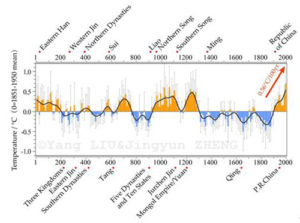
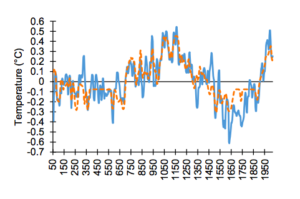
Our results show up to 1°C of warming. The average divergence between the proxy temperature record and our ANN projection is just 0.09 degree Celsius. This suggests that even if there had been no industrial revolution and burning of fossil fuels, there would have still been warming through the twentieth century – to at least 1980, and of almost 1°C.
AFTER deconstructing 2,000-year old proxy-temperature series back to their most basic components, and then rebuilding them using the latest big data techniques, John Abbot and I show what global temperatures might have done in the absence of an industrial revolution. The results from this novel technique, just published in GeoResJ, accord with climate sensitivity estimates from experimental spectroscopy but are at odds with output from General Circulation Models.
Tremendous amounts of soot, lofted into the air from global wildfires following a massive asteroid strike 66 million years ago, would have plunged Earth into darkness for nearly two years, new research finds. This would have shut down photosynthesis, drastically cooled the planet, and contributed to the mass extinction that marked the end of the age of dinosaurs.
by Robin Mills, August 20, 207 UAE Ed The National
The Middle Eastern countries that are looking at coal are trying to diversify their fuel mix, and to reduce vulnerability to economic or supply shocks. Gas is cheap at the moment but its price is volatile, and states such as Dubai, Egypt and Turkey do not want to be too import-dependent. For Dubai, which attracted a very competitive bid from Acwa and Harbin, coal is a key part of strengthening its negotiating position with other suppliers. Iran and Turkey are trying to maximise the use of their domestic coal, and for Turkey, reliance on rivals Iran and Russia for two-thirds of its gas is dangerous.
Despite gas prices being low at the moment, coal is cheaper still — at least once the required import facilities are constructed. Chinese power and engineering companies, looking for other markets, are offering their expertise and low-cost financing.
Total rachète le Danois Maersk Oil pour plus de 7 milliards de dollars, soit sa plus grosse acquisition depuis celle d’Elf Aquitaine en 2000. Grâce à elle, le pétrolier vise 3 millions de barils-jours en 2019.
That’s the peak oil argument in a nutshell, but the peak demand argument is entirely different. In this case, oil production falls — not because of geological factors — but because the world turns its back on oil as cleaner, cheaper options become available. Electric vehicles and ride-sharing on a massive scale are envisioned as two of the key factors that will make oil obsolete.
In order to determine if records are possible in 2017, one must know the previous records as well as the average to date and what is required for the rest of the year in order for a particular data set to set a new record.
For the five data sets I cover, records were set in 2016. For now, I am not concerned about the statistical significance of the records, nor the number of decimal places. I merely want to know if the record can be beaten this year. At the end of the year, I plan on reporting any records and how statistically significant they are.
Al Gore has provided a target-rich environment of deceptions in his new movie.
After viewing Gore’s most recent movie, An Inconvenient Sequel: Truth to Power, and after reading the book version of the movie, I was more than a little astounded. The new movie and book are chock-full of bad science, bad policy, and factual errors.
The climate industry likes to pretend that the Little Ice Age was just a local event in Europe, but studies like this one give the lie to that.
Interestingly this Tyson study also includes graphs of historical temperature trends in other parts of the world, for comparison. They all clearly show the MWP and Little Ice Age, although the peaks and troughs don’t always match.
If “the supervolcano threat is substantially greater than the asteroid or comet threat,” does this mean we can stop fretting about Gorebal Warming and the Sixth Mass Extinction? Is NASA really moving on to actual threats to the planet? Well, not threats to the planet… The planet has handled supervolcanoes, asteroids and comets quite well over its 4.5 billion year lifespan.
“We should view the Permian Basin as a permanent resource,” he says, “The Permian is best viewed as a near infinite resource – we will never produce the last drop of economic oil from the Basin.”
No one disputes that the resource in the Permian is huge, but ‘infinite’ is a big word. I asked him to expand on that concept.
“There are models that predict that the interior of the East Antarctic ice sheet wouldn’t change very much, even if the West Antarctic ice sheet was taken away,” Licht said. According to these models, even if the ice sheet’s perimeter retreats, its core remains stable.
Satellite observations indicate that the average Arctic sea ice extent has generally decreased since the start of the satellite records in October 1978. Is this period long enough to assess whether the current sea level trend is unusual, and to what extent the decline is caused by humans?
This change in Arctic climate is often promoted as evidence that humans are causing drastic climate change. For instance, an April 29th 2017 article in the Economist (“Skating on thin ice”, pg 16) implied that the Arctic is melting unusually, dramatically and worryingly (…)
The ‘Rise of Algae’ created food webs with more efficient nutrient and energy transfers, driving ecosystems towards larger and increasingly complex organisms. This effect is recorded by the concomitant appearance of biomarkers for sponges and predatory rhizarians, and the subsequent radiation of eumetazoans in the Ediacaran period.