Remarkably, some Japanese families kept weather record diaries in the 1700 and 1800s, and some for as long as 150 years. The connections they reveal are tantalizing but so incomplete. We are trying to fish out primitive signals from murky water. The Sun turns around on itself every 27 days, so these researchers are looking for repeating patterns in lightning that fit, but the poles of the sun spin slower than the equator and the sun spots can take their own time. Hence, it’s not a neat “27″ days.
During periods of high solar activity, they found regular peaks in lightning activity with the right timing, from May to September when the cold Siberian air mass is not so influential.
Other studies we’ve discussed here have investigated long solar cycles on the 11 year or 200 year scales ….
by P. Homewood, July 22, 2018 in NotaLotofPeopleKnowThat
Last week, the BBC seriously misled the public about so-called “heat records”, as I noted in this post here.
In particular the BBC made a song and dance about Southern California, even though the LA records were seriously compromised by siting in car parks or next to air conditioning exhaust vents.
But how does the recent Californian heatwave really compare with historical weather?
Fairmont is a rural USHCN station, just 110 km north of LA, and with a long term record dating back to 1922. (There is some data going back to 1909 as well):
Coastal zones constitute one of the most heavily populated and developed land zones in the world. Despite the utility and economic benefits that coasts provide, there is no reliable global-scale assessment of historical shoreline change trends. Here, via the use of freely available optical satellite images captured since 1984, in conjunction with sophisticated image interrogation and analysis methods, we present a global-scale assessment of the occurrence of sandy beaches and rates of shoreline change therein. Applying pixel-based supervised classification, we found that 31% of the world’s ice-free shoreline are sandy. The application of an automated shoreline detection method to the sandy shorelines thus identified resulted in a global dataset of shoreline change rates for the 33 year period 1984–2016. Analysis of the satellite derived shoreline data indicates that 24% of the world’s sandy beaches are eroding at rates exceeding 0.5 m/yr, while 28% are accreting and 48% are stable. The majority of the sandy shorelines in marine protected areas are eroding, raising cause for serious concern.
I know there are many articles on this website about sea level, none better than the recent one by David Middleton that speaks about “More nonsense about sea level rise.” I thought his article would make the continuance of this article unnecessary. It doesn’t because it is written for the WUWT readers. Unfortunately, too many of them like most of the public, scientists, and media don’t know what is involved in creating the net result that is sea level. I think because they don’t know, that it is time for something more basic as a citizen’s template for fighting city hall. Citizens of Honolulu are the most recent victims of this as the Mayor of Honolulu directs the City to prepare for a 3-foot sea level rise in some undetermined time period. It was reinforced during a recent radio interview when a caller asked about it because his city was planning to spend millions on structures to anticipate sea level rise. I provided a few facts about changes in sea level, scientifically called eustasy, and all the other mechanisms that could explain that change.
In response to a study from the University of Washington posted on WUWT (and elsewhere) today about a shift in the AMOC and a very clear statement about it not collapsing (as posited for collapse by many), including Michael Mann, Dr. Judith Curry gave this response to the Daily Caller’s Mike Bastasch: …
Deep in the ocean’s twilight zone, swarms of ravenous single-celled organisms may be altering Earth’s carbon cycle in ways scientists never expected, according to a new study from Florida State University researchers.
In the area 100 to 1,000 meters below the ocean’s surface — dubbed the twilight zone because of its largely impenetrable darkness — scientists found that tiny organisms called phaeodarians are consuming sinking, carbon-rich particles before they settle on the seabed, where they would otherwise be stored and sequestered from the atmosphere for millennia.
This discovery, researchers suggest, could indicate the need for a re-evaluation of how carbon circulates throughout the ocean, and a new appraisal of the role these microorganisms might play in Earth’s shifting climate.
The findings were published in the journal Limnology and Oceanography.
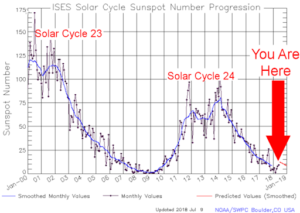
The sun has been blank for 21 days–3 whole weeks without sunspots. To find an equal number of consecutive spotless days in the historical record, you have to go back to July-August 2009 when the sun was emerging from an unusually deep solar minimum. Solar minimum, welcome back!
While NBC News might think that 68,000 page views per month is impressive, in comparison to our regular daily traffic on WUWT, it pales in comparison. For example, here is a screencap from my WordPress dashboard from yesterday, July 16th, which was a fairly typical summer day for WUWT. Note that it shows 92,467 page views in one day.
…
What’s most interesting is that while there’s been a slow, almost imperceptible increase in the phrase “climate change”, the search phrase “global warming” is getting far less use than it did when data was first collected, back in 2004. Right now, both “climate change”, and “global warming” have low interests.
Sometimes a chance comment sets off a whole chain of investigation. Somewhere recently, in passing I noted the idea of the slope of the temperature gradient across the Pacific along the Equator. So I decided to take a look at it. Here is the area that I examined.
…
I’ve written about this temperature gradient before, in a post called The Tao of El Nino. If you take time to read that post, this one will make more sense. …
Unearthed new evidence (Mangerud and Svendsen, 2018) reveals that during the Early Holocene, when CO2 concentrations hovered around 260 ppm, “warmth-demanding species” were living in locations 1,000 km farther north of where they exist today in Arctic Svalbard, indicating that summer temperatures must have been about “6°C warmer than at present”.
Proxy evidence from two other new papers suggests Svalbard’s Hinlopen Strait may have reached about 5 – 9°C warmer than 1955-2012 during the Early Holocene (Bartels et al., 2018), and Greenland may have been “4.0 to 7.0 °C warmer than modern [1952-2014]” between 10,000 and 8,000 years ago according to evidence found in rock formations at the bottom of ancient lakes (McFarlin et al., 2018).
In these 3 new papers, none of the scientists connect the “pronounced” and “exceptional” Early Holocene warmth to CO2 concentrations.
Hurricane threat to East Coast due to natural factors
First at his most recent Saturday Summary, the 40-year meteorologist first warns that in-close developing hurricanes of the sort seen in the 1930s are a risk to the US East Coast this year, due the current Atlantic temperature pattern. The reason has nothing to do with CO2 in the atmosphere, but because of natural sea surface temperature cycles.
Sea surface temperatures see “pretty dramatic turnaround”
The Climategate emails expose to our view a world that was previously hidden from virtually everyone.
This formerly hidden world was made up of a very few players. But they controlled those critical Intergovernmental Panel on Climate Change (IPCC) processes involv- ing the temperature records from the past, and the official interpretation of cur- rent temperature data. They exerted previously unrecognized influence on the “peer review” process for papers seeking publication in the officially recognised climate science literature from which the IPCC was supposed to rely exclusively in order to draw its conclusions.
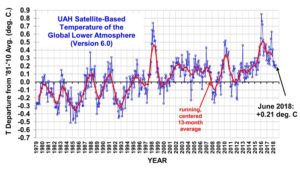
The ‘average’ world temperature for June 2018 was +0.21 deg C above the 1981 – 2010 mean. That represented a decline of about 0.65 deg C from the all-time high of this 39-year record, which was reached in early 2016. The 0.65 deg C decline represented more than 75% of the amount by which the average temperature had exceeded the 1981 – 2010 mean at the highest point. Suddenly the fact that some large number of “all-time highs” was being set at the end of June does not seem very significant.”
by A. Alam Khan, February17, 2018 in GeoScienceFrontiers
Highlights
• Global warming and polar ice-melt not contribute to sea level rise.
• Melting of huge volume of floating sea-ice around polar region cool ocean-water preventing thermal expansion.
• Polar ice melting re-occupy same volume of the displaced water causing no sea level rise.
• Gravitational attraction of the earth plays a dominant role against sea level rise.
• Melting of land ice in the polar region allow crust to rebound elastically for isostatic balancing through uplift should cause sea level to drop relatively.
A University of Aizu team has identified two distinct Indo-Pacific processes shaping the unique features and extraordinary ferocity of super El Ninos. A systematic analysis of these processes and their interactions will improve forecasts of the elusive super El Ninos, the researchers claim.
…
Extremely warm sea surface temperatures are a notable feature of the super El Ninos that occurred in 1972, 1982, and 1997. The fact that Pacific Ocean processes responsible for generating regular El Ninos could not explain this key signature of super El Ninos came as a big shock,” says Dachao Jin, co-author of the study.
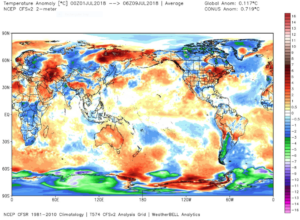
If you were to believe the mainstream media, you’d think our world is burning up. But that is not true.
Yes, there were places on our planet where it was warmer than normal today. But many parts of the world displayed normal or even colder than normal temperatures.
A new German paper assesses wind energy in Europe . The results are devastating. It concludes that wind energy requires almost 100% backup and that the more capacity that gets installed, the greater the volatility.
The paper appearing at the VGB, authored by Thomas Linnemann and Guido Vallana, finds that “the total wind fleet output of 18 European countries extending over several thousand kilometers in north-south and east-west direction is highly volatile and exhibits a strong intermittent character.”
In other words the power supply across the European grid fluctuates wildly and thus cannot work well. The paper’s abstract continues: …
According to the report, if we are to take cooling demand seriously, the key stages to move towards a solution for cooling demand are:
Reducing the energy required for cooling: getting industry to adopt high efficiency cooling technologies and using maintenance to deliver optimum performance.
Reducing the need for cooling through better building design
Systems level thinking across built environment and transport
Considering the strategies and skills required for installing appliances and maintaining them in order to maximise efficiency and reduce energy demand
Creating a model for delivery of affordable cooling to those in rural and urban communities based on the energy needs of local requirements, rather than imposing a ‘one size fits all’ approach
According to the Guardian (9 July 2018), there is a “global heat wave” going on right now.
In Siberia, the heat is supposedly “completely unprecedented” and will surely (we are told) impact Arctic sea ice — the habitat of the iconic polar bear. Yet a comparison of previous years shows little to no impact on sea ice: there is more ice present than there was in 2007.
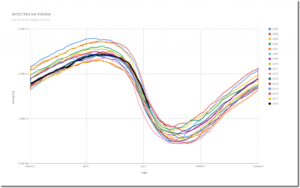
Lately Arctic sea ice volume has been a topic which climate skeptics have been looking at quite closely.
According to Al Gore and a number of climate ambulance chasers, Arctic sea ice in late summer should have long disappeared by now, see here..
But then just a few years after, the Arctic sea ice area began to recover from its lows of 2007 and 2012. So immediately alarmists shouted that area was not really what mattered, but rather sea ice volume is what really counted. Okay, that made perfect sense. Mass is in fact what’s important, and not area, when worrying about polar ice disappearing …
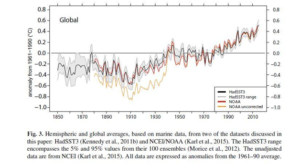
How have we measured the temperature of the ocean’s upper layer in the last 150 years? How does understanding physical processes and observational errors help to standardise climate data and understand climate change?
Sea surface temperature (SST) is also one of the climate indices with the longest histories of direct measurements. Because ocean makes up about 70% of the total Earth’s surface, changes in the temperature of its surface are a key factor for determining the global temperature of the planet’s surface.
Summers in the U.S. are hot. They always have been. Some are hotter than others.
Speaking as a PhD meteorologist with 40 years experience, this week’s heat wave is nothing special.
But judging from the memo released on June 22 by Public Citizen (a $17 million per year liberal/progressive consumer rights advocacy grouporiginally formed by Ralph Nader in 1971 and heavily funded by Leftwing billionaire George Soros’s Open Society Foundations), every heat wave must now be viewed as a reminder of human-caused climate change. The memo opines that (believe it or not) the news media have not been very good about linking weather events to climate change, which is leading to complacency among the public.
With those hot weather records in Los Angeles being set, it’s important to remember where measurements are taken. I’ve done an investigation and found that every “all time high” reported by the LA Times is from a station compromised by heat sources and heat sinks. In my opinion, the data from these stations is worthless.
It’s been going on for some time, for example, back in 2010, because there’s been a questionable high reading reading at USC of 113°F.
…
La géologie, une science plus que passionnante … et diverse