NOAA’s Climate Disaster Claims Are A Sham

by C. Rotter, Feb 20, 2021 in WUWT


When a hurricane hits a populated stretch of coast, which is almost invariably, it is inevitable losses will be big. But while last year was a busy year for hurricanes, we do know that the frequency of US hurricanes has not been unusual in the last decade, and if anything the long term trend is down. (Though it is worth noting that the 1980s and 90s were below average, making the choice of 1980 as a start date statistically inappropriate):

Climate Facts or Leaps of Faith? Governments Can’t Tell the Difference

by Donna Laframboise, Feb 17, 2021 in BigPicturesNews


We have no hard evidence of a crisis. Only expert opinion and best estimates.

Governments are currently fighting climate change to the tune of billions. For this to make sense, each idea in the following chain of reasoning needs to be bulletproof:

#1 – scientists know there’s a climate crisis
#2 – scientists know it’s humanity’s fault
#3 – scientists know we can alleviate the crisis by changing our behaviour

But each of these amounts to a leap of faith. Let’s start with the conviction that something unusual is going on. This planet is more than 4 billion years old. The climate was marching to its own drummer long before humans appeared. It has changed numerous times – sometimes gradually, sometimes violently. Twenty thousand years ago, much of North America was covered by ice.

Because humans weren’t recording and analyzing those billions of years of climatic history, today’s scientists have no way of knowing if anything unusual is going on now.

They can surmise. They can speculate. They can extrapolate. But they have no smoking gun. I’ve written two books about the UN’s Intergovernmental Panel on Climate Change (IPCC). That organization says it’s “extremely likely that more than half” of the global warming between 1951 and 2010 was caused by human activity. It talks about its “best estimate.”

Southeast Greenland Sea Surface Temperature 1° – 2°C Warmer In 1940 Than Today, New Study Shows

by P. Gosselin, Feb 14, 2021 in NoTricksZone


A team of Danish scientists led by David Wangner published a paper a year ago about the results of a Greenland sediment core from Skjoldungen Fjord, near the Thrym Glacier, which allowed sea surface temperatures to be reconstructed.

The core covers the past 200 years (1796–2013). The scientists find that the SST record compares well with other alkenone‐based reconstructions from SE‐Greenland and thus features regional shelf water variability.

Today some scientists like claiming the present is warmer than at any time in the past 1000 years and suggest the Greenland ice sheets are rapidly melting. But the results of the core reconstruction show that it was warmer in the past, some 80 years ago

Texas winter storm leaves 2M without power amid frigid temperatures

by E. Fordham, Feb 15, 2021 in FoxNews


HISTORIC WINTER STORM SLAMS TEXAS WITH RECORD COLD, ICY ROADS

Rotating power outages were initiated by the Electric Reliability Council of Texas, or ERCOT, early Monday morning, meaning thousands went without electricity for periods of time as temperatures fell into the teens near Dallas and 20s (about minus 5 degrees Celsius) around Houston.

Austin’s electric utility Austin Energy told residents the outages may be longer than usual, prompting angry social media replies from Texans who said they’d been without power for five or more hours.

“Typical events allow short durations of each outage, but outages are longer if the ERCOT grid requires — which is what we’re seeing in today’s event,” Austin Energy wrote on Twitter.

The utility advised residents to keep their keep their thermostat set to 68 degrees or lower, and to avoid using their oven or washing machine. Businesses were likewise advised to minimize operations to conserve energy.

See also : This Blizzard Exposes The Perils Of Attempting To ‘Electrify Everything’

Biden’s climate ‘fix’ is fantastically expensive and perfectly useless

by B. Lomborg, Feb 9, 2021 in NewYorkPost


Across the world, politicians are going out of their way to promise fantastically expensive climate policies. President Biden has promised to spend $500 billion each year on climate — about 13 percent of the entire federal revenue. The European Union will spend 25 percent of its budget on climate.

Most rich countries now promise to go carbon-neutral by mid-century. Shockingly, only one country has made a serious, independent estimate of the cost: New Zealand found it would optimistically cost 16 percent of its GDP by then, equivalent to the entire current New Zealand budget.

The equivalent cost for the US and the EU would be more than $5 trillion. Each and every year. That is more than the entire US federal budget, or more than the EU governments spend across all budgets for education, recreation, housing, environment, economic affairs, police, courts, defense and health.

Tellingly, the European Commission Vice President Frans Timmermans recently admitted that climate policies would be so costly, it would be a “matter of survival for our industry” without huge, protective border taxes.

Antarctica’s Larsen Ice Shelf Break-Up Driven by Geological Heat Flow Not Climate Change

by J.E. Kamis, Jan 19, 2017 in PlateClimatology


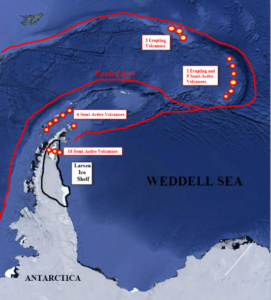
Figure 1  North tip of Antarctic Continent including Larsen Ice Shelf Outline (black line), very active
West Antarctica Rift / Fault System (red lines), and currently erupting or semi-active volcanoes (red dots).

Progressive bottom melting and break-up of West Antarctica’s seafloor hugging Larsen Ice Shelf is fueled by heat and heated fluid flow from numerous very active geological features, and not climate change.

This ice shelf break-up process has been the focus of an absolute worldwide media frenzy contending man-made atmospheric global warming is at work in the northwest peninsula of Antarctica. As evidence, media articles typically include tightly edited close-up photos of cracks forming on the surface of the Larsen Ice Shelf (Figure 2) accompanied by text laced with global warming alarmist catch phrases. This “advertising / marketing” approach does in fact produce beautiful looking and expertly written articles. However, they lack subsidence, specifically a distinct absence of actual scientific data and observations supporting the purported strong connection to manmade atmospheric global warming.

Working level scientists familiar with, or actually performing research on, the Larsen Ice Shelf utilize an entirely different approach when speaking about or writing about what is fueling this glacial ice break-up. They ascribe the break-up to poorly understood undefined natural forces (see quote below). Unfortunately, comments by these scientists are often buried deep in media articles and never seem to match the alarmist tone of the article’s headline.

“Scientists have been monitoring the rift on the ice shelf for decades. Researchers told NBC News that the calving event was “part of the natural evolution of the ice shelf,” but added there could be a link to changing climate, though they had no direct evidence of it.” (see here)

Biden’s climate ‘fix’ is fantastically expensive and perfectly useless-Bjorn Lomborg

by P. Homewood, Feb 214, 2021 in NotaLotofPeopleKnowThat


Across the world, politicians are going out of their way to promise fantastically expensive climate policies. President Biden has promised to spend $500 billion each year on climate — about 13 percent of the entire federal revenue. The European Union will spend 25 percent of its budget on climate.

Most rich countries now promise to go carbon-neutral by mid-century. Shockingly, only one country has made a serious, independent estimate of the cost: New Zealand found it would optimistically cost 16 percent of its GDP by then, equivalent to the entire current New Zealand budget.

The equivalent cost for the US and the EU would be more than $5 trillion. Each and every year. That is more than the entire US federal budget, or more than the EU governments spend across all budgets for education, recreation, housing, environment, economic affairs, police, courts, defense and health.

Tellingly, the European Commission Vice President Frans Timmermans recently admitted that climate policies would be so costly, it would be a “matter of survival for our industry” without huge, protective border taxes.

Climate change is a real, manmade problem. But its impacts are much lower than breathless climate reporting would suggest. The UN Climate Panel finds that if we do nothing, the total impact of climate in the 2070s will be equivalent to reducing incomes by 0.2-2 percent. Given that by then, each person is expected to be 363 percent as rich as today, climate change means we will “only” be 356 percent as rich. Not the end of the world.

Climate policies could end up hurting much more by dramatically cutting growth. For rich countries, lower growth means higher risks of protests and political breakdown. This isn’t surprising. If you live in a burgeoning economy, you know that you and your children will be much better off in the coming years. Hence, you are more forgiving of the present.

….

More trees do not always create a cooler planet, Clark University geographer finds

by Clark University, Feb 14, 203221 in WUWT


WORCESTER, Mass. — New research by Christopher A. Williams, an environmental scientist and professor in Clark University‘s Graduate School of Geography, reveals that deforestation in the U.S. does not always cause planetary warming, as is commonly assumed; instead, in some places, it actually cools the planet. A peer-reviewed study by Williams and his team, “Climate Impacts of U.S. Forest Loss Span Net Warming to Net Cooling,” published today (Feb. 12) in Science Advances. The team’s discovery has important implications for policy and management efforts that are turning to forests to mitigate climate change.

It is well established that forests soak up carbon dioxide from the air and store it in wood and soils, slowing the accumulation of greenhouse gases in the atmosphere; however, that is not their only effect on climate. Forests also tend to be darker than other surfaces, said Professor Williams, causing them to absorb more sunlight and retain heat, a process known as “the albedo effect.”

“We found that in some parts of the country like the Intermountain West, more forest actually leads to a hotter planet when we consider the full climate impacts from both carbon and albedo effects,” said Professor Williams. It is important to consider the albedo effect of forests alongside their well-known carbon storage when aiming to cool the planet, he adds.

Urban Heat Island Effects on U.S. Temperature Trends, 1973-2020: USHCN vs. Hourly Weather Stations

by Roy Spencer, Feb 11, 2021 in GlobalWarming


SUMMARY: The Urban Heat Island (UHI) is shown to have affected U.S. temperature trends in the official NOAA 1,218-station USHCN dataset. I argue that, based upon the importance of quality temperature trend calculations to national energy policy, a new dataset not dependent upon the USHCN Tmax/Tmin observations is required. I find that regression analysis applied to the ISD hourly weather data (mostly from airports)  between many stations’ temperature trends and local population density (as a UHI proxy) can be used to remove the average spurious warming trend component due to UHI. Use of the hourly station data provides a mostly USHCN-independent measure of the U.S. warming trend, without the need for uncertain time-of-observation adjustments. The resulting 311-station average U.S. trend (1973-2020), after removal of the UHI-related spurios trend component, is about +0.13 deg. C/decade, which is only 50%  the USHCN trend of +0.26 C/decade. Regard station data quality, variability among the raw USHCN station trends is 60% greater than among the trends computed from the hourly data, suggesting the USHCN raw data are of a poorer quality. It is recommended that an de-urbanization of trends should be applied to the hourly data (mostly from airports) to achieve a more accurate record of temperature trends in land regions like the U.S. that have a sufficient number of temperature data to make the UHI-vs-trend correction.

The Urban Heat Island: Average vs. Trend Effects

In the last 50 years (1970-2020) the population of the U.S. has increased by a whopping 58%. More people means more infrastructure, more energy consumption (and waste heat production), and even if the population did not increase, our increasing standard of living leads to a variety of increases in manufacturing and consumption, with more businesses, parking lots, air conditioning, etc.

UK National Temperature record at Cambridge Botanic Garden –An examination of the data.

by C. Rotter, Feb 13, 2021 in WUWT


Guest Post by Tony Brown

Section 1 Introduction

A visit to the Botanical gardens in Cambridge was made by the author of this paper on August 7th 2020 between 10.15AM to 12.25pm.  The purpose was to look at the site of the Stevenson screen there,  following the establishment at this location of the highest ever recorded UK instrumental  temperature, confirmed by the Met Office as 38.7 C ( 101.6 Fahrenheit ) taken at the gardens on 25 July 2019, and to determine the possible effects on this record caused by urbanisation.  From the botanic garden web site we note:

 “Analysis of the Garden’s weather records show that over the last 100 years our average temperature has risen by 1.2 Celsius and the hottest day, highest monthly and yearly average have all occurred within the last 20 years. The highest ever temperature recorded at the Garden before this new record was 36.9 C, recorded on 10 August, 2003.”  * See; “Section 5; Temperature trends.”

Cambridge University Botanic Garden records highest ever UK temperature – Cambridge Botanic Garden

Some context is provided by firstly examining the past and present urbanisation of the gardens, the location of the Stevenson screen and there then follows an examination of various temperature recordings locally to determine what affect if any the urbanisation may have had.

The visit  was  made during one of the hottest spells of the 2020 summer and  in similar conditions to the record, in as much it had been hot in the days running up to the record with  prolonged sunshine and light winds and these were mirrored on the day of the visit. The preceding day, August 6th 2020 was partially cloudy and very warm at 27C, close by at Cambridge Airport.

China Facing Winter Blackouts

by P. Homewood, Dec 23, 2020 in NotaLotofPeopleKnowThat


There’s an interesting story emerging from China:

BEIJING: Tens of millions across China are facing power shortages in below-freezing winter temperatures, as three provinces impose curbs on electricity use due to surging demand and a squeezed coal supply.

Residents, factories and businesses in Hunan, Zhejiang and Jiangxi provinces have been ordered to ration electricity with some areas citing a shortfall in coal supplies, according to local media reports and government notices.

China’s rebound from the Covid-19 pandemic has been driven by energy intensive industries such as construction, heaping pressure on the power grid and coal supplies, said Lauri Myllyvirta, lead analyst at the Centre for Research on Energy and Clean Air.

Earlier this month, Hunan authorities ordered all billboards and outdoor lighting on buildings to power off for long periods each day and a temperature cap on indoor heating at entertainment venues.

Hunan faces a shortfall of 3-4 million kilowatts of electricity this winter, local officials admitted last week, as demand soars due to unusually cold weather that will hit as low as -10°C.

Office workers in provincial capital Changsha complained on social media about being forced to climb dozens of flights of stairs and freezing indoor temperatures as a result of frequent power outages.

“My office heating has already been stopped, and there were blackouts on Dec 1, 3 and 5. Temperatures will drop to -8°C around New Year’s Day, will I freeze to death in Hunan?” one Weibo user wrote last week.

Meanwhile in Zhejiang province, factories in the manufacturing hub of Yiwu have been told to stop operations and streetlights have been turned off at night as part of an emissions-saving drive by the local government, according to media reports and photos circulated on Weibo.

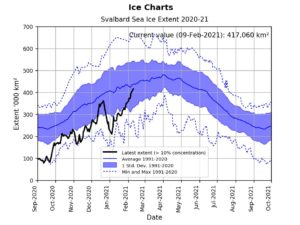
Polar bear sea ice habitat highs and lows in early February

by Polar Bear Science, Feb 10, 2021


Sea ice across the Arctic in the first week of February is a mix of highs and lows. Bering Sea is back up to almost normal coverage, as is the Barents Sea. However, ice coverage on the East Coast of Canada is the lowest its been in four decades. This is not yet a worry for polar bears because harp seals don’t pup until mid-March in this region so there is at least four weeks of potential ice growth that can happen before the seals are forced to pup on much reduced ice – where polar bears are sure to find them.

CMIP6 and AR6, a preview

by Andy May, Feb 11, 2021 in WUWT


The new IPCC report, abbreviated “AR6,” is due to come out between April 2021 (the Physical Science Basis) and June of 2022 (the Synthesis Report). I’ve purchased some very strong hip waders to prepare for the events. For those who don’t already know, sturdy hip waders are required when wading into sewage. I’ve also taken a quick look at the CMIP6 model output that has been posted to the KNMI Climate Explorer to date. I thought I’d share some of what I found.

India to overtake EU as world’s third largest energy consumer by 2030: IEA

by P. Homewood, Feb 20, 2021 in NotaLofPeopleKnowThat


India will overtake the European Union as the world’s third-largest energy consumer by 2030, the International Energy Agency (IEA) said on Tuesday as it forecast India accounting for the biggest share of energy demand growth over the next two decades.

In its India Energy Outlook 2021, IEA saw primary energy consumption almost doubling to 1,123 million tonnes of oil equivalent as the Gross Domestic Product (GDP) expands to USD 8.6 trillion by 2040.

India at present is the fourth-largest global energy consumer behind China, the United States and the European Union.

Underpinned by “a rate of GDP growth that adds the equivalent of another Japan to the world economy by 2040”, India will overtake the European Union by 2030 to move up to the third position, it said in the report.

India accounts for nearly one-quarter of global energy demand growth from 2019-40 — the largest for any country. Its share in the growth in renewable energy is the second-largest in the world, after China, IEA said.

“By 2040, India’s power system is bigger than that of the European Union, and is the world’s third-largest in terms of electricity generation; it also has 30 per cent more installed renewables capacity than the United States,” it said.

A five-fold increase in per capita car ownership will result in India leading the oil demand growth in the world. Also, it will become the fastest-growing market for natural gas, with demand more than tripling by 2040.

Hematite reconstruction of Late Triassic hydroclimate over the Colorado Plateau

by Lepre, J & Olsen P.E., Feb 21, 2021 PNAS


Significance

Hematite provides much of the color for the classic Triassic–Jurassic “red beds” of North America and elsewhere. Measuring the spectrum of visible light reflected and absorbed by the red beds, we demonstrate that the hematite concentrations faithfully track 14.5 million years of Late Triassic monsoonal rainfall over the Colorado Plateau of Arizona and use this information to assess interrelationships between environmental perturbations, climate, and the evolution of terrestrial vertebrates. The research challenges conventional ideas that the hematite has limited use for interpreting the ancient past because it is a product of natural chemical alterations that occurred long after the beds were initially deposited.

Abstract

Hematite is the most abundant surficial iron oxide on Earth resulting from near-surface processes that make it important for addressing numerous geologic problems. While red beds have proved to be excellent paleomagnetic recorders, the early diagenetic origin of hematite in these units is often questioned. Here, we validate pigmentary hematite (“pigmentite”) as a proxy indicator for the Late Triassic environment and its penecontemporaneous origin by analyzing spectrophotometric measurements of a 14.5-My–long red bed sequence in scientific drill core CPCP-PFNP13-1A of the Chinle Formation, Arizona. Pigmentite concentrations in the red beds track the evolving pattern of the Late Triassic monsoon and indicate a long-term rise in aridity beginning at ∼215 Ma followed by increased oscillatory climate change at ∼213 Ma. These monsoonal changes are attributed to the northward drift of the Colorado Plateau as part of Laurentia into the arid subtropics during a time of fluctuating CO2. Our results refine the record of the Late Triassic monsoon and indicate significant changes in rainfall proximal to the Adamanian–Revueltian biotic transition that thus may have contributed to apparent faunal and floral events at 216 to 213 Ma.

Delingpole: Study Disputes That Earth Is in a ‘Climate Emergency’

by P. Homewood, Feb 9, 2021 in NotaLotofPeopleKnowThat


There is no “climate emergency”, according to a study for the Global Warming Policy Foundation by independent scientist Dr Indur Goklany.

Goklany concludes:

While climate may have changed for the warmer:

• Most extreme weather phenomena have not become more extreme, more deadly, or more destructive

• Empirical evidence directly contradicts claims that increased carbon dioxide has reduced human wellbeing. In fact, human wellbeing has never been higher

• Whatever detrimental effects warming and higher carbon dioxide may have had on terrestrial species and ecosystems, they have been swamped by the contribution of fossil fuels to increased biological productivity. This has halted, and turned around, reductions in habitat loss

The report will make hugely depressing reading for all the prominent environmental activists — from the Pope and Doom Goblin Greta Thunberg to the Great Reset’s Klaus Schwab — who have been pushing the “climate emergency” narrative. It is an article of faith for the globalist elite and their useful idiots in the media, in politics, in business, and the entertainment that the world is on course for climate disaster which only radical and costly international action can prevent.

Continue reading “Delingpole: Study Disputes That Earth Is in a ‘Climate Emergency’”

Journal Nature Refutes PIK’s Fantasy-Rich Science That A Warmer Arctic Causes Extreme Cold Snaps

by P. Gosselin, Feb 9, 2021 in NoTricksZone


The polar vortex theory takes a beating: The claim a warm Arctic is behind the brutally cold winter conditions at the mid latitudes is shown by a Nature study to be scientifically baseless.

Now that Europe and North America are getting blasted by unusually severe winter weather, which climate alarmists predicted 20 years ago would be a thing of the past, the alarmists are desperate to find an explanation to escape embarrassment.

PIK science suggests warmth begets cold

They’ve come up with the polar vortex explanation: the bitter cold we are now experiencing at the middle latitudes is in fact due to the warmer Arctic, they say. And this wreaks havoc on the jet stream which in turn results in cold Arctic blasts dipping deep into the middle latitudes. Yes, cold winters are in fact exactly what we should expect in a rapidly warming world!

Levermann and Rahmstorf

For example the two media front men Anders Levermann and Stefan Rahmstorf of the Potsdam Climate Institute (PIK) have been telling this to the ever gullible German media outlets, like Bild and Spiegel. Yet, many suspect it’s scientific fraud designed to fool the public and to hide the fact that their global warming predictions are in reality glaring failures.

Journal Nature refutes fantasy-rich PIK explanation

For example a recent paper appearing in Nature titled “Weakened evidence for mid-latitude impacts of Arctic warming“, authored by Blackport et al, refutes this highly fantasy-rich hypothesis pitched by the two PIK scientists.


“Climate Adaptation Summit” turns out to be a fundraising event

by D. Wojick, Fab 6, 2021 in CFACT/CLINTEL


The recent Climate Adaptation Summit 2021 was not about helping nations against the effects of climate change. It was all about finding huge amounts of money. Even worse, it was about planning on finding money, not actually finding it. Even more embarrassing, in some cases it was just about thinking about planning. In fact its primary product was an Agenda. Climate Summits are like that. However, world leaders call it thinking big’.

Climate adaptation is proactive and that is its big strength. It is proactive to the combination of gradual changes (think of the gradually increasing sea level) and excessive events (think of all types of extreme weather). Using Darwin, if mankind does not adapt to these changes in his environment, extinction will be his fate as happened so often to other species in the past.

Climate is a long term statistic, typically 30 years, or more. In this case it is mostly the long term frequency of various extreme weather events, the usual litany of floods, droughts, heat waves, etc., plus there is the usual sea level rise.

The real thing is that adaptation is not about preventing these extreme events, but it is about adapting to those events. For instance, dont build houses in flood planes or build dikes to keep them dry. Keep in mind that with any form of climate adaptation, the cause of climate change is of no importance.

What does matter, in a very bad way, is that humans are being blamed for all bad weather. This supports the nonsensical thing called mitigation, where human well being is sacrificed in a foolish attempt to end bad weather.

Our friends at the Climate Intelligence Foundation (CLINTEL) have made it a central policy that adaptation is the way to go. In commenting on CAS 2021 they point out that adaptation is actually very profitable, increasing the prosperity and safety of nations.

Here is what they say: “The world should focus much more on climate adaptation and much less on mitigation. This is the conclusion of the global CLINTEL following the international climate summit that took place in the Netherlands over the past two days. Adaptation has already amply proven its value, while mitigation turns out to be inefficient and expensive.

Scientists Discover Plate Tectonics… Again

by D. Middleton, Feb 5, 2021 in WUWT


An upwelling of rock beneath the Atlantic may drive continents apart
The Mid-Atlantic Ridge may play a more active role in plate tectonics than thought

By Maria Temming

FEBRUARY 4, 2021

An upsurge of hot rock from deep beneath the Atlantic Ocean may be driving the continents on either side apart.

The Americas are moving away from Europe and Africa by a few centimeters each year, as the tectonic plates underlying those continents drift apart. Researchers typically think tectonic plates separate as the distant edges of those plates sink down into Earth’s mantle, creating a gap (SN: 1/13/21). Material from the upper mantle then seeps up through the rift between the plates to fill in the seafloor.

But new seismic data from the Atlantic Ocean floor show that hot rock is welling up beneath a seafloor rift called the Mid-Atlantic Ridge from hundreds of kilometers deep in Earth’s mantle. This suggests that material rising up under the ridge is not just a passive response to tectonic plates sliding apart. Rather, deep rock pushing toward Earth’s surface may be driving a wedge between the plates that helps separate them, researchers report online January 27 in Nature.

A better understanding of plate tectonics — which causes earthquakes and volcanic eruptions — could help people better prepare for these natural disasters (SN: 9/3/17).

Climate Researcher’s New E-Book: IPCC Significantly Overstates CO2, “The Sorry State Of Climate Science”

by P. Gosselin, Feb 5, 2021 in NoTricksZone


This is an outstanding reference. Using the table of contents the reader can conveniently look up the topic that’s of interest. The ebook has been downloaded over 10,000 times so far.

The 449-page book contains 120 figures and 177 equations and concludes that climate change is mostly about politically-fanned fear, and based very little on hard science.

Predictions of gloom haven’t come true

According to Poyet, a geologist, the worse climate predictions have been made for 50 years and none of them has ever become true. For example, despite the unsupported claims that the Maldives islands would be submerged by 2050, 97% of them have grown so far, for various reasons having nothing to do with “climate change”.

Also 50 years ago, the first Earth Day promoted ice age fears, and environmentalist Nigel Calder (later a prominent AGW skeptic) warned: “The threat of a new ice age must now stand alongside nuclear war as a likely source of wholesale death and misery for mankind.”

IPCC ignores vast majority of the science

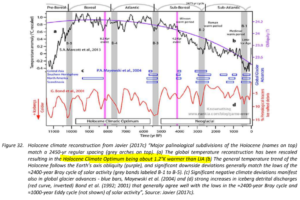
While IPCC-affiliated scientists claim man to been behind the climate change of the past decades, Poyet’s book shows that this can only be concluded if one ignores all other factors. Fig 12, of his book, for example, depicts the natural fluctuations witnessed during the Holocene.


Solving the mystery of why atmospheric carbon dioxide was lower during ice ages

by M. Floyd, June 13, 2019 in PhysOrg


Since scientists first determined that atmospheric carbon dioxide (CO2) was significantly lower during ice age periods than warm phases, they have sought to discover why, theorizing that it may be a function of ocean circulation, sea ice, iron-laden dust or temperature.

Yet no based on existing evidence has been able to explain why CO2 levels were as much as one-third lower when an ice age settled in.

A new study published this week in Science Advances provides compelling evidence for a solution—the combination of sea water variation and iron from dust off Southern Hemisphere continents.

Interview: Climate Change – A Different Perspective with Judith Curry

by J. Curry, Jan 30, 2021 in WUWT


My recent interview on the Strong and Free podcast.

I recently did an interview with Christopher Balkaran on his Strong and Free podcast [link]

While I wasn’t previously aware of Balkaran or his podcast, you can see why I agreed to this interview, from these excerpts from the ‘About’ page:

“I created the Strong and Free Podcast to explore news topics by gathering multiple perspectives together and allowing people and organizations to discuss their opinions with detail. This allows for a nuanced conversation. It also means putting aside my own bias to explore these to the fullest. It means making all guests feel welcomed to share their opinions safely, without fear that the host will paint them into a corner, or make them sound incoherent. I want this place to be truly safe. I believe everyone, even those I disagree with, deserve to be treated with respect and to be on the Podcast to share their perspective. It also means having a concrete discussion on issues and determining the best way forward.  As long as we restore thoughtful approaches to the biggest issues of our time our conversations will have deep, valuable meaning. And, we enrich our own opinion.”

We covered a lot of topics that I think will provide good fodder for discussion and debate here.

Here is a transcript of the interview (quicker to read than to listen to the hour long podcast).  I edited the transcript eliminate thousands of ‘like’, ‘you know’, ‘okay’ (I am really a much better writer than speaker).  I also edited to increase overall coherency of what was said.

Transcript:

The spiralling environmental cost of our lithium battery addiction

by A. Katwala, Aug 5, 2018 in Wired


Here’s a thoroughly modern riddle: what links the battery in your smartphone with a dead yak floating down a Tibetan river? The answer is lithium – the reactive alkali metal that powers our phones, tablets, laptops and electric cars.

In May 2016, hundreds of protestors threw dead fish onto the streets of Tagong, a town on the eastern edge of the Tibetan plateau. They had plucked them from the waters of the Liqi river, where a toxic chemical leak from the Ganzizhou Rongda Lithium mine had wreaked havoc with the local ecosystem.

There are pictures of masses of dead fish on the surface of the stream. Some eyewitnesses reported seeing cow and yak carcasses floating downstream, dead from drinking contaminated water. It was the third such incident in the space of seven years in an area which has seen a sharp rise in mining activity, including operations run by BYD, the world’ biggest supplier of lithium-ion batteries for smartphones and electric cars. After the second incident, in 2013, officials closed the mine, but when it reopened in April 2016, the fish started dying again.


ANTARCTICA SUFFERING COLDEST JANUARY SINCE 1978 + GLOBAL SEA ICE GROWING EXPONENTIALLY

by Cap Allon, Jan 29, 2021 in Electroverse


The start of 2021 in Antarctica has been an unusually chilly one. In fact, the first half of January has been the coldest since 1978, according to data compiled by @LpdlcRamirez and @peikko763 on Twitter.

As of Jan. 19, the month-to-date temperature anomaly across Antarctic is approx. -0.5C, making this the continents coldest first 3-or-so-weeks of Jan. since 1978 (solar minimum of cycle 20), according to research conducted by @peikko163 on Twitter, who also notes that the Southern Hemisphere as a whole is suffering anomalous January chills not seen since 2012.

But this chill of solar minimum isn’t just confined to the Southern Hemisphere either, the mercury ACROSS the planet is tumbling. In one month global temperatures dropped by a whopping 0.26C: from 0.53C above the 1981-2010 avg. in Nov. 2020 to just 0.27C above the avg. in Dec. 2020 (UAH). This drop was in spite of a warming Arctic–a region expected to “heat” during times of otherwise “global” cooling (more on that below).

The Sun appears to be sliding into its next Grand Solar Minimum cycle–a multidecadal spell of reduced solar output where the solar disc can be devoid of sunspots for months or even years at a time. The result on Earth’s climate will be one of violent swings between extremes due to a weakening of the jet streams: intense bursts of heat will linger in one area, while a teeth-chattering chill will dominate nearby, and then the regions will “switch” — it is this unpredictable chopping and changing that will hasten the failure of our modern food production systems: crops will fail, on a large scale, and famine could quickly ensue.

Overall, Earth’s temperature trends colder during a Grand Solar Minimum, as the Sun’s output sinks lower and lower (increased cloud nucleation being one likely forcing). However, not ALL regions experience the chill: as with the previous GSM (the Maunder Minimum 1645-1715), areas such as the Arctic, Alaska, and S. Greenland/N. Atlantic actually warmed while the rest of the planet cooled — NASA reveals the phenomenon in their Maunder Minimum temperature reconstruction map:

The Rational Climate e-Book, By Patrice Poyet

P. Homewood, Jan 27, 2021 in NotaLotofPeopleKnowThat


I am delighted to give a plug to Patrice Poyet’s new e-Book, The Rational Climate e-Book.

It can be downloaded for free on the link below:

https://www.researchgate.net/publication/347150306_The_Rational_Climate_e-Book/link/5fe21ddb92851c13feb1763d/download

Patrice is a geologist, a geochemist and an applied computer scientist with an interest in various domains like Earth and Planetary Sciences, Astronomy, Finance and Trading, Integration in Manufacturing and Design, Simulation and Defense Systems, etc The development of computer systems has given him the chance to take part in a wide variety of projects in very different areas of expertise. Patrice published 37 articles mostly in peer-reviewed scientific journals, 6 books jointly-reviewed with colleagues, 6 peer-reviewed chapters in books, 64 papers in peer-reviewed conferences, one D.Sc. thesis (1986), and 32 scientific and technical reports for demanding public and private clients (e.g. French Navy, EC-funded R&D projects, CIEH, etc.) and acted as an expert reviewer for several EC R&D projects. He is now using his initial training as a geochemist and his passion for Earth and Space sciences to completely revisit the subject of climate and paleo-climates. The result is this free 431 pages e-Book that addresses all aspects of the subject.

La géologie, une science plus que passionnante … et diverse