Tous les articles par Alain Préat

Full-time professor at the Free University of Brussels, Belgium apreat@gmail.com apreat@ulb.ac.be • Department of Earth Sciences and Environment Res. Grp. - Biogeochemistry & Modeling of the Earth System Sedimentology & Basin Analysis • Alumnus, Collège des Alumni, Académie Royale de Sciences, des Lettres et des Beaux Arts de Belgique (mars 2013). http://www.academieroyale.be/cgi?usr=2a8crwkksq&lg=fr&pag=858&rec=0&frm=0&par=aybabtu&id=4471&flux=8365323 • Prof. Invited, Université de Mons-Hainaut (2010-present-day) • Prof. Coordinator and invited to the Royal Academy of Sciences of Belgium (Belgian College) (2009- present day) • Prof. partim to the DEA (third cycle) led by the University of Lille (9 universities from 1999 to 2004) - Prof. partim at the University of Paris-Sud/Orsay, European-Socrates Agreement (1995-1998) • Prof. partim at the University of Louvain, Convention ULB-UCL (1993-2000) • Since 2015 : Member of Comité éditorial de la Revue Géologie de la France http://geolfrance.brgm.fr • Since 2014 : Regular author of texts for ‘la Revue Science et Pseudosciences’ http://www.pseudo-sciences.org/ • Many field works (several weeks to 2 months) (Meso- and Paleozoic carbonates, Paleo- to Neoproterozoic carbonates) in Europe, USA (Nevada), Papouasia (Holocene), North Africa (Algeria, Morrocco, Tunisia), West Africa (Gabon, DRC, Congo-Brazzaville, South Africa, Angola), Iraq... Recently : field works (3 to 5 weeks) Congo- Brazzaville 2012, 2015, 2016 (carbonate Neoproterozoic). Degree in geological sciences at the Free University of Brussels (ULB) in 1974, I went to Algeria for two years teaching mining geology at the University of Constantine. Back in Belgium I worked for two years as an expert for the EEC (European Commission), first on the prospecting of Pb and Zn in carbonate environments, then the uranium exploration in Belgium. Then Assistant at ULB, Department of Geology I got the degree of Doctor of Sciences (Geology) in 1985. My thesis, devoted to the study of the Devonian carbonate sedimentology of northern France and southern Belgium, comprised a significant portion of field work whose interpretation and synthesis conducted to the establishment of model of carbonate platforms and ramps with reefal constructions. I then worked for Petrofina SA and shared a little more than two years in Angola as Director of the Research Laboratory of this oil company. The lab included 22 people (micropaleontology, sedimentology, petrophysics). My main activity was to interpret facies reservoirs from drillings in the Cretaceous, sometimes in the Tertiary. I carried out many studies for oil companies operating in this country. I returned to the ULB in 1988 as First Assistant and was appointed Professor in 1990. I carried out various missions for mining companies in Belgium and oil companies abroad and continued research, particularly through projects of the Scientific Research National Funds (FNRS). My research still concerns sedimentology, geochemistry and diagenesis of carbonate rocks which leads me to travel many countries in Europe or outside Europe, North Africa, Papua New Guinea and the USA, to conduct field missions. Since the late 90's, I expanded my field of research in addressing the problem of mass extinctions of organisms from the Upper Devonian series across Euramerica (from North America to Poland) and I also specialized in microbiological and geochemical analyses of ancient carbonate series developing a sustained collaboration with biologists of my university. We are at the origin of a paleoecological model based on the presence of iron-bacterial microfossils, which led me to travel many countries in Europe and North Africa. This model accounts for the red pigmentation of many marble and ornamental stones used in the world. This research also has implications on the emergence of Life from the earliest stages of formation of Earth, as well as in the field of exobiology or extraterrestrial life ... More recently I invested in the study from the Precambrian series of Gabon and Congo. These works with colleagues from BRGM (Orléans) are as much about the academic side (consequences of the appearance of oxygen in the Paleoproterozoic and study of Neoproterozoic glaciations) that the potential applications in reservoir rocks and source rocks of oil (in collaboration with oil companies). Finally I recently established a close collaboration with the Royal Institute of Natural Sciences of Belgium to study the susceptibility magnetic signal from various European Paleozoic series. All these works allowed me to gain a thorough understanding of carbonate rocks (petrology, micropaleontology, geobiology, geochemistry, sequence stratigraphy, diagenesis) as well in Precambrian (2.2 Ga and 0.6 Ga), Paleozoic (from Silurian to Carboniferous) and Mesozoic (Jurassic and Cretaceous) rocks. Recently (2010) I have established a collaboration with Iraqi Kurdistan as part of a government program to boost scientific research in this country. My research led me to publish about 180 papers in international and national journals and presented more than 170 conference papers. I am a holder of eight courses at the ULB (5 mandatory and 3 optional), excursions and field stages, I taught at the third cycle in several French universities and led or co-managed a score of 20 Doctoral (PhD) and Post-doctoral theses and has been the promotor of more than 50 Masters theses.

Les COP se succèdent, le charbon résiste

by Connaissance des Energies, 18 décembre 2018


Trois jours après la clôture de la COP24, l’Agence internationale de l’énergie (AIE) a publié le 18 décembre son rapport annuel consacré au charbon. Elle y souligne le rôle central de cette énergie au niveau mondial et estime que sa consommation globale devrait rester stable dans les 5 prochaines années. Explications.

La consommation de charbon encore appelée à augmenter en Inde et en Asie du Sud-Est

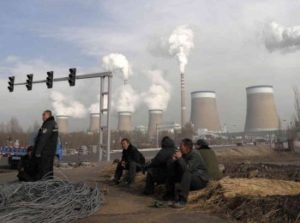
Après deux années de baisse, la consommation mondiale de charbon a augmenté de près de 1% en 2017 et cette hausse devrait se poursuivre en 2018 selon les dernières estimations de l’AIE. Principalement consommé à des fins de production électrique(1), le charbon a encore compté pour 38% de la production mondiale d’électricité en 2017.

Dans son rapport Coal 2018, l’AIE estime que la consommation mondiale de charbon pourrait rester stable d’ici à 2023 : la baisse de la demande envisagée en Europe et en Amérique du Nord serait plus que compensée par une forte croissance de la consommation en Inde et en Asie du Sud-Est selon les prévisions de l’Agence.

Study reconstructing ocean warming finds ocean circulation changes may account for significant portion of sea level rise

by Anthony Watts, January 7, 2019 in WUWT


Study suggests that in the last 60 years up to half the observed warming and associated sea level rise in low- and mid- latitudes of the Atlantic Ocean is due to changes in ocean circulation.

Over the past century, increased greenhouse gas emissions have given rise to an excess of energy in the Earth system. More than 90% of this excess energy has been absorbed by the ocean, leading to increased ocean temperatures and associated sea level rise, while moderating surface warming.

The multi-disciplinary team of scientists have published estimates in PNAS, that global warming of the oceans of 436 x 1021 Joules has occurred from 1871 to present (roughly 1000 times annual worldwide human primary energy consumption) and that comparable warming happened over the periods 1920-1945 and 1990-2015.

U.S. Media Bans Scientific Dissent – Claim Wildfires, Floods, Droughts, Hurricanes Are Human-Controlled

by K. Richard, January 7, 2019 in NoTricksZone


NBC News’ Chuck Todd recently asserted that we humans can control the climate and the frequency or intensity of extreme weather events (hurricanes, floods, droughts) and disasters (wildfires) with our CO2 emissions. He has declared the science is “settled” on this point and therefore no “denier” is allowed on his Meet the Press program. But Todd and the members of his panel have recited claims that are contravened by observational evidence and scientific publications.

The Belgian electricity industry in chaos

by Prof. Samuel Furfari, January 7, 2019 in EuropeanScientist


Belgium’s electricity supply has become a serious problem. Without investment in new generation capacity, the security of electricity supply will deteriorate in the next few years. However, the country’s situation does not lend itself to optimism on this topic. Belgium is not a straightforward country. Its institutional structure can only be described as one of […] The post The Belgian electricity industry in chaos (https://www.europeanscientist.com/en/features/the-belgian-electricity-industry-in-chaos/) appeared first on European Scientist (https://www.europeanscientist.com/en)

4 oil price predictions for 2019

by Steve Austin, January 7, 2019 in Oil-Price.Net


Last year, we gave out five blazing predictions as we stepped into a brand new 2018. And, how did we fare? Well, the year isn’t new anymore but we did get 5 out of 5 of our predictions right! Self-congratulations are in order reaffirming why you read us. For 2019, really it’s more of the same, but with some caveats. Investors, listen. Readers, pay heed, we are about to deconstruct the next year. As audacious as it sounds, here are our 4 oil price predictions for 2019:

Forget El Nino, StormFest is about to Hit the West Coast

by Charles the moderator, January 6, 2019 in WUWT


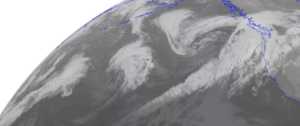
Things often calm down after January 1 during El Nino years….but not this year…with the U.S. West Coast from central California to Washington State about to be pummeled by a series of storms.   Rain, snow, wind?  Plenty for everyone.

A view of the latest infrared satellite imagery shows an amazing line-up of one storm after another stretching way into the Pacific.  A traffic jam of storms.


Let’s examine our stormy future, using a series of sea level pressure forecasts from the UW WRF weather forecast models (solid lines are sea level pressure, shading in lower atmosphere temperature).


Kerala Floods “Likely Due To Climate Variability, Not AGW”–New Study

by P. Homewood, January 5, 2019 in NotaLotofPeopleKnowThat


Since there is no increase in mean and extreme precipitation in Kerala over the last six decades, the extreme event during August 2018 is likely to be driven by anomalous atmospheric conditions due to climate variability rather anthropogenic climate warming. The severity of the Kerala flood of 2018 and the damage caused might be affected by several factors including land use/ land cover change, antecedent hydrologic conditions, reservoir storage and operations, encroachment of flood plains, and other natural factors. The impacts of key drivers (anthropogenic and natural) on flood severity need to be established to improve our understanding of floods and associated damage.

http://www.geosocindia.org/index.php/jgsi/article/view/137443

Storage wars

by Charles the moderator, January 5, 2019 in WUWT


UC Santa Barbara researcher conducts first-ever global-scale evaluation of the role of soil minerals in carbon storage

University of California – Santa Barbara

One answer to our greenhouse gas challenges may be right under our feet: Soil scientists Oliver Chadwick of UC Santa Barbara and Marc Kramer of Washington State University have found that minerals in soil can hold on to a significant amount of carbon pulled from the atmosphere. It’s a mechanism that could potentially be exploited as the world tries to shift its carbon economy.

“We’ve known for quite a long time that the carbon stored on minerals is the carbon that sticks around for a long time,” said Chadwick, co-author of the paper, “Climate-driven thresholds in reactive mineral retention of soil carbon at the global scale,” published in the journal Nature Climate Change. How much carbon the soil can take and how much it can keep, he said, are dependent on factors including temperature and moisture.

“Terrifying Sea-Level Prediction Now Looks Far Less Likely”… But “marine ice-cliff instability” is “just common sense”

by David Middleton, January 5, 2019 in WUWT


Marine ice cliff instability (MICI) “has not been observed, not at such a scale,” “might simply be a product of running a computer model of ice physics at a too-low resolution,” ignores post glacial rebound, couldn’t occur before ” until 2250 or 2300″… Yet “the idea is cinematic,” “it’s just common sense that Antarctic glaciers will develop problematic ice cliffs” and something we should plan for…

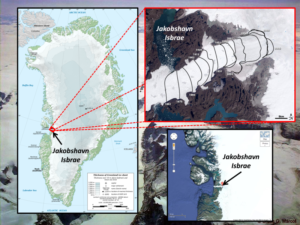
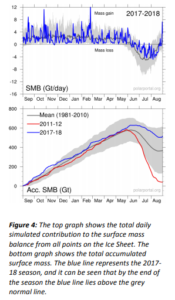
“Our results support growing evidence that calving glaciers are particularly sensitive to climate change.”  Greenland’s climate is always changing… Always has and always will change… And the climate changes observed over the last few decades are not unprecedented. The Greenland ice sheet is no more disappearing this year than it was last year and it is physically impossible for the ice sheet to “collapse” into the ocean.

Figure 6. Jakobshavn Isbrae. (Wikipedia and Google Earth)

Consensus? 500+ Scientific Papers Published In 2018 Support A Skeptical Position On Climate Alarm

by K. Richard, January 3, 2019 in NoTricksZone


In 2018,  over 500 scientific papers were published that cast doubt on the position that anthropogenic CO2 emissions function as the climate’s fundamental control knob…or that otherwise serve to question the efficacy of climate models or the related “consensus” positions commonly endorsed by policymakers and mainstream media sources.

UK Climate Trends – 2018

by P. Homewood, January 4, 2019 in NotaLotofPeopleKnowThat


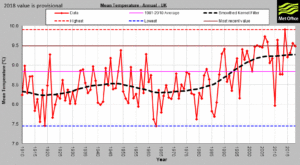
The Met Office has now published its data for 2018. We can expect plenty of claims about last year being the 7th warmest in the UK since records began (in 1910). Or that all of the ten warmest years have occurred this century.

The real significance of these latest numbers, however, is that they continue to confirm that UK temperatures stopped rising more than a decade ago, after a step up during the 1990s.


https://www.metoffice.gov.uk/climate/uk/summaries/actualmonthly…


Sea level oscillations in Japan and China since the start of the 20th century and consequences for coastal management – Part 1: Japan Author links open overlay panel

by Albert Parker, March 1, 2019 in Ocean&CoastalManagement


Highlights
• Japan has strong quasi-20 and quasi-60 years low frequencies sea level fluctuations.
• These periodicities translate in specific length requirements of tide gauge records.
• 1894/1906 to present, there is no sea level acceleration in the 5 long-term stations.
• Those not affected by crustal movement (4 of 5) do not even show a rising trend.
Proper consideration of the natural oscillations should inform coastal planning.

See also here

Global-scale evaluation of role of soil minerals in carbon storage

by U. of California – Santa Barbara, January 2, 2019 in ScienceDaily


“We’ve known for quite a long time that the carbon stored on minerals is the carbon that sticks around for a long time,” said Chadwick, co-author of the paper, “Climate-driven thresholds in reactive mineral retention of soil carbon at the global scale,” published in the journal Nature Climate Change. How much carbon the soil can take and how much it can keep, he said, are dependent on factors including temperature and moisture.

“When plants photosynthesize, they draw carbon out of the atmosphere, then they die and their organic matter is incorporated in the soil,” Chadwick explained. “Bacteria decompose that organic matter, releasing carbon that can either go right back into the atmosphere as carbon dioxide or it can get held on the surface of soil minerals.”

..

Heads up Newfoundland & Labrador: polar bear season has begun

by Susan Crockford, January 2, 2019 in PolarBearScience


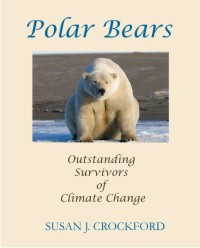
There is now enough sea ice off southern Labrador and the northern tip of Newfoundland for Davis Strait polar bears to come ashore looking for food. Baby seals won’t be available for months yet. And since winter is the lean season for these bears, some may seek food sources onshore. The bears come down from the area of Hudson Strait and southern Baffin Island: as the sea ice expands south, so do the bears.


Can wind and solar replace fossil fuels?

by Richard Patton, January 1, 2019 in WUWT


Statements implying that wind and solar can provide 50% of the power to the grid are not difficult to find on the internet. For example, Andrew Cuomo announced that

“The Clean Energy Standard will require 50 percent of New York’s electricity to come from renewable energy sources like wind and solar by 2030…”

Considering that the wind is erratic, and the solar cells only put out full power 6 hours per day, it seems a remarkable statement. Can intermittent energy actually supply that much power?

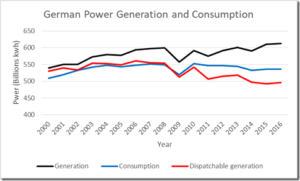
For some answers, we turn to Germany, which has some of the highest electric bills in the world as well as a high proportion of its electric power produced by wind and solar (19%). Let’s take a look at German consumption and generation.


Global Warming Win: Venezuelan Socialists On Track to Eliminate Their Nation’s Oil Industry

by Eric Worrall, December 31, 2018 in WUWT


Despite oil accounting for a whopping 90% of Venezuela’s export earnings, President Maduro, a fervent supporter of the Paris Agreement, has courageously put principle before profits by implementing his version of a new green deal. Maduro has eliminated the capitalist exploiters from his nation’s oil industry, and replaced them with loyal army officers who are rapidly dismantling the infrastructure left behind by the capitalists.

Read more: https://www.businessinsider.com/r-special-report-oil-output-goes-awol-in-venezuela-as-soldiers-run-pdvsa-2018-12/

TOP 12 DEBUNKED CLIMATE SCARES OF 2018

by GWPF, December 31, 2018


January 2018:  Worst-case global warming scenarios not credible: Study

PARIS (AFP) – Earth’s surface will almost certainly not warm up four or five degrees Celsius by 2100, according to a study released Wednesday (Jan 17) which, if correct, voids worst-case UN climate change predictions.

A revised calculation of how greenhouse gases drive up the planet’s temperature reduces the range of possible end-of-century outcomes by more than half, researchers said in the report, published in the journal Nature.

February:  ‘Sinking’ Pacific nation Tuvalu is actually getting bigger, new research reveals

The Pacific nation of Tuvalu — long seen as a prime candidate to disappear as climate change forces up sea levels — is actually growing in size, new research shows.

A University of Auckland study examined changes in the geography of Tuvalu’s nine atolls and 101 reef islands between 1971 and 2014, using aerial photographs and satellite imagery.

It found eight of the atolls and almost three-quarters of the islands grew during the study period, lifting Tuvalu’s total land area by 2.9 percent, even though sea levels in the country rose at twice the global average.

 March …. April… etc.

China Ignores Paris Climate Accord As CO2 Emissions Rapidly Rise

by Chriss Street, December 31, 2018 in ClimateChange Dispatch


Despite being lauded by President Obama for signing the Paris UN Climate Change Accords, China is still rapidly expanding greenhouse gas emissions.

President Obama and China’s President Xi Jinping issued a ‘U.S.-China Joint Presidential Statement on Climate Change’on March 31, 2016 stating that both nations were signing the Paris Accords and would take further “concrete steps” to “use public resources to finance and encourage the transition toward low carbon technologies as a priority.”

Arctic Ice Volume Shames Climate Experts …Antarctic Stations Show Cooling, Not Warming

by P. Gosselin, December 28, 2018 in NoTricksZone


By Kirye in Tokyo

We constantly hear from the untrustworthy media how polar ice is melting rapidly – due to human-induced global warming.

But when we look at the real data, we understand why audiences worldwide increasing distrust the mainstream media and their constant stream of doomsday reports, which they uncritically produce.

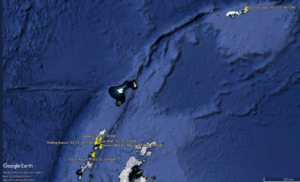
Recently I looked at some island stations near Antarctic, a continent where we are told melting ice will lead to many meters of sea level rise if we continue emitting CO2 into the atmosphere business as usual. These stations I examined are:

Base Arturo P
Bellingshause
Centro Met.An, Marsh
Base Orcadas
Great Wall
Jubany

hese six stations in the South Shetland Islands or the South Orkney Islands (located in the Antarctic Ocean) have even seen a slight cooling trend for decades.

Why all you’ve been told about these polar bears could be WRONG

by David Rose, December 30, 2018 in DailyMail


Animals driven to the edge of their natural habitat by shrinking ice have become one of the defining images of climate change, but Inuits who know the predators have a very different story
  • Aaron Gibbons, 31, was mauled to death by a polar bear earlier this year 
  • Inuit leaders want to be allowed to increase the amount of bears they kill
  • Climate change activists say bears are in decline, due to global warming
  • But locals say polar bears are adapting and are perfectly able to breed

Going Nowhere Fast on Climate, Year After Year

by Paul Bledsoe, December 2018 in TheNewYorkTimes


Three decades after a top climate scientist warned Congress of the dangers of global warming, greenhouse gas emissions keep rising and so do global temperatures.

Thirty years ago, a NASA scientist, James Hansen, told lawmakers at a Senate hearing that “global warming is now large enough that we can ascribe with a high degree of confidence a cause-and-effect relationship with the greenhouse effect.” He added that there “is only 1 percent chance of accidental warming of this magnitude.”

By that, he meant that humans were responsible.

His testimony made headlines around the United States and the world. But in the time since, greenhouse gas emissions, the global temperature average and cost of climate-related heat, wildfires, droughts, flooding and hurricanes have continued to rise.