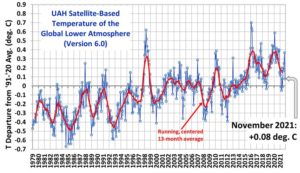
The Version 6.0 global average lower tropospheric temperature (LT) anomaly for November 2021 was +0.08 deg. C, down substantially from the October 2021 value of +0.37 deg. C.
Perhaps the last bear leaving Cape Churchill for the sea ice, 4 December 2021.
Moreover, considering that 2021 fall ice formation for the Arctic in general is well ahead of 2016 (and every year since, except 2018), it’s hard to see why human-caused global warming caused by ever-increasing CO2 emissions explains the slow freeze-up of Hudson Bay. Timing of Hudson Bay freeze-up has always been highly variable from one year to the next (Castro de la Guardia et al. 2017: Fig. 3, copied below). The average freeze-up date in the 1980s was 16 November ± 5 days, while from 2005-2015 this had shifted about a week to 24 November ± 8 days (Castro de la Guardia et al. 2017:230). This year freeze-up was later than usual but last year and the three years before that the ice froze as early as it did in the 1980s. Cue the zombie apocalypse.
Until recently, human CO2 emissions were responsible for ~10% of the variance in year-to-year CO2 growth rate. But a new analysis says human CO2 emissions have been slightly declining for the last decade. So 0% responsible, apparently.
CO2 emissions derived from human activity (fossil fuel combustion and land use changes) only account for about +0.1 to 0.3 PgC/yr of the annual change in CO2 concentration. This is about “10% of the variance (σ²) of the CO2 growth rate” (Wang et al., 2013).
During an exchange with French parliamentarians this week, the EU Commission vice-president in charge of the Green Deal, Frans Timmermans, said Brussels “will support, sustain and assist those member states that make this choice” of using nuclear power. EURACTIV France reports.
Timmermans, who was speaking on Wednesday (8 December) to the National Assembly’s committees on European Affairs and Sustainable Development, promised an inclusive and ambitious ecological transition that leaves no one behind.
They discussed the work of the European Commission on various issues related to the ecological transition, ranging from the carbon market to hydrogen, the evolution of the automotive sector, nuclear power in the green taxonomy and the timetable for the Fit for 55 package.
“We know that there will be a lot of negotiating to do [by the European Commission],” said Laurence Maillard Méhaignerie, chair of the French parliament’s Committee on Sustainable Development and Regional Planning.
“It is also a work of conviction, because, in the end, it is the economic models and value chains that need to be reviewed, the lifestyles and jobs that are also profoundly transformed” by the ecological transition.
This ecological transition and the measures that come with it would not only make individuals and companies feel excluded or suffer from the transition, but, as Renew Europe MEP Pascal Canfin warned a few months ago, could also create a new movement like the Gilets jaunes.
But according to Timmermans, “no one will be left behind, abandoned in this transition”.
“We must show through concrete steps (…) that we are concerned about social issues. The transition will be social or it will not be!” he added.
THANKFULLY we usually always get to hear the inconvenient and raw truth about taxpayer funded, unelected, bloated government bureaucracies when members eventually leave and are not subject to bullying and financial repercussions. Definitely no exception here…
46 enlightening statements by IPCC experts against the IPCC:
Dr Robert Balling: The IPCC notes that “No significant acceleration in the rate of sea level rise during the 20th century has been detected.” This did not appear in the IPCC Summary for Policymakers.
Dr Lucka Bogataj: “Rising levels of airborne carbon dioxide don’t cause global temperatures to rise…. temperature changed first and some 700 years later a change in aerial content of carbon dioxide followed.”
Dr John Christy: “Little known to the public is the fact that most of the scientists involved with the IPCC do not agree that global warming is occurring. Its findings have been consistently misrepresented and/or politicized with each succeeding report.”
Dr Rosa Compagnucci: “Humans have only contributed a few tenths of a degree to warming on Earth. Solar activity is a key driver of climate.”
Dr Richard Courtney: “The empirical evidence strongly indicates that the anthropogenic global warming hypothesis is wrong.”
Dr Judith Curry: “I’m not going to just spout off and endorse the IPCC because I don’t have confidence in the process.”
Dr Robert Davis: “Global temperatures have not been changing as state of the art climate models predicted they would. Not a single mention of satellite temperature observations appears in the IPCC Summary for Policymakers.”
Dr Willem de Lange: “In 1996 the IPCC listed me as one of approximately 3000 “scientists” who agreed that there was a discernible human influence on climate. I didn’t. There is no evidence to support the hypothesis that runaway catastrophic climate change is due to human activities.”
Dr Chris de Freitas: “Government decision-makers should have heard by now that the basis for the long-standing claim that carbon dioxide is a major driver of global climate is being questioned; along with it the hitherto assumed need for costly measures to restrict carbon dioxide emissions. If they have not heard, it is because of the din of global warming hysteria that relies on the logical fallacy of ‘argument from ignorance’ and predictions of computer models.”
Dr Oliver Frauenfeld: “Much more progress is necessary regarding our current understanding of climate and our abilities to model it.”
Dr Peter Dietze: “Using a flawed eddy diffusion model, the IPCC has grossly underestimated the future oceanic carbon dioxide uptake.”
Dr John Everett: “It is time for a reality check. The oceans and coastal zones have been far warmer and colder than is projected in the present scenarios of climate change. I have reviewed the IPCC and more recent scientific literature and believe that there is not a problem with increased acidification, even up to the unlikely levels in the most-used IPCC scenarios.”
Dr Eigil Friis-Christensen: “The IPCC refused to consider the sun’s effect on the Earth’s climate as a topic worthy of investigation. The IPCC conceived its task only as investigating potential human causes of climate change.”
Dr Lee Gerhard: “I never fully accepted or denied the anthropogenic global warming concept until the furore started after NASA’s James Hansen’s wild claims in the late 1980s. I went to the [scientific] literature to study the basis of the claim, starting with first principles. My studies then led me to believe that the claims were false.”
Dr Indur Goklany: “Climate change is unlikely to be the world’s most important environmental problem of the 21st century. There is no signal in the mortality data to indicate increases in the overall frequencies or severities of extreme weather events, despite large increases in the population at risk.”
Dr Vincent Gray: “The [IPCC] climate change statement is an orchestrated litany of lies.”
Dr Mike Hulme: “Claims such as ‘2500 of the world’s leading scientists have reached a consensus that human activities are having a significant influence on the climate’ are disingenuous … The actual number of scientists who backed that claim was only a few dozen.”
Dr Kiminori Itoh: “There are many factors which cause climate change. Considering only greenhouse gases is nonsense and harmful.”
Dr Yuri Izrael: “There is no proven link between human activity and global warming. I think the panic over global warming is totally unjustified. There is no serious threat to the climate.”
Dr Steven Japar: “Temperature measurements show that the climate model-predicted mid-troposphere hot zone is non-existent. This is more than sufficient to invalidate global climate models and projections made with them.”
Dr Georg Kaser: “This number [of receding glaciers reported by the IPCC] is not just a little bit wrong, it is far out by any order of magnitude … It is so wrong that it is not even worth discussing.”
Dr Aynsley Kellow: “I’m not holding my breath for criticism to be taken on board, which underscores a fault in the whole peer review process for the IPCC: there is no chance of a chapter [of the IPCC report] ever being rejected for publication, no matter how flawed it might be.”
Dr Madhav Khandekar: “I have carefully analysed adverse impacts of climate change as projected by the IPCC and have discounted these claims as exaggerated and lacking any supporting evidence.”
Dr Hans Labohm: “The alarmist passages in the IPCC Summary for Policymakers have been skewed through an elaborate and sophisticated process of spin-doctoring.”
Dr Andrew Lacis: “There is no scientific merit to be found in the Executive Summary. The presentation sounds like something put together by Greenpeace activists and their legal department.”
Dr Chris Landsea: “I cannot in good faith continue to contribute to a process that I view as both being motivated by pre-conceived agendas and being scientifically unsound.”
Dr Richard Lindzen: “The IPCC process is driven by politics rather than science. It uses summaries to misrepresent what scientists say and exploits public ignorance.”
Dr Harry Lins: “Surface temperature changes over the past century have been episodic and modest and there has been no net global warming for over a decade now. The case for alarm regarding climate change is grossly overstated.”
Dr Philip Lloyd: “I am doing a detailed assessment of the IPCC reports and the Summaries for Policy Makers, identifying the way in which the Summaries have distorted the science. I have found examples of a summary saying precisely the opposite of what the scientists said.”
Dr Martin Manning: “Some government delegates influencing the IPCC Summary for Policymakers misrepresent or contradict the lead authors.”
Steven McIntyre: “The many references in the popular media to a ‘consensus of thousands of scientists’ are both a great exaggeration and also misleading.”
Dr Patrick Michaels: “The rates of warming, on multiple time scales, have now invalidated the suite of IPCC climate models. No, the science is not settled.”
Dr Nils-Axel Morner: “If you go around the globe, you find no sea level rise anywhere.”
Dr Johannes Oerlemans: “The IPCC has become too political. Many scientists have not been able to resist the siren call of fame, research funding and meetings in exotic places that awaits them if they are willing to compromise scientific principles and integrity in support of the man-made global-warming doctrine.”
Dr Roger Pielke: “All of my comments were ignored without even a rebuttal. At that point, I concluded that the IPCC Reports were actually intended to be advocacy documents designed to produce particular policy actions, but not a true and honest assessment of the understanding of the climate system.”
Dr Paul Reiter: “As far as the science being ‘settled,’ I think that is an obscenity. The fact is the science is being distorted by people who are not scientists.”
Dr Murry Salby: “I have an involuntary gag reflex whenever someone says the science is settled. Anyone who thinks the science is settled on this topic is in fantasia.”
Dr Tom Segalstad: “The IPCC global warming model is not supported by the scientific data.”
Dr Fred Singer: “Isn’t it remarkable that the Policymakers Summary of the IPCC report avoids mentioning the satellite data altogether, or even the existence of satellites — probably because the data show a slight cooling over the last 18 years, in direct contradiction of the calculations from climate models?”
Dr Hajo Smit: “There is clear cut solar-climate coupling and a very strong natural variability of climate on all historical time scales. Currently I hardly believe anymore that there is any relevant relationship between human CO2 emissions and climate change.”
Dr Richard Tol: “The IPCC attracted more people with political rather than academic motives. In AR4, green activists held key positions in the IPCC and they succeeded in excluding or neutralising opposite voices.”
Dr Tom Tripp: “There is so much of a natural variability in weather it makes it difficult to come to a scientifically valid conclusion that global warming is man made.”
Dr Gerd-Rainer Weber: “Most of the extremist views about climate change have little or no scientific basis.”
Dr David Wojick: “The public is not well served by this constant drumbeat of alarms fed by computer models manipulated by advocates.”
Dr Miklos Zagoni: “I am positively convinced that the anthropogenic global warming theory is wrong.”
Dr Eduardo Zorita: “Editors, reviewers and authors of alternative studies, analysis, interpretations, even based on the same data we have at our disposal, have been bullied and subtly blackmailed.”
Dr Lucka Bogataj (Kajfež Bogataj Lučka) The joint recipient of the Nobel Peace Prize in 2007, she is one of Slovenia’s pioneers in researching the impact of climate change, and she regularly informs the general public of her findings.She is a full professor and teaches at the Biotechnical Faculty, while also lecturing at the Faculty of Mathematics and Physics and at the Faculty of Architecture. More…
The recent UN climate summit in Glasgow was predictably branded our “last chance” to tackle the “climate catastrophe” and “save humanity.” Like many others, US climate envoy John Kerry warned us that we have only nine years left to avert most of “catastrophic” global warming.
But almost every climate summit has been branded the last chance. Setting artificial deadlines to get attention is one of the most common environmental tactics. We have actually been told for the past half-century that time has just about run out.
This message is not only spectacularly wrong but leads to panic and poor policies.
Two years ago, Britain’s Prince Charles announced that we had just 18 months left to fix climate change. This wasn’t his first attempt at deadline-setting. Ten years earlier, he told an audience that he “had calculated that we have just 96 months left to save the world.”
It is an interesting read but not because it presents good advice to the scientific community. Rather, it presents the case that climate and ice models, which are used to make projections, are not up to the task. While those who program climate models have been trained in what we know about the basic physics involved in the biggest sea level rise issue – ice sheet dynamics – the actual projections by those models depend on parameters that are loose guesses about things we don’t know. As a result, Bassis says “…recent studies using climate and ice sheet models are, more and more often, coming to very different conclusions about future rates of sea level rise and even about the sensitivity of ice sheets to future warming…” and because of that, he tells us:
“Large discrepancies among model projections of long-term sea level rise have spawned calls among the scientific community for scientists to work on reducing uncertainty. However, focusing on uncertainty is a trap we must avoid. Instead, we should focus on the adaptation decisions we can already make on the basis of current models and communicating and building confidence in models for longer-term decisions.”
…
…
Kip Hansen is an expert on sea level and sea-level rise. Prolific author of numerous articles on the subjects. WUWT lists 445 commentaries and articles.
He has spent much of his adult life at sea, first as an officer on a merchant ship, and later as a USCG-licensed captain in the Caribbean, where he sailed with his wife while doing humanitarian work (mostly Dominican Republic).
He is a proud member of the CO2 Coalition.
This commentary was first published by the CO2 Coalition, December 3, 2021
by P. Homewood, Nov 27, 2021 in NotaLotofPeopleKnowThat
A new study throws doubt on the theory that Arctic warming is man made.
The Arctic Ocean has been warming since the onset of the 20th century, decades earlier than instrument observations would suggest, according to new research.
The study, published Wednesday in the journal Science Advances, found that the expansion of warm Atlantic Ocean water flowing into the Arctic, a phenomenon known as “Atlantification,” has caused Arctic water temperature in the region studied to increase by around 2 degrees Celsius since 1900.
Francesco Muschitiello, an author on the study and assistant professor of geography at the University of Cambridge, said the findings were worrisome because the early warming suggests there might be a flaw in the models scientists use to predict how the climate will change.
New Brunswick, N.J. (Dec. 1, 2021) – Using artificial intelligence techniques, an international team that included Rutgers-New Brunswick researchers have traced the evolution of coccolithophores, an ocean-dwelling phytoplankton group, over 2.8 million years.
Their findings, published this week in the journal Nature, reveal new evidence that evolutionary cycles in a marine phytoplankton group are related to changes in tropical seasonality, shedding light on the link between biological evolution and climate change.
Coccolithophores are abundant single-celled organisms that surround themselves with microscopic plates made of calcium carbonate, called coccoliths. Due to their photosynthetic activity, mineral production and widespread abundance throughout the world’s oceans, coccolithophores play an important role in the carbon cycle.
Scientists have long thought that climate changes’ effects on plants, animals and other organisms occur in cycles, which are reversed when each cycle is completed, thus erasing any small evolutionary changes during each cycle. In contrast, evolutionary changes, as known from the fossil record, are non-cyclic trends that occur over millions of years.
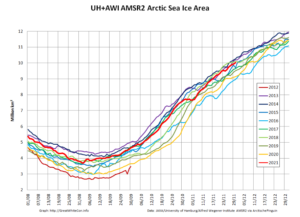
Christmas is coming. Santa’s secret summer swimming pool has frozen over. The time has come for a new monthly Arctic update.
The JAXA/ADS/ViSHOP web site is undergoing maintenance for a week, so let’s start the festive season with a look at high resolution AMSR2 area and extent:
On the Finnmark plateau, between Kautokeino and Karasjok, temperatures dropped down to -35°C on Sunday. The forecast for the coming week shows a temperature anomaly for the last days of November of 10°C below the reference period 1961-1990, the Swedish Meteorological and Hydrological Institute informs.
Coldest out is Nikkaluokta near Gällivare in Norrbotten with -36°C.
In times of climate change, the current freeze comes in sharp contrast to last fall, when meteorologists reported about the hottest October and early November ever measured, with an average of 6,7°C above normal across the Arctic.
Cold weather even sweeps the coast of northernmost Norway where the Arctic waters are kept ice-free by the warm Gulf Stream. In Kirkenes, on the border to Russia, the thermometer read -25°C on Saturday outside the Barents Observer’s office.
…
On the Kola Peninsula, Sunday November 28 came with temperatures from -18°C to -30°C the news online Severpost reported.
Further east in the Russian Arctic, quickly accumulating sea-ice on the Northern Sea Route has created a critical situation as a number of ships have been trapped in thick sea-ice for several weeks.
Data sources like the National Snow and Ice Data Center show global sea ice has been” drastically decreasing for a long time” and so we need to panic and overhaul the entire carbon economy. We hear this daily in the media.
Surprising global sea ice area findings
But Zoe has analyzed what she characterizes as a “very legitimate source” of data from NASA, (here, or here). And according to her findings, the data from these sources suggest global sea ice loss is not as dramatic as some institutes would like us to believe it is. In fact there ‘s been a gain!
Zoe plotted the data going back 40 years, from 1982 to 2021, the “Global Sea Ice Area Fraction”, which “is a proportion of the entire Earth’s surface that is ice over water.”
…
…
“As you can see, about 3.6% (on average) of our planet’s area is covered in ice over water,” reports Zoe. “In the last 40 years, ice over water has INCREASED, and not decreased, as popularly claimed.”
According to Zoe, the observed increase is equivalent to ~30,600 km², or “roughly the size of Belgium”.
A new study suggests CO2 molecules have little consequential impact affecting outgoing radiation, and that climate models attribute global temperature effects to CO2 that are fundamentally erroneous.
They assesses the role of CO2 molecules in the standard atmosphere and assert “we have a contradiction with the results of climatological models in the analysis of the Earth’s greenhouse effect.”
Key points from the paper include the following:
1. Climate model calculations of CO2’s impact on global temperatures are in error by a factor of 5 as a result of “ignoring, in climatological models, the Kirchhoff law” which says radiators are “simultaneously the absorbers.”
2. Change in the concentration of an optically active atmospheric component (like CO2) “would not lead to change in the outgoing radiative flux.”
3. CO2 molecules “are not the main radiator of the atmosphere.” Water vapor molecules are, and thus they “may be responsible for the observed heating of the Earth.”
Two icebreakers are on the way to rescue ice-locked ships on Northern Sea Route (snip)
District authorities in the Russian Far East have decided to commission two icebreakers to aid the vessels currently ice-locked in the East Siberian Sea. (snip)
[T]he South Pole also just witnessed a historically cold winter. As reported last month: “Between the months of April and September, the South Pole averaged a temperature of -61.1C (-78F). Simply put, this was the region’s coldest 6-month spell ever recorded, and it comfortably usurped the previous coldest ‘coreless winter‘ on record: the -60.6C (-77F) from 1976 (solar minimum of weak cycle 20).”
In fact, it turns out that, according to a study released a week ago:
PALEOCLIMATE DATA INDICATE THERE WAS LESS ARCTIC SEA ICE DURING THE PRE-INDUSTRIAL PERIOD THAN IN MODERN TIMES, OR WHEN CO2 CONCENTRATIONS WERE 100 PPM LOWER THAN TODAY (280 VS. 380 PPM).
Scientists (Diamond et al., 2021) assert that during the 18th and 19th centuries Arctic sea ice extent minimum (September) values averaged 5.54 million km².
Die kalte Sonne reports on a new aerosol study by Liu et al.
The results are a major blow to the high greenhouse-gas climate sensitivity modelers.
IPCC scientists have a favorite wild card they often use to explain serious model discrepancies: aerosols. Mysterious cooling events in the past are often explained away by aerosols from major volcanic eruptions, for example. They act to filter out sunlight.
ccording to IPCC climate models, the mean global temperature should have risen by 1.5°C since 1850 due to the higher CO2 concentrations. But best estimates show that it has instead risen by only 1.1°C. So what about the missing 0.4°C?
Naturally, the missing 0.4°C of warming since 1850 gets explained by the higher 20th century aerosol levels in the atmosphere – due to the burning of fossil fuels. Air pollution by man over the course of the late 19th century and entire 20th century are said to have dimmed the earth, and thus this explains the 0.4°C less warming.
Surprise: global aerosol emissions have been flat over past 250 years
But now results by a new study appearing in the journal Science Advances by Liu et al tells us that the forcing by aerosols had to have been overestimated by climate modelers. IPCC modelers insisted that 20th century aerosol concentrations were higher than during the pre-industrial times, and this is what kept the climate from warming by 1.5°C.
According to the scientists led by Liu, however, atmospheric aerosols in the preindustrial times were just as high as they were just recently. They were in fact more or less constant over the past 250 years. No change means it could not have been aerosols putting the brakes on temperature rise:
…
…
That’s a real embarrassment for the IPCC modelers. It means CO2 climate sensitivity has been overestimated.
A new study suggests CO2 molecules have little consequential impact affecting outgoing radiation, and that climate models attribute global temperature effects to CO2 that are fundamentally erroneous.
They assesses the role of CO2 molecules in the standard atmosphere and assert “we have a contradiction with the results of climatological models in the analysis of the Earth’s greenhouse effect.”
Key points from the paper include the following:
1. Climate model calculations of CO2’s impact on global temperatures are in error by a factor of 5 as a result of “ignoring, in climatological models, the Kirchhoff law” which says radiators are “simultaneously the absorbers.”
2. Change in the concentration of an optically active atmospheric component (like CO2) “would not lead to change in the outgoing radiative flux.”
3. CO2 molecules “are not the main radiator of the atmosphere.” Water vapor molecules are, and thus they “may be responsible for the observed heating of the Earth.”
Earth’s atmosphere reacted in surprising ways to the lowering of emissions during the pandemic, showing how closely climate warming and air pollution are linked.
The COVID-19 pandemic and resulting limitations on travel and other economic sectors by countries around the globe drastically decreased air pollution and greenhouse gas emissions within just a few weeks. That sudden change gave scientists an unprecedented view of results that would take regulations years to achieve.
A comprehensive new survey of the effects of the pandemic on the atmosphere, using satellite data from NASA and other international space agencies, reveals some unexpected findings. The study also offers insights into addressing the dual threats of climate warming and air pollution. “We’re past the point where we can think of these as two separate problems,” said Joshua Laughner, lead author of the new study and a postdoctoral fellow at Caltech in Pasadena, California. “To understand what is driving changes to the atmosphere, we must consider how air quality and climate influence each other.”
Published Nov. 9 in the Proceedings of the National Academy of Sciences, the paper grew from a workshop sponsored by Caltech’s W.M. Keck Institute for Space Studies, led by scientists at that institution and at the Jet Propulsion Laboratory in Southern California, which is managed by Caltech. Participants from about 20 U.S. and international universities, federal and state agencies, and laboratories pinpointed four atmospheric components for in-depth study: the two most important greenhouse gases, carbon dioxide and methane; and two air pollutants, nitrogen oxides and microscopic nitrate particles.
Carbon Dioxide
The most surprising result, the authors noted, is that while carbon dioxide (CO2) emissions fell by 5.4% in 2020, the amount of CO2 in the atmosphere continued to grow at about the same rate as in preceding years. “During previous socioeconomic disruptions, like the 1973 oil shortage, you could immediately see a change in the growth rate of CO2,” said David Schimel, head of JPL’s carbon group and a co-author of the study. “We all expected to see it this time, too.”
Using data from NASA’s Orbiting Carbon Observatory-2 satellite launched in 2014 and the NASA Goddard Earth Observing System atmospheric model, the researchers identified several reasons for this result. First, while the 5.4% drop in emissions was significant, the growth in atmospheric concentrations was within the normal range of year-to-year variation caused by natural processes. Also, the ocean didn’t absorb as much CO2 from the atmosphere as it has in recent years – probably in an unexpectedly rapid response to the reduced pressure of CO2 in the air at the ocean’s surface.
If you have been following the news at all for the past several weeks, you know that the latest gigantic UN “climate” conference, going by the name COP (Conference of Parties) 26, has been taking place in Glasgow, Scotland. Mercifully, it ended yesterday, Saturday, November 13. All of those hundreds of private jets have now flown home.
Every time one of these UN confabs takes place, you have to hold your breath fearing that some tremendously damaging result will emerge. But, reviewing the final outcome of this latest conference, my comment is that we climate realists have gotten about the best result we could have hoped for. If you read some mainstream news sources, you may well get exactly the opposite impression. So let me give my reasoning.
At this point, there are basically two paths that the world might take in the movement toward so-called “decarbonization” of the energy system:
Path 1 is the path of strict world socialism. Of course, this is the preferred path of climate activists and UN bureaucrats. In this scenario, the entire world is forced, through binding international agreements, into an energy straightjacket, mandating reduction and then elimination of the use of fossil fuels within two or three decades at most.
Path 2 is what happens when there are no compacts with material binding worldwide energy restrictions. On this path, everybody talks a good game about decarbonization but, lacking meaningful binding agreements, most of the countries, with most of the population, continue to pursue whatever energy system is most reliable and cost effective. In practice that almost inevitably means fossil fuels for most to all applications. Meanwhile, a small number of wealthy, small-population jurisdictions that somehow become obsessed with the perceived virtue of eliminating fossil fuels — likely examples being Germany, California, New York, the UK, and perhaps South Australia (aggregating about 2-3% of world population) — will push the limits of decarbonization and intermittent renewable energy sources.
They will then be the guinea pigs for the rest of the world to find out whether a decarbonized energy system can be made to work, and at what cost.
Data from the Danish Polar Portal shows Greenland ice melt slowing significantly over past 10 years. Increasingly rapid mass loss is a myth.
German climate site Die kalte Sonne here looks at whether Greenland is really melting faster or not in its 78th climate and energy video (3rd segment).
Satellite measurement has allowed accurate measurements over the years and so reliable trends are detectable.
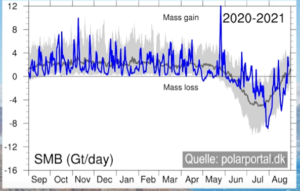
Greenland has added mass since July
Over the past year, since September 2020, Greenland has seen a number of heavy snowfalls, as depicted by the solid blue line in the chart by the Danish polarportal.dk:
by P. Homewood, Nov 15, 2021 in NotaLot ofPeopleKnowThat
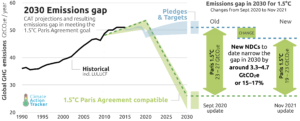
For the last few weeks, the BBC has been regularly publishing the above graph from Climate Action Tracker, showing the extra emission reductions resulting from the new NDCs, National Plans, submitted for COP26.
Essentially they estimate a figure of 3.3 to 4.7 GtCO2e for all GHGs. Significantly this means that they will still be much higher than 2010 in 2030. According to the science, they need to be cut by 45% from 2010 levels to stay on track for 1.5C
Curiously however in the last few days, the BBC has dropped the above graph, and replaced with an ostensibly fake one, which claims that the new COP26 pledges will cut emissions by 10.5 GtCO2e, more than double the Climate Tracker numbers, bringing 2030 levels down to 90% of 2010 ones.
A hugely funny thing happened on the outskirts of COP 26. The press seems to have missed this huge news, but the Paris Accord’s goal of keeping global warming below 2 degrees has now been met. Well okay, it has just been promised by politicians. But if you take political promises seriously, as they do in COP-world, the end is here.
Specifically, several independent green analyses find that the various commitments made at COP 26 would limit global warming to just 1.8 or so degrees. The Paris target is “less than 2 degrees” so there you have it. Target met!
Where are the green headlines screaming “Planet saved”? Where are the green marches of celebration instead of protest?
The funny part is that this paper success raises big problems for the climate activist movement. All that remains is to makes sure the promises are kept. But these promises are for dates that range from from 2030 to way out in 2060 or 2070. There is almost nothing to do now as far as implementation is concerned. What are all these activists to do?
There are some technical things that need doing, at some point. In particular these big promises are not part of the actual COP. The COP is the Conference of the Parties to the UN Framework Convention on Climate Change, which includes over 200 countries, each of which has a veto.
None of these grand promises, even those made by over 100 countries like the methane reduction goal for 2030, are part of the official COP. In fact the thousands of national COP negotiators are reportedly “sour” because the grand announcements got all the press.
The actions of the COP are highly formal. What has to happen now is that all of these promises get incorporated into the official Nationally Determined Contribution (NDC) for each country that is a member of the Paris Accord. Even here the next round of updated NDCs is not due until 2025. So in a very real sense there is nothing urgent to do now, even though the Planet is saved (on paper).
Some of the global activists might simply reject the finding that the Paris target has been reached. This may be tough because one of these Earth saving analyses was done by the prestigious (to alarmists) International Energy Agency. IEA got a low 1.8 degrees of warming if all the agreements and public promises are met by every country.
Die hard alarmists might argue that the target is 1.5 degrees, not 1.8. But China has said officially that 1.5 is not the Paris Accord target and if people want it the entire Accord will have to be renegotiated.
There are some relatively immediate issues on the COP table that relate to these promises. One is finally establishing the global emissions trading system. Many of the “rich” country NDCs depend on trading in order to get to so-called net zero emissions. They need to buy indulgences for their air transport and shipping, which cannot be electrified.
Then there is the huge unresolved issue called finance. Many of the developing country NDCs are contingent on the rich countries paying the huge cost of getting to net zero, or even for hitting lesser targets like the 30% methane cut by 2030. The supposedly agreed on funding of $100 billion a year from 2020 through 2024 has yet to appear. Developing countries, led by an alliance of African leaders, is calling for a trillion a year beginning 2025, but that target too is a long way off.
Where does the climate alarmist movement go from here? Greta Thunberg in her new newly profane persona has asked of COP 26 “What the F are they doing in there.” The COPers can now answer “Saving the planet, what are you doing out there.”
Of course it is all just political promises. Many are economically impossible, some physically so. At this point that is not the point. The alarmist movement has the serious problem of apparent success. How they handle it will be fun to watch.
The Glasgow climate conference has been a three-ring circus of doomsday clowns, all warning of ever increasing extreme weather events. But as hurricane trends have shown, most of it is baseless hysteria.
Pacific typhoons trending downward
As the 2021 tropical cyclone season for the northern hemisphere approaches its end, the Japan Meteorological Agency (JMA) presents the latest data for Pacific typhoons — going back to 1951.
In my last post I plotted the NASA CO2 and the HadCRUT5 records from 1850 to 2020 and compared them. This was in response to a plot posted on twitter by Robert Rohde implying they correlated well. The two records appear to correlate because the resulting R2 is 0.87. The least square’s function used made the global temperature anomaly a function of the logarithm to the base 2 of the CO2 concentration (or ‘log2CO2‘). This means the temperature change was assumed to be linear with the doubling of the CO2concentration, a common assumption. The least squares (or ‘LS’) methodology assumes there is no error in the measurements of the CO2 concentration and all error resulting from the correlation (the residuals) resides in the HadCRUT5 global average surface temperature estimates.
In the comments to the previous post, it became clear that some readers understood the computed R2(often called the coefficient of determination), from LS, was artificially inflated because both X (log2CO2) and Y (HadCRUT5) were autocorrelated and increased with time. But a few did not understand this vital point. As most investors, engineers, and geoscientists know, two time series that are both autocorrelated and increase with time will almost always have an inflated R2. This is one type of “spurious correlation.” In other words, the high R2 does not necessarily mean the variables are related to one another. Autocorrelation is a big deal in time series analysis and in climate science, but too frequently ignored. To judge any correlation between CO2 and HadCRUT5 we must look for autocorrelation effects. The most tool used is the Durbin-Watson statistic.
The Durbin-Watson statistic tests the null hypothesis that the residuals from a LS regression are not autocorrelated against the alternative that they are. The statistic is a number between 0 and 4, a value of 2 indicates non-autocorrelation and a value < 2 suggests positive autocorrelation and a value >2 suggests negative autocorrelation. Since the computation of R2 assumes that each observation is independent of the others, we hope that we get a value of 2, that way the R2 is valid. If the regression residuals are autocorrelated and not random—that is normally distributed about the mean—the R2 is invalid and too high. In the statistical program R, this is done—using a linear fit—with only one statement, as shown below:
Argentina’s (Tixi Cave) present annual temperature is 13.8°C. It was 3.5°C (17.3°C), 1.7°C (15.5°C), 3°C (16.8°C), and 4.5°C (18.3°C) warmer than today 3496, 1656, 656, and 160 years before present, respectively. So ~1860 was 4.5°C warmer.
Glasgow, Scotland (CNN)After 11 days of climate talks that have included progress on protecting forests, phasing out coal and transitioning to electric cars, the future of our planet has boiled down to one key thing: who’s going to pay for the mess we’re in?
In what has been the fiercest opposition to the summit’s draft agreement published Wednesday, Bolivia’s chief negotiator Diego Pacheco said his country and 21 other allied nations — including major emitters like China, India and Saudi Arabia — would oppose the entire section on climate change mitigation.
…
La géologie, une science plus que passionnante … et diverse

is a professor of geography at Arizona State University, and the former director of its Office of Climatology. His research interests include climatology, global climate change, and geographic information systems. Balling has declared himself one of the scientists who oppose the consensus on global warming, arguing in a 2009 book that anthropogenic global warming “is indeed real, but relatively modest”, and maintaining that there is a publication bias in the scientific literature.