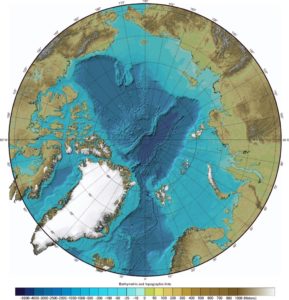
A la grande différence de l’Antarctique, l’Arctique est un océan entouré de plateaux continentaux (Fig. 2). L’océan ou bassin arctique est actuellement constitué par un double bassin, séparé une crête très importante, la ride Lomonosov : le sous-bassin canadien à croûte continentale amincie (3 600 m) et le sous-bassin eurasiatique à croûte océanique mince, de loin le plus profond (5000 m entre la crête Lomonosov et la ride océanique active de Gakkel). Il est entouré comme le long de l’Atlantique Nord par une plateforme continentale ennoyée, constituée de croûte continentale. Le bassin arctique d’abord marin et connecté au Proto-Atlantique au début du Jurassique (voir plus loin), est isolé depuis le Jurassique moyen et essentiellement de nature lacustre, modifiant le régime thermique océanique, amenant un contexte voisin du Glaciaire au Crétacé inférieur (au Valanginien in Dromart et al. 2003 ; Korte et al. 2015 ; Piskarev et al. 2018). Il ne se ré-ouvrira sur le bassin atlantique qu’à partir de l’Eocène, via l’ouverture du détroit de Fram. D’autre part le pôle magnétique terrestre (Nord) est resté sur le bassin arctique depuis le début du Jurassique, donc en position de déficit énergétique lié à l’obliquité de l’orbite terrestre.
…
Fig. 2 Image Gebco Arctique : L’océan ou bassin arctique est actuellement constitué par un double bassin, séparé une crête très importante, la ride Lomonossov (voir texte).
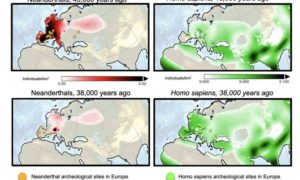
Climate scientists from the IBS Center for Climate Physics discover that, contrary to previously held beliefs, Neanderthal extinction was neither caused by abrupt glacial climate shifts, nor by interbreeding with Homo sapiens. According to new supercomputer model simulations, only competition between Neanderthals and Homo sapiens can explain the rapid demise of Neanderthals around 43 to 38 thousand years ago.
Neanderthals lived in Eurasia for at least 300,000 years. Then, around 43 to 38 thousand years ago they quickly disappeared off the face of the earth, leaving only weak genetic traces in present-day Homo sapiens populations. It is well established that their extinction coincided with a period of rapidly fluctuating climatic conditions, as well as with the arrival of Homo sapiens in Europe. However, determining which of these factors was the dominant cause, has remained one of the biggest challenges of evolutionary anthropology.
…
Figure 1: Computer simulations of population density of Neanderthals (left) and Homo sapiens (right)
by D.W. Euring, May 20, 2020 in PrincipiaScientificInternational
It became apparent from investigation of the Variability of the Gravitational Constant that Jupiter’s orbit is affecting the Sun’s surface temperature and driving the Sunspot Cycle which appear to be triggered at its Aphelion and suppressed at Perihelion.
Saturn has even greater eccentricity than Jupiter and it is noted that it was at Perihelion at the end of 1972 which seems to account for the Low Solar Maximum at that time and a particular dip after the main peak. So, whilst cycle periods are not influenced by Saturn, it does impact on their magnitude, and it seems likely that it will have augmented in 1957-58 as well as 1990.
by Bulgin et al., May 14, 2020 in Nature OPEN ACCESS
Abstract
Quantifying global trends and variability in sea surface temperature (SST) is of fundamental importance to understanding changes in the Earth’s climate. One approach to observing SST is via remote sensing. Here we use a 37-year gap-filled, daily-mean analysis of satellite SSTs to quantify SST trends, variability and persistence between 1981–2018. The global mean warming trend is 0.09 K per decade globally, with 95% of local trends being between −0.1 K and + 0.35 K. Excluding perennial sea-ice regions, the mean warming trend is 0.11 K per decade. After removing the long-term trend we calculate the SST power spectra over different time periods. The maximum variance in the SST power spectra in the equatorial Pacific is 1.9 K2 on 1–5 year timescales, dominated by ENSO processes. In western boundary currents characterised by an intense mesoscale activity, SST power on sub-annual timescales dominates, with a maximum variance of 4.9 K2. Persistence timescales tend to be shorter in the summer hemisphere due to the shallower mixed layer. The median short-term persistence length is 11–14 days, found over 71–79% of the global ocean area, with seasonal variations. The mean global correlation between monthly SST anomalies with a three-month time-lag is 0.35, with statistically significant correlations over 54.0% of the global oceans, and notably in the northern and equatorial Pacific, and the sub-polar gyre south of Greenland. At six months, the mean global SST anomaly correlation falls to 0.18. The satellite data record enables the detailed characterisation of temporal changes in SST over almost four decades.
These past few days have seen a violent worldwide volcanic uptick, sending us all further signs that the next Grand Solar Minimum is dawning.
HIMAWARI-8 (a Japanese weather satellite) recorded two HIGH-LEVEL eruptions on May 16, both occurring in Indonesia.
The first took place at Ibu –a relatively new volcano with only 3 notable eruptions; in 1911, 1998, and 2008– and was confirmed by the Volcanic Ash Advisory Center (VAAC) Darwin which warned of an ash plume rising to an estimated 45,000 ft (13.7 km).
The second high-level eruption took place just a few hours later at Semeru –a very active volcano with an eruptive history peppered with VEI 2s and 3s; the first coming in 1818, the most recent in 2014– and as with Ibu’s, Semeru’s eruption was picked up by both HIMAWARI-8 and the VAAC Darwin, with the latter confirming the generation of “a dark ash plume which reached an altitude of 46,000 ft (14 km).”
In addition, and as recently reported by VolcanoDiscovery.com, active lava flows remain active on the Semeru’s southeast flank, currently about 4,921 ft (1.5 km) long (as of the morning of May 18).
The global mean temperature in April 2020 was again significantly lower than in February and March, at 0.38°C above the average from 1981 to 2010. The average temperature increase on the globe from 1981 to February 2020 was 0.14°C per decade. The further development promises to be interesting, especially since a number of research institutes expect a higher probability of a cooling La Nina in the Pacific towards the end of the year. March’s solar activity was very low with a sunspot number of 1.5. Activity in April rose slightly to 5.4. The first sunspots of the new cycle are showing.
What causes the sun to have an 11-year cycle?
Since the Dessau pharmacist Heinrich Samuel Schwabe discovered in 1843 that the sunspots of the sun increase and decrease in an 11-year cycle, science has been puzzling over the reason why this cycle lasts 11 years and why the solar magnetic field also changes its polarity in this rhythm: the north pole becomes the south pole and vice versa.
In July last year, scientists at the Helmholtz Centre in Dresden Rossendorf made a little-noticed but exciting discovery. Every 11.07 years, the planets Venus, Earth and Jupiter are aligned quite precisely. At this point in time, their gravitational force acts jointly in one direction on the Sun.
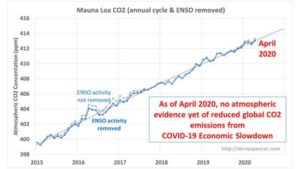
Summary:Atmospheric levels of carbon dioxide (CO2) continue to increase with no sign of the global economic slowdown in response to the spread of COVID-19. This is because the estimated reductions in CO2 emissions (around -11% globally during 2020) is too small a reduction to be noticed against a background of large natural variability. The reduction in economic activity would have to be 4 times larger than 11% to halt the rise in atmospheric CO2.
Changes in the atmospheric reservoir of CO2 occur when there is an imbalance between surface sources and sinks of CO2. While the global land and ocean areas emit approximately 30 times as much CO2 into the atmosphere as humans produce from burning of fossil fuels, they also absorb about an equal amount of CO2. This is the global carbon cycle, driven mostly by biological activity.
…
Fig. 2. Monthly CO2 data since 2015 from Mauna Loa, HI after the average seasonal cycle is statistically removed.
…
…
ADDENDUM: How much of a decrease in CO2 emissions would be required to stop the atmospheric rise in CO2?
UH researchers reveal largest and hottest shield volcano on Earth
Posted on May 13, 2020 by Marcie Grabowski
In a recently published study, researchers from the University of Hawai‘i at Mānoa School of Ocean and Earth Science and Technology revealed the largest and hottest shield volcano on Earth. A team of volcanologists and ocean explorers used several lines of evidence to determine Pūhāhonu, a volcano within the Papahānaumokuākea Marine National Monument, now holds this distinction.
Geoscientists and the public have long thought Mauna Loa, a culturally-significant and active shield volcano on the Big Island of Hawai‘i, was the largest volcano in the world. However, after surveying the ocean floor along the mostly submarine Hawaiian leeward volcano chain, chemically analyzing rocks in the UH Mānoa rock collection, and modeling the results of these studies, the research team came to a new conclusion. Pūhāhonu, meaning ‘turtle rising for breath’ in Hawaiian, is nearly twice as big as Mauna Loa.
“It has been proposed that hotspots that produce volcano chains like Hawai‘i undergo progressive cooling over 1-2 million years and then die,” said Michael Garcia, lead author of the study and retired professor of Earth Sciences at SOEST. “However, we have learned from this study that hotspots can undergo pulses of melt production. A small pulse created the Midway cluster of now extinct volcanoes and another, much bigger one created Pūhāhonu. This will rewrite the textbooks on how mantle plumes work.”
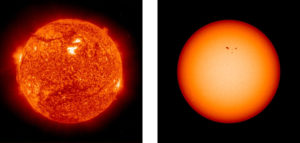
The lack of any sunspots suggests the current solar minimum is one of the ‘deepest’ in 100 years.
The sun has been reported to have a ‘very deep’ solar minimum with 100 days of 2020 not seeing any sunspots on its surface.
Astronomer Dr Tony Phillips says the current lack of sunspot counts suggests the current solar minimum is one of the ‘deepest’ of the past century.
A sunspot is an area of magnetic activity on the surface of the sun – also known as storms – and appear in areas of darkness. They play a huge part in the sun’s activity, including birthing solar flares and coronal mass ejections.
A solar minimum occurs when zero sunspots are spotted, but, before you start panicking and thinking this is a bad thing, solar minimums are all part of the sun’s cycle and occur every 11 years or so.
NASA first recorded no activity on the sun last summer and it is thought to have continued to be without sunspots ever since. Solar minimums usually consist of 12 months of little sunspot activity.
“The cause” of climate alarmism and forced energy transformation has been pushed backward by a very long overdue hard look at renewable energy as a mass substitute for mineral energies. Being dilute and intermittent, renewables have more bad secrets than any closet could hold. Small wonder; renewable energies chew up the earth’s surface and creatures in a way that leads to the joke:
Q. “When is an environmentalist not an environmentalist?” A. “When it comes to industrial wind turbines and solar farms.”
Moore’s Planet of the Humans all but ensures that DC-based Big Environmentalism will frontally reject biomass/biofuels, their loss-leader to try to prop up wind and solar as viable. Remove biomass from “green” portfolios and it gets a little skinnier for the business cronies.
And if Big Environmentalism loses wind, the supply-side ruse is over, and people will reconsider climate science given that the ‘cure’ is gone. Hence Michael Mann versus Michael Moore’s Planet of the Humans, the gist of Maxime Joselow’s “Michael Moore’s documentary irks climate scientists” (May 5, 2020).
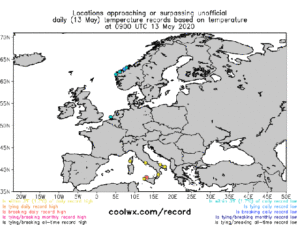
Parts of the UK and US have suffered their lowest May temperatures on record of late, according to data from filthy warm-mongers&partners-in-crime the Met Office and NOAA.
While the official li(n)e coming out of these agencies is that our World Is On Fire, thermometer stations the length and breadth of both Europe and North America are telling a rather different story.
Overnight Wednesday (May 13-14), the mercury in Katesbridge and Castlederg, N. Ireland, plummeted to an extra-duvet-grabbing -6.1C (21F) and -3.9C (25F), respectively, as a wave of brutal Arctic air rode anomalously-far south on the back on a meridional (wavy) jet stream flow.
Wednesday night followed what had been a record-chilly day — a minimum temperature of -5C (23F)was observed in Tulloch Bridge, Scotland.
The wave of record cold actually engulfed much of Northern Europe overnight Wednesday, as visible in coolwx.com‘s temperature animation:
Almost a full two months after the season officially ended, winter reared its ugly head in much of the United States over the weekend. A winter-type Polar Vortex has caused record cold and extremely late season snow from the Rockies to the Atlantic Ocean. What’s responsible for this late season cold? If you listen to climate alarmists, the answer is simple: global warming.
In the Northeast, higher elevation areas reported snowfalls of up to 10 inches over the weekend. New York City received a trace of snow on May 9, tying the city’s record for the latest snowfall. In Islip, New York, a town of the southern shore of Long Island, the month of May was officially snowier than the month of February. Mother’s Day celebrations across the Midwest and Northeast were ruined by cold and windy conditions in the regions. Near record cold temperatures were reported from the Dakotas stretching down Texas and across most of the eastern United States.
Short summary: scientists sought political relevance and allowed policy makers to put a big thumb on the scale of the scientific assessment of the attribution of climate change.
The importance of this book is reflected in its acknowledgements, in context of assistance and contributions from early leaders and participants in the IPCC:
This book would not have been possible without the documents obtained via Mike MacCracken and John Zillman. Their abiding interest in a true and accurate presentation of the facts prevented my research from being led astray. Many of those who participated in the events here described gave generously of their time in responding to my enquiries, they include Ben Santer, Tim Barnett, Tom Wigley, John Houghton, Fred Singer, John Mitchell, Pat Michaels . . . and many more.
Read the whole book, it is well worth reading. The focus of my summary of the book is on Chapters 8-16 in context of the theme of ‘detection and attribution’, ‘policy cart in front of the scientific horse’ and ‘manufacturing consensus’. Annotated excerpts from the book are provided below.
by P. Homewood, May 10, 2020 in NotaLotofPeopleKnowThat
China approved nearly 10 gigawatts of new coal-fired power generation projects in the first quarter, roughly equal to the amount approved for all of last year, amid a broader scramble to jump-start an economy hobbled by the COVID-19 epidemic.
Investment in infrastructure like power generation has played an important part in China’s rapid economic rise, especially in times of economic distress like the global financial crisis of 2008 and 2009. Many expect such spending to play an important role as Beijing tries to restart the economy in the aftermath of the coronavirus outbreak that has brought activity to a crawl, causing the economy to post its first quarterly contraction since modern record-keeping began.
Coal has always been a controversial part of the nation’s power mix. On the one hand, China has plentiful supply of the resource, which it has harnessed to rapidly build up power infrastructure to feed the country’s growing economy. But such energy is notoriously dirty, and overly aggressive building led to oversupply earlier this decade that sent many producers into the red.
Those factors led the government to scale back and even halt many new coal-powered projects in recent years. But that trend went into reverse in the first quarter, when six major new coal-fired projects were approved that could add 9.96 GW of capacity, according to calculations by Caixin.
That was roughly equal to the amount of similar new power projects approved for all of last year. Of the new projects, four were in the coal-rich area of Shaanxi province, one was in South China’s Guangdong Province and one was in Inner Mongolia.
The lightness of water vapor buffers climate warming in the tropics.
Conventional knowledge has it that warm air rises while cold air sinks. But a study from the University of California, Davis, found that in the tropical atmosphere, cold air rises due to an overlooked effect — the lightness of water vapor. This effect helps to stabilize tropical climates and buffer some of the impacts of a warming climate.
The study, published today (May 6, 2020) in the journal Science Advances, is among the first to show the profound implications water vapor buoyancy has on Earth’s climate and energy balance.
Abstract
Moist air is lighter than dry air at the same temperature, pressure, and volume because the molecular weight of water is less than that of dry air. We call this the vapor buoyancy effect. Although this effect is well documented, its impact on Earth’s climate has been overlooked. Here, we show that the lightness of water vapor helps to stabilize tropical climate by increasing the outgoing longwave radiation (OLR). In the tropical atmosphere, buoyancy is horizontally uniform. Then, the vapor buoyancy in the moist regions must be balanced by warmer temperatures in the dry regions of the tropical atmosphere. These higher temperatures increase tropical OLR. This radiative effect increases with warming, leading to a negative climate feedback. At a near present-day surface temperature, vapor buoyancy is responsible for a radiative effect of 1 W/m2 and a negative climate feedback of about 0.15 W/m2 per kelvin.
This paper discusses the physical linkage between the surface and the atmosphere, and demonstrates how even slight changes in surface conditions can have a pronounced effect on weather and climate. Observational and modeling evidence are presented to demonstrate the influence of landscape type on the overlying atmospheric conditions. The albedo, and the fractional partitioning of atmospheric turbulent heat flux into sensible and latent fluxes is shown to be particularly important in directly affecting local and regional weather and climate. It is concluded that adequate assessment of global climate and climate change cannot be achieved unless mesoscale landscape characteristics and their changes over time can be accurately determined.
UPDATE: Changed emphasis from Northern Hemisphere extratropics to entire Northern Hemisphere (h/t John Christy)
In April, 2020, the Northern Hemisphere experienced its 2nd largest 2-month drop in temperature in the 497-month satellite record.
The Version 6.0 global average lower tropospheric temperature (LT) anomaly for April, 2020 was +0.38 deg. C, down from the March, 2020 value of +0.48 deg. C.
The Northern Hemisphere temperature anomaly fell from +0.96 deg. C to 0.43 deg. C from February to April, a 0.53 deg. C drop which is the 2nd largest 2-month drop in the 497-month satellite record. The largest 2-month drop was -0.69 deg. C from December 1987 to February 1988.
The oldest bones of Homo sapiens ever found in Europe have been discovered in a Bulgarian cave, providing the earliest known evidence of our species’ emergence in the European continent, according to new research.
The appearance and spread of modern humans in Europe is a difficult timeline for researchers to reconstruct, owing to a scarcity of sufficiently ancient remains that have been identified in the fossil record.
When modern humans did show up, though, our arrival ultimately sealed the fate of the indigenous Neanderthals who called Europe home before us, as we then proceeded to swiftly replace them over the course of the next several thousand years.
Michael Moore has had enough of the modern green movement.
The Oscar-winning director made it official late last month by unleashing his new project, for free, on YouTube.
“The Planet of the Humans,” which Moore executive produced and shared via his Rumble Media platform, excoriates some of the green movement’s sacred cows:
Wind Energy
Solar Power
Electric Cars
Al Gore
The documentary shreds all of the above, albeit from a decidedly progressive perspective. Solar and wind, no matter how well-intentioned those who support them, can’t power the planet. Electric cars require fossil fuels, a non-starter for saving the world.
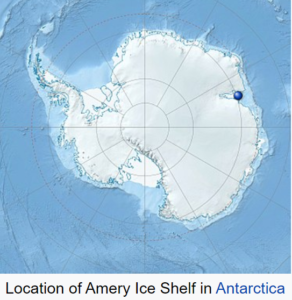
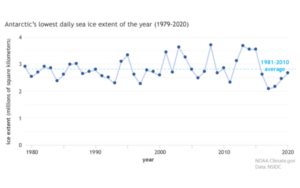
According to climate scientists, less dense meltwater on the surface of the Antarctic ocean reduced convection between the surface and ocean depths, leaving heat trapped in the depths.
A
…
Don’t you love climate science? When sea ice accumulates, scientists adjust the models until they get the right result. When the sea ice melts, well that is what you would expect from global warming.
Researchers at Purdue University in the US have developed a new technology that promises to be a game-changer in the extraction of rare earths.
THE GLOBAL MARKET OF RARE EARTH METALS HAS BEEN VALUED AT $4 BILLION PER YEAR BUT 70% OF THE PRODUCTION IS CONCENTRATED IN CHINA
In a paper published in the journal Green Chemistry, the scientists explain that the patented extraction and purifying processes use ligand-assisted chromatography and are shown to remove and purify rare earth metals from coal ash, recycled magnets and raw ore safely, efficiently and with virtually no detrimental environmental impact.
This is key because, at present, many companies across the world don’t even dare to consider extracting REE due to the damages caused to the environment by acid-based separation and purification of these elements.
“About 60% of rare earth metals are used in magnets that are needed in almost everyone’s daily lives. These metals are used in electronics, aeroplanes, hybrid cars and even windmills,” Nien-Hwa Linda Wang, whose lab developed the technology, said in a media statement. “We currently have one dominant foreign source for these metals and if the supply were to be limited for any reason, it would be devastating to people’s lives. It’s not that the resource isn’t available in the US, but that we need a better, cleaner way to process these rare earth metals.”
See also Two-zone ligand-assisted displacement chromatography for producing high-purity praseodymium, neodymium, and dysprosium with high yield and high productivity from crude mixtures derived from waste magnets (here)
Although shallow magma storage at Erta Ale volcano hints at a rift-to-ridge transition, the tectonic future of the Afar region is far from certain.
Standing next to a lava lake at the summit of a massive volcano, Christopher Moore, a Ph.D. candidate at the School of Earth and Environment at the University of Leeds in the United Kingdom, could see the red haze of lava flows a few kilometers away. This might seem like a rare sight, but at Ethiopia’s Erta Ale, it’s business as usual.
Are such behaviors the first signs of a tectonic transition? This question is part of what Moore has been studying at Erta Ale. The entire Afar region in eastern Africa finds itself in the middle of changes that could split the continent, forming a new ocean basin. The magmatism at Erta Ale might be offering signs of this switch by mimicking the characteristics of a mid-ocean ridge.
The East African Rift valley, the Red Sea, and the Gulf of Aden are clearly visible in this Landsat 8 image, taken on 8 November 2019. Credit: NASA/Erik Klemetti
However, there isn’t agreement about how close the Afar region is to this tectonic transition. The geophysical characteristics of magma storage at Erta Ale could point to the region’s conversion to an incipient oceanic spreading center, but the petrology of the erupting lava might be telling us that we aren’t there yet.
UPDATE: Changed emphasis from Northern Hemisphere extratropics to entire Northern Hemisphere (h/t John Christy)
In April, 2020, the Northern Hemisphere experienced its 2nd largest 2-month drop in temperature in the 497-month satellite record.
The Version 6.0 global average lower tropospheric temperature (LT) anomaly for April, 2020 was +0.38 deg. C, down from the March, 2020 value of +0.48 deg. C.
The Northern Hemisphere temperature anomaly fell from +0.96 deg. C to 0.43 deg. C from February to April, a 0.53 deg. C drop which is the 2nd largest 2-month drop in the 497-month satellite record. The largest 2-month drop was -0.69 deg. C from December 1987 to February 1988.
The linear warming trend since January, 1979 has now increased to +0.14 C/decade (but remains statistically unchanged at +0.12 C/decade over the global-averaged oceans, and +0.18 C/decade over global-averaged land).
…
La géologie, une science plus que passionnante … et diverse