Archives de catégorie : climate-debate

New Study Effectively Eliminates Confidence In Human Attribution For Modern Global Warming

by K. Richard, Nov 5, 2020 in NoTricksZone


The forcing uncertainties and lack of observational measurements in the top-to-bottom global ocean preclude an assessment that modern warmth is due to anthropogenic activities.

Key points from a new paper (Gebbie, 2021):

• 93% of the changes to the Earth’s energy budget, manifested as warming of the Earth system, are expressed in the global ocean. Just 1% of global warming is atmospheric.

• Even with the advent of “quasi-global” temperature sampling of the ocean since 2005 (ARGO), these floats “do not measure below 2,000-m depth.” This means that temperature changes in “approximately half the ocean’s volume” are still not being measured today.

• To detect the effects of anthropogenic forcing, it would require energy budget imbalance measurement precision of 0.1 W/m² at the top of the atmosphere (TOA). Uncertainty in the forcing changes affecting climate are ±4 W/m², meaning that uncertainty is about 80 times greater than an anthropogenic signal detection.

• Past changes in global ocean heat content, such as the last deglaciation, have been 20 times larger than modern changes.

• Ocean heat storage during the Medieval Warm Period (Medieval Climate Anomaly, or MCA) was much greater than modern. Modern global ocean heat uptake is “just one-third” of what is required to reach the levels attained during Medieval times.

Sea level rise and Antarctica

by Jim Steele, Nov 4, 2020 in WUWT


California’s and other American coastal towns are engaged in divisive arguments regards rising sea levels. Although observed sea levels rose less than 8 inches (0.08 inches per year) since 1900, some modelers forecast much bleaker futures. They predict a 2.4-foot rise for every 1°F rise above preindustrial temperatures, then accelerating to nearly 4.5 feet for every 1°F additional increase. Why a dramatic acceleration in sea level? It’s based primarily on dire models, typically presented to coastal planning commissions as ‘best science’, suggesting increasing ice instability and Antarctica ice sheet collapse. “Antarctica has the potential to contribute more than 3.3 feet of sea-level rise by 2100 and more than 49 feet by 2500.”

Those models have prompted some citizens to argue we must abandon the coasts via managed retreat. Others argue we should build better sea walls. But how high? Others rightfully ask, “how trustworthy are those models?” Model predictions of a collapsing Antarctica ice sheet are not based on observations.  Models of Antarctica’s catastrophic ice collapse are attempts to explain ancient sea levels such as the 30-foot higher levels 120,000 years ago.

There are good reasons toquestion catastrophic models. For one, away from the coast Antarctica’s surface temperatures average −70 °F. Antarctica’s extremely cold surfacesrequire global warming to increase many, many times more before surface glaciers could ever melt. For another, although greenhouse theory predicts increasing CO2  concentrations will raise temperatures, greenhouse theory also predicts added CO2  has a cooling effect on Antarctica (Wijngaarden & Happer 2020, Schmithüsen 2015).


Study suggests no more CO2 warming

by C. Rotter, Oct 26, 2020 in WUWT


By David Wojick |October 26th, 2020|Climate

Precision research by physicists William Happer and William van Wijngaarden has determined that the present levels of atmospheric carbon dioxide and water vapor are almost completely saturated. In radiation physics the technical term “saturated” implies that adding more molecules will not cause more warming.

In plain language this means that from now on our emissions from burning fossil fuels could have little or no further impact on global warming. There would be no climate emergency.  No threat at all. We could emit as much CO2 as we like; with no effect.

This astounding finding resolves a huge uncertainty that has plagued climate science for over a century. How should saturation be measured and what is its extent with regard to the primary greenhouse gases?

In radiation physics the term “saturation” is nothing like the simple thing we call saturation in ordinary language, just as the greenhouse effect is nothing like how greenhouses work. Your paper towel is saturated when it won’t pick up any more spilled milk. In contrast greenhouse gases are saturated when there is no more milk left to pick up, as it were, but it is far more complex than this simple analogy suggests.

Happer is probably best known to our readers as a leading skeptical scientist. He co-founded the prestigious CO2 Coalition and recently served on the staff of the National Security Council, advising President Trump. But his career has been as a world class radiation physicist at Princeton. His numerous peer reviewed journal articles have collectively garnered over 12,000 citations by other researchers.

In this study Professors Happer and van Wijngaarden (H&W) have worked through the saturation physics in painstaking detail. Their preprint is titled “Dependence of Earth’s Thermal Radiation on Five Most Abundant Greenhouse Gases“. They have gone far beyond the work done to date on this complex problem.

To begin with, while the standard studies treat the absorption of radiation by greenhouse molecules using crude absorption bands of radiation energy, H&W analyze the millions of distinct energies, called spectral lines, which make up these bands. This line by line approach has been an emerging field of analysis, often giving dramatically new results.

….

….

Clearly this is work that the climate science community needs to carefully consider. This may not be easy given that three major physics journals have refused to publish it. The reviews have been defensive and antagonistic, neither thoughtful nor helpful. Alarmism is in control of the journals, censoring contrary findings, hence the preprint version.

3 More New Studies Show Modern Arctic Sea Ice Extent Is Greater Than Nearly Any Time In The Last 10,000 Years

by K. Richard, Oct 29, 2029 in NoTricksZone


For years scientists have been using biomarker evidence (IP25, PIP25) to reconstruct the Arctic’s sea ice history. The evidence shows modern (20th-21st century) Arctic sea ice is at its greatest extent since the Holocene began.

Scientists (Wu et al., 2020) have determined that from about 14,000 to 8,000 years ago, when CO2 lingered near 250 ppm, the Beaufort Sea (Arctic) was “nearly ice free throughout the year” (<0.2 PIP25) and ~4°C warmer than today in winter.

With CO2 at ~400 ppm, this region is 70-100% ice-covered (>0.8 PIP25) for all but 1-2 summer months in the modern (1988-2007) era.

….

Roger Revelle – the backstory of the father of Atmospheric CO2 monitoring

by A. May, Oct 321, 2020 in WUWT


Roger Revelle was an outstanding and famous oceanographer. He met Al Gore, in the late 1960s, when Gore was a student in one of his classes at Harvard University. Revelle was unsure about the eventual impact of human carbon dioxide emissions on climate, but he did show that all carbon dioxide emitted by man would not be absorbed by the oceans. For an interesting discussion of Revelle’s work in this area see this post on “The Discovery of Global Warming,” by Spencer Weart (Weart, 2007). The original paper, on CO2 absorption by the oceans, published in 1957 by Roger Revelle and Hans Suess, is entitled: “Carbon Dioxide Exchange Between Atmosphere and Ocean and the Question of an Increase of Atmospheric CO2, during the Past Decades” (Revelle & Suess, 1957). This meant that human emissions of carbon dioxide would accumulate in the atmosphere and that the CO2 atmospheric concentration would increase, probably causing Earth’s surface to warm at some unknown rate. This is not an alarming conclusion, as Revelle well knew, but Al Gore turned it into one.

One of Revelle’s good friends was Dr. S. Fred Singer. Singer was a professor of environmental science at the University of Virginia and both Revelle and Singer had been science advisors in the U.S. Department of the Interior. They first met in 1957 and were more than professional colleagues, they were personal friends (Singer, 2003). Unfortunately, Revelle passed away in July 1991 and Singer passed away in April 2020, so we will refer to them and their friendship in the past tense. Both were leading Earth scientists and at the top of their fields, it was natural they would become friends. They also shared an interest in climate change and chose to write an article together near the end of Revelle’s life.


Indeed, ten years later, CO2 emissions were still increasing, but the world had started to cool as shown in Figure 1. This casts considerable doubt on the idea that human emissions somehow control global warming, since some other factor, presumably natural, is strong enough to reverse the overall warming trend for ten years. Revelle was correct to encourage the government to wait for ten more years. Just a year before their paper was published the IPCC reported that warming to date fell within the range of “natural variability” and that the detection of a human influence on climate was “not likely for a decade or more.” (IPCC, 1990, p. XII).
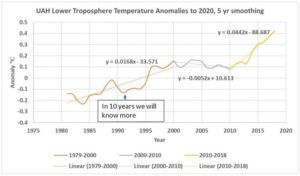
Figure 1. In 1990 and 1991, respectively, the IPCC and Roger Revelle and colleagues said it was too early to do anything about possible man-made climate change, they thought we would know more in 10 years. The plot is smoothed with a 5-year running average to reduce the effect of El Nino and La Nina events. This makes the longer term trends easier to see.

Les chercheurs prenant le plus l’avion sont… les experts du climat

by Le Point, Oct 29,  2020


Selon une étude britannique, les climatologues voyagent en moyenne davantage en avion que les scientifiques spécialisés dans d’autres domaines.

Les arroseurs arrosés. Les climatologues alertent régulièrement et, à raison, sur les effets sur le climat des déplacements en avion, fortement émetteurs de gaz à effet de serre. Mais une étude publiée en ce mois d’octobre dans la revue Global Environmental Change vient mettre le doigt sur certains de leurs comportements. Selon cette étude britannique coordonnée par l’université de Cardiff, et relayée par Nature et Courrier International, les experts en réchauffement climatique sont les scientifiques qui voyagent le plus souvent en avion, en comparaison avec leurs collègues d’autres disciplines. Au total, plus de 1 400 chercheurs, provenant de 59 pays différents et de domaines scientifiques divers, ont été interrogés.

En moyenne, les experts du climat, qui représentaient environ 17 % des personnes sollicitées, prennent l’avion à raison de cinq fois par an. En comparaison, les chercheurs spécialisés dans d’autres disciplines disent effectuer quatre trajets par an en avion. Les vols effectués par les climatologues sont davantage domestiques qu’internationaux. Toutefois, ils avancent souvent des raisons professionnelles pour ces trajets, ce qui n’est pas forcément le cas de leurs autres collègues scientifiques. Les professeurs spécialisés dans le dérèglement climatique voyagent en avion environ neuf fois par an en moyenne, contre huit fois pour leurs collègues d’autres spécialités.

“Where’s the sea ice?” Right where it’s been for most of the Holocene.

by D. Middleton, Oct 30, 2020 in WUWT


This is sort of a sequel yesterday’s post: Where’s the sea ice? 3 reasons the Arctic freeze is unseasonably late and why it matters.

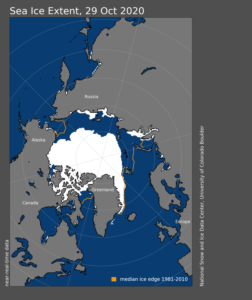
What a difference a day can make! Looks like it’s starting to crust over:

Figure 0. Daily sea ice extent map, October 29, 2020. (NSIDC)

Two key takeaways:

  1. Maximum Holocene sea ice extent occurred within the past 500-1,000 years at every location.
  2. The current sea ice extent is higher at all of the locations than over 50% to 85% of the Holocene.

While this doesn’t tell us what the sea ice extent was in million km2, it does tell us that the modern sea ice extent is larger than it was over most of the Holocene Epoch. It also tells us that the areas of currently seasonal sea ice extent have been seasonal or reduced over most of the past 5,000 years and ice-free or nearly ice-free over the prior 3,000 years or so. Here’s is the Kinnard graph plotted at the same horizontal scale as the Stein cross section:

EU report about vanishing beaches was alarmist and wrong, scientists say

by Ben Webster, Oct 27  in TheTimes


Sandy beaches are much less vulnerable to rising seas than was claimed in a recent European Commission study which caused “unnecessary alarm”, research has found.

Beaches will survive by migrating landwards as the sea level rises as long as they are given space to move and not impeded by sea walls and other structures on the coast, the research

The new findings contradict claims made in March in a study by the commission’s joint research centre, which supplies scientific evidence to guide EU policy.


See also:  Satellite Data: 75% Of The World’s Beaches Are Stable Or Growing

Analysis of satellite derived shoreline data indicates that 24% of the world’s sandy beaches are eroding at rates exceeding 0.5 m/yr, while 28% are accreting and 48% are stable.


Global Warming Wallops 20 Million Americans With Snow, Freezing Rain

by B. Lyman, Oct 27, 2020 in ClimateChangeDispatch


More than 20 million Americans are under some sort of winter weather watch, warning, or advisory from the Southwest through the Midwest as of Monday.

The Weather Channel has dubbed the storm “Winter Storm Billy” and said the storm will bring snow throughout parts of the Southern Rockies, the Central Plains, and Missouri.

From Arizona to Wisconsin, residents could see snowfall Monday, while those further south, like in Texas and Oklahoma, will see freezing rain and sleet, according to CNN.

Ice in Texas and Oklahoma is expected to accumulate roughly half an inch, which could cause dangerous travel conditions and knock power out, per the same article. Oklahoma City is under an Ice Storm Warning.

Temperatures in North Texas are roughly 25 degrees Fahrenheit below average. Texans living in the Texas Panhandle area could see one to two inches of snow during the area’s first Winter Storm Warning of the season, according to CBS Dallas-Ft. Worth.

While temperatures in Arizona won’t be as cold as some other states, some areas in the state could see a low of 46 degrees on Tuesday — the first temperature in the 40s since March, according to AZ Central.

Some areas of Colorado and New Mexico are expected to see two feet of snow, which comes as a bit of relief as wildfires continue to rage in Colorado’s Boulder and Larimer Counties, according to The Denver Channel. In Aguilar, Colorado, there were already 14 inches recorded from snowfall Sunday into Monday, per the same report.

Guardian Needlessly Alarmed By Late Freeze

by P. Homewood, Oct 27, 2020 in NotaLotofPeopleKnowThat


For the first time since records began, the main nursery of Arctic sea ice in Siberia has yet to start freezing in late October.

The delayed annual freeze in the Laptev Sea has been caused by freakishly protracted warmth in northern Russia and the intrusion of Atlantic waters, say climate scientists who warn of possible knock-on effects across the polar region.

Ocean temperatures in the area recently climbed to more than 5C above average, following a record breaking heatwave and the unusually early decline of last winter’s sea ice.

The trapped heat takes a long time to dissipate into the atmosphere, even at this time of the year when the sun creeps above the horizon for little more than an hour or two each day.

Graphs of sea-ice extent in the Laptev Sea, which usually show a healthy seasonal pulse, appear to have flat-lined. As a result, there is a record amount of open sea in the Arctic.

“The lack of freeze-up so far this fall is unprecedented in the Siberian Arctic region,” said Zachary Labe, a postdoctoral researcher at Colorado State University. He says this is in line with the expected impact of human-driven climate change.

“2020 is another year that is consistent with a rapidly changing Arctic. Without a systematic reduction in greenhouse gases, the likelihood of our first ‘ice-free’ summer will continue to increase by the mid-21st century,’ he wrote in an email to the Guardian.

The warmer air temperature is not the only factor slowing the formation of ice. Climate change is also pushing more balmy Atlantic currents into the Arctic and breaking up the usual stratification between warm deep waters and the cool surface. This also makes it difficult for ice to form.

Science and politics

by Judith Curry, Oct 26, 2020 in WUWT


“I’m reaching out to scientists this week about the election. How do you feel about it? Which of the candidates has the best plan, for you, in science and technology?”

The above question was emailed to me today by a reporter.

My response:

I am not happy with either the Democratic or Republican plans for science in the U.S.  Both sides seem to want to use and misuse science as a club to further their political agendas.  The Republicans seem to prefer to ignore science, while the Democrats cherry pick science to further their political agendas.

Here is the long response,some text from something that I’m working on:

Dutch regulatory lawyer Lucas Bergkamp summarizes the challenge in this way. Science has become an instrument used by politicians and agencies to arm themselves with powerful arguments in complex value-laden debates. Scientists have let the politicians hijack the scientific enterprise. Both policy makers and scientists exploit scientific uncertainty to avoid debate on the relation between science and politics, facts and values. Armed with science, politicians are able to avoid accountability for decisions. Serious debate is avoided because politicized science has purged doubt and skepticism. Activist climate science makes use of a series of strategies and tactics to influence public opinion and politics. Bergkamp concludes that climate science itself has come under siege.

Scientization of policy is a response to intractable political conflicts that transforms the political issues into scientific ones. The rationale for scientization is the belief that science can act as a neutral arbiter of policy — if we could only determine the facts of a matter, the appropriate course of action would become clear. The problem is that science is neither neutral nor capable of answering political questions. The answers that science gives depend on what questions are asked, which inevitably involves value judgments. Science is not designed to answer questions about how the world ought to be, which is the work of politics.

Policy makers are culpable in the misuse of science for policy making by:

DENVER OBLITERATES ALL-TIME LOW TEMPERATURE RECORDS IN WEATHER BOOKS DATING BACK 148 YEARS

by Cap Allon, Oct 27, 2020 in Electroverse


The GRAND SOLAR MINIMUM has taken out multiple low temperature records in Denver, Colorado of late, as a weak and wavy “meridional” jet stream sends Arctic air anomalously-far south.

Denver has detailed weather books dating all the way back to 1872. One thing they reveal is that on each and every October day in those past 148 years, the thermometer has never failed to reach at least 18F… until yesterday, that is.

On Monday, October 26, the mercury struggled to a high of just 16F — a new record for the coldest October high temperature ever recorded in Denver.

New Study Finds A Robust Link Between European Temperatures And Solar Activity Via AMO/NAO Modulation

by K. Richard, Oct 22, 2020 in NoTricksZone


European winter temperature variability is “dominated” by the North Atlantic Oscillation (NAO), which is, in turn, modulated by solar activity.

Even proponents of anthropogenic global warming (AGW) agree natural processes (AMO, NAO, ENSO, solar forcing, volcanism) drive temperature variability. But they insist the rising temperature trend is human-caused.

So if we don’t have a regional upward trend, is the non-warming natural or anthropogenic?

Lüdecke et al., 2020 find temperatures across Europe have been oscillating, not rising in linear fashion, for the last century. The timings of the temperature undulations correspond quite closely to natural ocean cycles (the NAO and AMO). The authors detail a non-linear and indirect solar activity impact on these ocean cycles, and ultimately to the European climate.

Why lockdown had little to no effect on global temperatures

by A.N. Archer & J.Weber, Oct 22, 2020 in Phys.Org


Countries across the world took unprecedented action in the first few months of 2020 to control the spread of COVID-19. At its peak, one-third of the world’s population was in lockdown. Around the world, car travel fell by 50%, the number of flights plummeted by 75% and industrial activity fell by around 35%.

With so many cars parked, airplanes grounded and factories closed, global carbon dioxide (CO₂) emissions fell by around 17% compared with the same period in 2019. But greenhouse gases such as CO₂ weren’t the only emissions to fall, and not all pollution heats the planet. Some of the industrial activities that shut down—particularly heavy industry, including steel and cement making—also produced aerosols, which are that linger in the atmosphere for weeks and reflect heat from the Sun.

Previous studies have suggested that if a lot of these industrial processes were to suddenly shut down, it would lead to short-term warming because the atmosphere would lose the reflective effect of aerosols. But as the lockdown cleared skies, temperatures didn’t rocket.

In new research, we show that lockdown had a negligible effect on global temperatures. So what really happened?

NSIDC: 2020 POLAR ICE DOING JUST FINE

by Cap Allon, Oct 24, 2020 in Electroverse


According to the latest October report from the National Snow and Ice Data Center (NSIDC), the ice locked at Earth’s poles is, overall, GROWING.

By volume, Antarctica contains 90% of Earth’s ice, and volume is a far better metric to use when judging the state of an ice sheet than sea ice extent. Extent is prone to wild and unpredictable fluctuations due to natural changes in ocean currents and wind patterns, etc–though these fluctuations are of a much lesser degree in Antarctica than in its northern cousin, the Arctic.

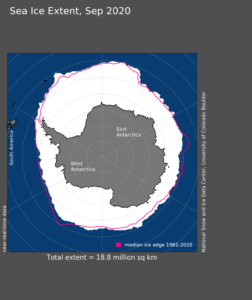
According to the latest NSIDC report, Antarctic sea ice extent reached a whopping 18.95 million square kilometers (7.32 million square miles) on September 28. Mid to late Sept would usually give us the year’s maximum extent, but given the favorable conditions in October, the maximum may well be higher. “As is typical this time of year, there are wide swings caused by winds and storms along the extensive ice edge,” writes the NSIDC.

Ice extent around Antarctica is now “well above the 1981 to 2020 median extent,” the NSIDC informs us. “Ice extent is above the median extent along a broad area off the Wilkes Land coast and western Ross Sea, near the median extent from the Amundsen Sea clockwise to the Weddell Sea and above the median north of Dronning Maud Land, Enderby Land, and the Cosmonaut Sea. The only major area of below the median extent is in the Indian Ocean sector near the Amery Ice Shelf and eastward.”

Continuer la lecture de NSIDC: 2020 POLAR ICE DOING JUST FINE

Ten fat polar bears filmed raiding a stalled Russian garbage truck

by Siberian Times, Oct 21, 2020 in WUWT/Ch.Rotter


From the Siberian Times today (20 October) is a story with few facts but a fabulous video of six fat adults and four fat cubs as they set siege to a stalled open garbage truck in the Russian Arctic. It may have been filmed on Novaya Zemlya but that has not been confirmed.

Of course, Novaya Zemlya has had previous problems with bears habituated to garbage, most famously an extended incident in 2019 that was perversely blamed on climate change.

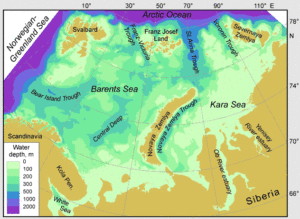
There were two families that I could see in the video: a female with two cubs-of-the-year and another with two year old cubs. All were in excellent condition, as were the other four adults. Novaya Zemlya, if indeed this is where the incident took place, is between the Barents and Kara Seas (see below):


Dubai builds first coal power plant despite pledging lowest carbon footprint in the world by 2050

by Independent, Oct 22, 2020


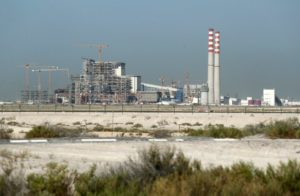
A new wonder is rising in the southern desert of Dubai against the backdrop of Persian Gulf beaches, but it’s not another skyscraper to grace the futuristic sheikhdom. Instead, it’s one of mankind’s oldest power sources gaining its own space on the oil-rich Arabian Peninsula — a coal-fired power plant

The construction of the $3.4 billion Hassyan plant in Dubai appears puzzling, as the United Arab Emirates hosts the headquarters of the International Renewable Energy Agency. It’s also building the peninsula’s first nuclear power plant and endlessly promotes its vast solar-power plant named after Dubai’s ruler. Dubai has also set the lofty goal of having the world’s lowest carbon footprint in the world by 2050 — something that would be impacted by burning coal.

The coal plant’s arrival comes as Gulf Arab nations remain among the world’s hungriest for energy and amid political concerns over the use of natural gas imported from abroad, concerns underscored by a yearslong dispute with gas-producer Qatar, which is boycotted by four Arab nations, including the UAE.

“Dubai was really saying we’re far too exposed on gas imports, those could be interrupted by all kinds of things, the cost is very high and so we have to do something else to diversify our fuel supply and bring down the total cost,” said Robin Mills, the CEO of Qamar Energy, a Dubai-based consulting company. “They got a very competitive offer on the coal plant … and so the decision was made.”

New Study: East Antarctica Was Up To 6°C Warmer Than Today During The Medieval Warm Period

by K. Richard, Oct 15, 2020 in NoTricksZone


As recently as 2000 to 1000 years ago, spanning the Roman to Medieval Warm Periods, East Antarctica was 5-6°C warmer than it is today. The consequent ice melt resulted in >60 meters higher water levels in East Antarctica’s lakes.

East Antarctica has been rapidly cooling in recent decades, with magnitudes reaching -0.7°C to -2.0°C per decade since the mid-1980s (Obryk et al., 2020).

A new study (Myers et al., 2020) reports that until about 15,000 years ago and throughout the Last Glacial Maximum, East Antarctica was 4-9°C colder than it is today.

Antarctica then abruptly warmed 15°C within centuries. From 12,000 to 6,000 years before present, East Antarctica was about 5°C warmer than it is today.

NORTHERN HEMISPHERE SNOW MASS ABOVE AVERAGE + GREENLAND ICE SHEET’S ASTONISHING GAINS CONTINUE

by Cap Allon, Oct 21, 2020 in Electroverse


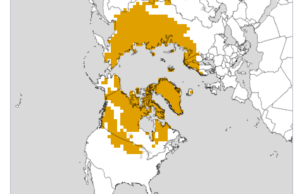
Following on from one of its snowiest winters on record in 2019-20 comes the first 2020-21 data-points from the Finnish Meteorological Institute (FMI). What they clearly reveal is that the Northern Hemisphere is at it again, continuing the trend of growth observed in recent years.

Despite decades of doom-and-gloom prophecies and fear-mongering claptrap, the Northern Hemisphere continues to GAIN “snow mass” at a rate comfortably above the 1982-2012 average:


….

See also here (Minnesota just suffered its Largest Early-Season Snowstorm in Recorded History)

Creepy Climate Conversations

by Donna Laframboise, Oct 21, 2020 in BigPicturesNews


Tony Thomas has a disturbing piece over at Quandrant.org, concerning an Australian organization allegedly run by child activists. It’s now urging kids to initiate creepy conversations with adults as a means of spreading climate propaganda.

Matters may not develop as expected, though. Because any adult who was around for the global cooling scare, who was told acid rain would wipe out the worlds forests, and that the hole in the ozone layer would induce widespread skin cancer has, in fact, heard it all before.

It’s interesting that the SchoolStrike4Climate.com website can’t stay on topic. Its front page tells us Australia was stolen from First Nation communities, and that “there can be no climate justice without first nations justice.” If you click the large button labelled: Black Lives Matter Resources, you’re taken to a 7-page Google document that similarly declares: “There is no climate justice without racial justice…”

These statements, call to mind 17-year-old Greta Thunberg’s assertion that “We can not have climate justice without gender equity.”

Climate justice. First Nations justice. Racial justice. Gender equity. What does this collection of causes tell us? That these young people aren’t rebels at all. Nor are they independent thinkers.

Rather than being sincere and passionate about a single issue they themselves have carefully investigated, these youngsters are merely hopping aboard the bandwagon known as fashionable left wing politics.

If you truly believed your future was imperiled, wouldn’t you keep on topic? Wouldn’t your anxiety focus your attention? Wouldn’t you pursue a single, realistic, achievable goal?

Instead, these high school students are being encouraged to believe that, by skipping school, they’ll convince the rest of us to do their bidding – not just about the climate, but with respect to other complicated, longstanding social issues. Everything will be transformed. Fixed to their satisfaction. All at the same time, no less.

Only a naive young person could imagine this to be remotely possible.


New Climate Report: Islands Not Losing Land, People To Sea-Level Rise

by J. Taylor, Oct 19, 2020 in ClimateChangeDispatch


A new study posted at ClimateAtAGlance.com documents that most small islands are growing, not losing land to sea-level rise, and island nations are attracting growing populations rather than shedding climate refugees.

The new climate summary drives a stake into the heart of alarmist assertions that climate change and rising seas are threatening island nations and their populations.

Objective measurements show that islands and atolls are growing in size, not disappearing under rising seas.

Rising seas bring sand and sediment, which build up coastal shorelines and are more than keeping pace with rising waters.

Also, coral, as living organisms growing near sea level, build up their height along with the rising sea.

For example, climate activists often claim the island nation of Tuvalu is shrinking due to rising seas and spawning climate refugees.

However, a recent peer-reviewed study found eight out of Tuvalu’s nine coral atolls have grown in size during recent decades, and three-fourths of Tuvalu’s 101 reef islands have similarly grown in size.

Also, Tuvalu’s population is consistently growing, not declining, with 20% more people living on Tuvalu now than 30 years ago. Tuvalu’s population has doubled since 1970.

Additional peer-reviewed studies (see here, here, and here) confirm the same processes are allowing – and will continue to allow – other Pacific islands to keep up with rising seas.

For example, 30 years ago, the Canberra Times claimed all 1196 islands that comprise the Maldives could be completely underwater by now.

Not only are all 1196 islands still there, but the Maldives population has doubled during the past 20 years.

People are flocking to the Maldives islands, not fleeing them. The Maldives are absorbing political refugees, not spawning climate refugees.

To read the full summary, see Climate at a Glance: Islands and Sea Level Rise.

Is Mauna Loa Really The Best Location To Measure ‘Global’ CO2 Levels?

by K. Richard, Oct 19, 2020 in NoTricksZone


Highly anomalous terrain (an active volcano), 40 years of cooling temperatures, and a CO2 record that dramatically contrasts with fluctuating values from forests and meadows reaching 600-900 ppm all beg the question: Is Mauna Loa’s CO2 record globally representative?

Mauna Loa is the Earth’s largest land volcano. It has erupted over 3 dozen times since 1843, making this terrestrial landscape extremely unusual relative to the rest of the globe’s terrain. (Forests, in contrast, cover over 30% of the Earth’s  land surface.)

Mauna Loa has been thought to be the world’s best location to monitor global CO2 levels since 1958.

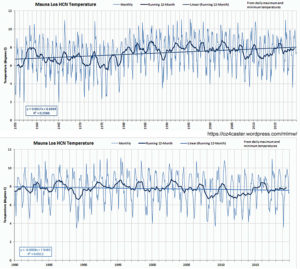
While Mauna Loa CO2 levels show a rise of 338 ppm to 415 ppm since 1980, Mauna Loa temperatures (HCN) show a cooling trend during this same time period. The only warming period in the last 65 years occurred between about 1975 and 1985.

Image Source: oz4caster

Forest CO2 fluctuations

As mentioned above, forests are orders of magnitude more terrestrially representative than the highly anomalous site of the Earth’s largest volcano.

In forests or tree-covered areas, CO2 rises from around 300 ppm in the warmth of the afternoon (~3 p.m.) to over 600 ppm before sunrise (~4 a.m.), when it is cooler (Fennici, 1986, Hamacher et al., 1994). This massive fluctuation occurs daily and CO2 values average out to be far higher than the Mauna Loa record suggests.

Low Solar Activity Points To Colder Than Normal 2020/21 European Winter

by P. Gosselin, Oct 16, 2020 in NoTricksZone


SnowFan here reports on the latest winter forecasts for the 2020/21 Europe winter. History and statistics show Europe could be in for a frosty winter. 

Currently a significant La Nina is shaping up, and history shows that these events in the Pacific have an impact on Europe’s winters:


The NOAA reanalysis above shows the temperature deviations (left) and for precipitation (right) from the WMO average 1981-2010 during the six La Niña years of winter in Europe. Large parts of Europe have average temperatures and precipitation is distributed differently, with Germany being slightly drier overall than the WMO average. Is a 2020/21 winter in Germany under La Niña conditions shaping up to have average temperatures and slightly less humidity?

Strong winter-solar correlation

A more important factor determining winter in Europe may be solar activity. Data from the German DWD national weather service since 1954 show a remarkable higher frequency of cold winters in times of low solar activity, such as we are now in the midst of.

The Great Energy Non-Transition

by B. Everett, Oct 15, 2020 in CO2Coalition


One of the troubling characteristics of today’s civic discourse is the tendency to confuse predictions with reality.  Nowhere is this problem more severe than in the debate over climate and its associated issues.

The last hundred years have seen increasing emissions of carbon dioxide – a benign gas.  In reality, this slight increase in atmospheric COconcentrations (from 0.03% in the nineteenth century to 0.04% today) has brought nothing but beneficial effects, including increased crop yields and greater drought resistance.  Nonetheless, climate alarmists argue that rising temperatures are bringing catastrophic storms, flooding, disease, inundation, extinction and general misery.  Unlike the benefits of CO2 which are clear and measurable, climate catastrophe remains nothing more than a prediction generated by computer models which have never produced meaningful forecasts of climate impacts.

A frequent corollary of climate alarmism is that the world has undertaken a radical transformation of the global energy system away from fossil fuels toward zero-carbon, renewable energy.  A Google search of the term “energy transition” yields over 5 million hits, many accompanied by terms such as “unstoppable” and “irreversible”.  But is this transition actually taking place? Three arguments are generally offered – none of them valid.

First, “energy transition” supporters point to the high growth rates for renewable energy sources with wind increasing at over 20% annually since 2000 and solar at over 40% per year, compared to less than 2% for fossil fuels.  Sounds great, but the absolute numbers tell a different story.  In 2019, despite forty years and trillions of dollars of subsidies, wind energy contributes about 2% of total global energy use and solar just over 1%.  Fossil fuels accounted for 84%, down just two percentage points over the last 20 years.