Archives de catégorie : climate-debate

Global CO2 Emissions Rose By 1.7% Last Year, As Energy Demand Climbs

by P. Homewood, March 26, 2019 in NotaLotofPeopleKnowThat


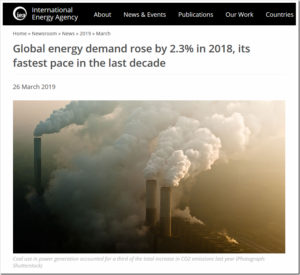
Energy demand worldwide grew by 2.3% last year, its fastest pace this decade, an exceptional performance driven by a robust global economy and stronger heating and cooling needs in some regions. Natural gas emerged as the fuel of choice, posting the biggest gains and accounting for 45% of the rise in energy consumption. Gas demand growth was especially strong in the United States and China.

Demand for all fuels increased, with fossil fuels meeting nearly 70% of the growth for the second year running. Solar and wind generation grew at double-digit pace, with solar alone increasing by 31%. Still, that was not fast enough to meet higher electricity demand around the world that also drove up coal use.

As a result, global energy-related CO2 emissions rose by 1.7% to 33 Gigatonnes (Gt) in 2018. Coal use in power generation alone surpassed 10 Gt, accounting for a third of the total increase. Most of that came from a young fleet of coal power plants in developing Asia. The majority of coal-fired generation capacity today is found in Asia, with 12-year-old plants on average, decades short of average lifetimes of around 50 years.


Inconvenient: NASA says a Greenland glacier did an about-face – growing again

by Anthony Watts, March 25, 2019 in WUWT


“…scientists were so shocked to find the change.”

From NASA JPL: Cold Water Currently Slowing Fastest Thinning Greenland Glacier

NASA research shows that Jakobshavn Glacier, which has been Greenland’s fastest-flowing and fastest-thinning glacier for the last 20 years, has made an unexpected about-face. Jakobshavn is now flowing more slowly, thickening, and advancing toward the ocean instead of retreating farther inland. The glacier is still adding to global sea level rise – it continues to lose more ice to the ocean than it gains from snow accumulation – but at a slower rate.

The researchers conclude that the slowdown of this glacier, known in the Greenlandic language as Sermeq Kujalleq, occurred because an ocean current that brings water to the glacier’s ocean face grew much cooler in 2016. Water temperatures in the vicinity of the glacier are now colder than they have been since the mid-1980s.

See also here in NBS

Nature Unbound III: Holocene climate variability (Part A)

by Javier, April 30, 2017 in ClimateEtc.


First in a two part series on Holocene climate variability.

Summary: Holocene climate is characterized by two initial millennia of fast warming followed by four millennia of higher temperatures and humidity, and a progressively accelerating cooling and drying for the past six millennia. These changes are driven by variations in the obliquity of the Earth’s axis. The four millennia of warmer temperatures are called the Holocene Climatic Optimum which was 1-2°C warmer than the Little Ice Age. This climatic optimum was when global glaciers reached their minimum extent. The Mid-Holocene Transition, caused by orbital variations, brought a change in climatic mode, from solar to oceanic dominated forcing. This transition displaced the climatic equator, ended the African Humid Period and increased El Niño activity.


Figure 36. Holocene temperature profile. A. Summer (July-August) Central England temperature reconstruction from multiple proxies and sources by H. H. Lamb.Crosses represent dating and temperature uncertainty. Black dots are centennial averages. Red dot is 1900-1965 average. Source: Lamb, H.H. 1977. Climate: Present, past and future. Volume 2. B. Greenland temperature reconstruction based on an average of uplift corrected δ18O isotopic data from Agassiz and Renland ice cores. This average has been corrected for changes in the δ18O of seawater and calibrated to borehole temperature records. Some historical periods are indicated. Source: B. Vinther et al., 2009.

“Global climate change” does not cause species extinctions

by Paul Berth, March 22, 2019 in ScienceClimatEnergie


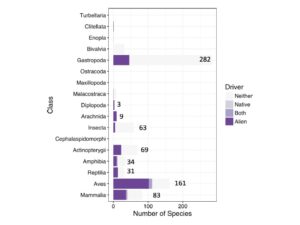
Contrary to what the media tries to make you believe, global climate change is not a major cause of species extinction. A recent study published in March 2019 in Frontiers in Ecology and the Environment shows that the major cause of extinction is the introduction of invasive alien species (IAS) into ecosystems. This phenomenon, well known to biologists and confirmed by the IUCN (International Union for the Conservation of Nature), is unfortunately little known to the general public.

Figure 1. Number of recent animal extinctions (IUCN categories “extinct” [EX] and “extinct in the wild” [EW]) for different groups of animals (figures from IUCN Table 3a). The colors provide information on the causes of the extinctions (“Driver”); for example dark purple is used for IAS (“Alien”), extinctions caused by local species (“Native”) are light purple. The category “Neither” includes other causes of extinction or unknown causes (source, Blackburn et al., 2019).


EIA AEO shows U.S. CO2 emissions 1 billion metric tons below 2007 peak in 2050

by Larry Hamlin,  March 23, 2019 in WUWT


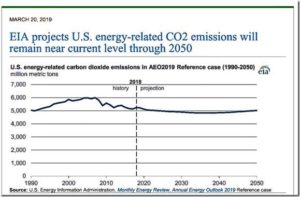
The Energy Information Administration (EIA) has released its 2019 Annual Energy Outlook(AEO) report for the U.S. showing that the nations year 2050 CO2 emissions will be just over 1 billion metric tons per year lower than its peak year 2007 CO2 emissions of 6.021 billion metric tons which retains and sustains the CO2 reductions achieved because of market driven increased use of natural gas while reducing coal fuel use.

During this same time period the world’s developing nations are forecast to increase their CO2 emissions by more than 14.5 billion metric tons per year bringing their CO2 emissions levels to a total of about 6 times those of the U.S.

Busted Hockey Sticks: 35 Non-Global Warming Papers Have Been Published In 2019

by Kenneth Richard, March 22, 2019 in NoTricksZone


Could a transition in paleoclimate reconstruction be underway? More and more, scientists aren’t hiding statements or graphical depictions of the lack of modern warming or the much-warmer Holocene past.


A compilation of 35 papers from across the globe indicate that modern climate is not unusual, remarkable or unprecedented, and that large regions of the Earth were as warm or warmer than now when CO2 concentrations were much lower (260 to 350 ppm).

This development continues apace with the trends from the last two years, when 253 non-hockey stick papers were published.

Summit leak reveals EU rift on climate change

by Frédéric Simon, March 21, 2019 in Euractiv


Confidential documents prepared in advance of a two-day EU summit in Brussels have exposed an East-West divide in Europe on climate change, with Germany siding with Poland, Hungary and the Czech Republic in their refusal to commit to climate neutrality by 2050.

The leaked documents, seen by EURACTIV, show the amendments proposed by each country in preparation for the final statement of the leaders summit that opens in Brussels on Thursday (21 March).

And when it comes to climate action, the papers reveal a growing rift between two distinct groups of countries.

On the one hand, France, the Netherlands, Luxembourg, Spain, Portugal, Finland, Sweden and Denmark have all backed a European Commission plan to decarbonise the EU by 2050, linking it specifically to the Paris Agreement objective of keeping global warming below 1.5°C.

A French proposal, for instance, underlines that Europe should strive for climate neutrality “by 2050, in line with the 1.5 degree objective of the Paris Agreement”.

It then calls on EU member states “to prepare a discussion in the European Council in June to define the announcements of the EU at the September Climate Summit in New York”. Both amendments were rejected in the final draft.

On the other hand, Germany, Poland, Hungary and the Czech Republic have refused to specifically link EU climate action with the 1.5°C objective. They also oppose any time-bound commitment to the EU’s climate neutrality objective, deleting any reference to 2050 for reaching that goal.

Inconvenient: Polar Bear Numbers May Have Quadrupled

by Anthony Watts, March 19, 2019 in WUWT


Researcher says attempts to silence her have failed

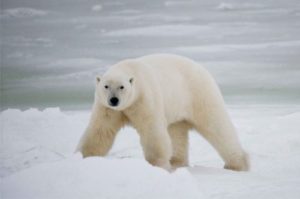
Polar bear numbers could easily exceed 40,000, up from a low point of 10,000 or fewer in the 1960s.

In The Polar Bear Catastrophe that Never Happened, a book published today by the Global Warming Policy Foundation, Dr Susan Crockford uses the latest data as well as revisiting some of the absurd values used in official estimates, and concludes that polar bears are actually thriving:

NOAA : “among the eight warmest Februarys on record”

by Tony Heller, March 19, 2019 in TheDeplorableClimSciBLog


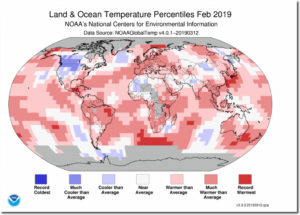
NOAA says last month was “among the eight warmest Februarys on record” in much of the Earth.

According to NCEI’s Regional Analysis, South America, Europe and Oceania had a February temperature that ranked among the eight warmest Februarys on record.

There is no such word as “Februarys” – plural for February is Februaries. But besides the fact they are illiterate, they are also lying

It looks like the world is burning up, with just a few slightly cool areas. It has an official government seal on it, so it must be accurate, right?

The map below shows where NOAA actually had surface temperatures in February.

The Green New Deal’s Weak Chain Of Logic

by Daniel G. Jones, March 18, 2019 in ClimateChangeDispatch


Reagan observed: “It isn’t so much that liberals are ignorant. It’s just that they know so many things that aren’t so.”

So it is with the Green New Deal. Most liberals regard it as a simple proposition: Global warming is a really big problem, and it’s our fault, so let’s fix it.

But closer analysis reveals that the argument for the Green New Deal rests upon a long chain of interdependent assertions, every one of which must be believed for the problem to be of sufficient peril to warrant their drastic solution.

Here are links in their chain of logic. If you doubt the truth of any single step, you must discard the entire argument.

The Climate Debate Twenty Years Later (recalling Houston’s 1999 conference)

by Robert Bradley Jr., March 7, 2019 in MasterResource


“Better climate knowledge about natural versus anthropogenic forcing seems to a decade away.” That was the major takeaway from a major 1999 climate conference in Houston, Texas as noted by Martin Cassidy of the Houston Geological Society, who  authored a conference summary, “Global Climate Change: Panel Agrees: ‘In 10 Years We Will Know‘.”

In fact, one of the conference participants, Gerald North, climatologist at Texas A&M, repeated this a decade after this conference. In his words:

In another decade of research we will have squared away a lot of our uncertainties about forced climate change. As this approaches we can be thinking about what to do if the warming does indeed appear to be caused by humans and to what extent things are changing as result. (North to Seldon B. Graham, Jr. January 6, 2010)

Now for Cassidy’s 1,000-word writeup. As you read this, ask yourself: what is really that different today, 20 years later, science-wise?

Planet-Sized Experiments – we’ve already done the 2°C test

by Willis Eschenbach, March 17, 2019 inWUWT


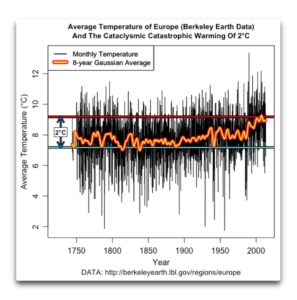
People often say that we’re heading into the unknown with regards to CO2 and the planet. They say we can’t know, for example, what a 2°C warming will do because we can’t do the experiment. This is seen as important because for unknown reasons, people have battened on to “2°C” as being the scary temperature rise that we’re told we have to avoid at all costs.

But actually, as it turns out, we have already done the experiment. Below I show the Berkeley Earth average surface temperature record for Europe. Europe is a good location to analyze, because some of the longest continuous temperature records are from Europe. In addition, there are a lot of stations in Europe that have been taking record for a long time. This gives us lots of good data.

So without further ado, here’s the record of the average European temperature.

An Analysis of the Recent Climate Change Hysteria

by Tim Ball, March 16, 2019 in WUWT


Most people were taken in by the false story of human-caused global warming. We can include all the students participating in the classroom walkout to demand governments stop climate change, organized by 16-year-old Greta Thunberg. Her goal is to keep global temperatures below 2 degrees Celsius above pre-industrial levels. Apparently, she has no idea that the temperature was near or above that level for most of the last 10,000-years in a period known as the Holocene Optimum.

They are taken in by the false claim that a minute amount of human-produced CO2 is effectively controlling the entire atmospheric system since 1950 and causing environmental collapse through global warming. They don’t know that there is an upper limit to the amount that CO2 can increase temperature. They don’t know that the average level of CO2 over the last 250 million years is 1200 ppm. They don’t know that every projection of temperature by the UN Intergovernmental Panel on Climate Change (IPCC) since 1990 was wrong. To paraphrase Winston Churchill, how did so few, fool so many, to such an extent, for so long?

GREENLAND ICE SHEET SIXTH HIGHEST ON RECORD

by GWPF, December 7, 2019


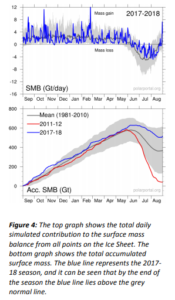
In 2018, Greenland’s total  surface mass budget (SMB) is almost 150bn tonnes above the average for 1981-2010, ranking as sixth highest on record.


The Danish Meteorological Institute (DMI) also performs daily simulations of how much ice or water the Ice Sheet loses or accumulates. Based on these simulations, an overall assessment of how the surface mass balance develops across the entire Ice Sheet is obtained (Fig. 4).

At the end of the 2018 season (31 August 2018), the net surface mass balance was 517 Gt, which means that 517 Gt more snow fell than the quantity of snow and ice that melted and ran out into the sea.

Exagérations climatiques extrêmes

by Jean N., 14 mars 2019 in ScienceClimatEnergie


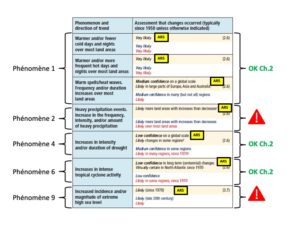
Il ne se passe pas une journée sans que l’on entende ou lise dans les médias que le climat est “déréglé” et qu’il y a de plus en plus d’évènements climatiques extrêmes. Et de nombreux scientifiques semblent penser la même chose. Par exemple, une pétition publiée fin janvier 2019 et signée par 3400 scientifiques belges, déclare au point 3 : “Le seul réchauffement actuel de 1°C entraîne déjà une augmentation de l’occurrence et de l’intensité des extrêmes climatiques tels que les canicules, les sécheresses ou encore les inondations.” Aucune référence n’est malheureusement donnée par les signataires de la pétition… Ces phénomènes climatiques sont-ils exagérés? Consultons donc le dernier rapport du GIEC, l’AR5 publié en 2013, et particulièrement le chapitre 2 qui traite des évènements climatiques extrêmes (depuis 2013, le GIEC n’a plus rien publié d’aussi complet sur le sujet). Préparez-vous à être surpris!

Figure 1. Extrait de la Table SPM.1 concernant les évènements climatiques extrêmes dans le résumé pour décideurs du rapport AR5 du GIEC. Sur 9 phénomènes climatiques extrêmes seulement 5 sont présentés dans la table par le GIEC. Le texte noir sont des conclusions tirées par l’AR5. Les textes en rouge et en bleu sont des conclusions plus anciennes (AR4 et rapport SREX). A droite, “OK Ch.2” indique que le résumé est correct par rapport au texte; le triangle rouge “attention”, indique que des informations importantes sont manquantes et peuvent induire en erreur.

Greenland’s Glaciers Expanding Again

by P. Homewood, March 11, 2019 in NotaLotofPeopleKnowThat


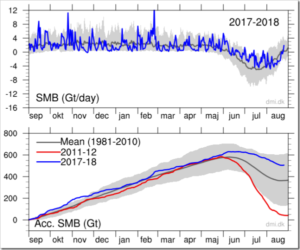
As I reported last  September, Greenland’s ice sheet mass balance had grown at close to record levels for the second year running.

To clarify again, the mass balance calculation accounts for:

1) Snowfall

2) Ice melt

3) Ablation


In other words, it does not include calving.

http://www.dmi.dk/en/groenland/maalinger/greenland-ice-sheet-surface-mass-budget/#

..

Emails reveal how children become pawns of climate alarmism

by Anthony Watts, March 13, 2019 in WUWT


Genesis of a Shakedown: New Records Expose Children’s Marches as Long-Planned Component of Litigation Campaign

These public records produced mere days after 60 Minutes’s promotional segment, and days before the nationwide children’s climate walkouts, affirm:

  • the climate litigation campaign was expressly grounded in this failure of “conventional approaches” otherwise known as our constitutional system

  • it was to be “linked to youth climate movement (world-wide marches)”;

  • it would be accompanied by a press strategy including documentaries featuring children;

  • the meeting was acknowledged, but this strategy laid out there was “not to be publicized”;

  • the strategy sought both a cooperative federal administration “Consent decrees (would be ideal)” — and to “Bring selected carbon majors to the table, then what?”

CA sea level rise alarmist study ignores 30 years of NOAA data with no coastal sea level rise acceleration

by Larry Hamlin, March 13, 2019 in WUWT


NOAA tide gauge data measurements exist for 17 locations along the California coast with 8 of these locations having actual measured sea level rise data covering periods for more than 70 to 120 years in duration.

This measured data shows that none of these California locations are experiencing coastal sea level rise acceleration since climate alarmist first made such erroneous and flawed sea level acceleration claims before the U.S. Senate in 1988.

Climate alarmists and their supporting media conveniently conceal the fact that their flawed claims have been hyped for the last 30 years as they continue to try again and again to make the same repeated but flawed claims apparently hoping that the public will forget their long track record of failure and exaggeration.

NOAA measured tide gauge data shows that coastal sea level rise at Ca. locations varies between 3 to 12 inches per century and have remained at those levels during the long measurement periods during which actual measured data have been recorded with a sample of that measured data shown below for San Diego, La Jolla, Los Angeles and San Francisco.

Polar bear habitat update: abundant sea ice across the Arctic, even in the Barents Sea

by Polar Bear Science, March 12, 2019


Abundant ice in Svalbard, East Greenland and the Labrador Sea is excellent news for the spring feeding season ahead because this is when bears truly need the presence of ice for hunting and mating. As far as I can tell, sea ice has not reached Bear Island, Norway at this time of year since 2010 but this year ice moved down to the island on 3 March and has been there ever since. This may mean we’ll be getting reports of polar bear sightings from the meteorological station there, so stay tuned.


The Role of Sulfur Dioxide Aerosols in Climate Change

by Buel Henry, May 26, 2015 in WUWT


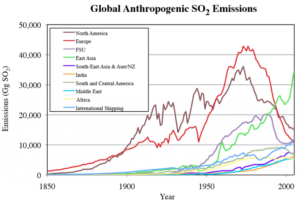
Anthropogenic emissions of SO2 into the troposphere peaked during year 1972 at about 131 Megatonnes. By year 2000, due to worldwide Clean Air Act efforts, SO2 emissions in the West had decreased by approximately 48 Megatonnes. However, during the same time period, emissions elsewhere rose by 23 Megatonnes, for a net worldwide decrease of 25 Megatonnes.

Figure 1: Global sulfur dioxide emissions by region (North Amer- ica = USA,Canada; East Asia, Japan, China, and South Korea). J.Smith et al., Fig 6.

It also proves that the IPCC “Graph of Radiative Forcings” is completely incorrect, since it does not include any warming due to the removal of dimming-aerosols from the atmosphere. To be correct, this forcing needs to be included (which will have the effect of completely eliminating any forcing due to CO2). As noted above, all of the warming can be accounted for by the reduction in SO2 emissions.

New Paper: Widespread Collapse Of Ice Sheets ~5000 Years Ago Added 3-4 Meters To Rising Seas

by K. Richard, March 11, 2019 in NoTricksZone


During the Mid-Holocene, when CO2 concentrations were stable and low (270 ppm), Antarctica’s massive Ross Ice Shelf naturally collapsed, adding the meltwater equivalent of 3-4 meters to sea levels.

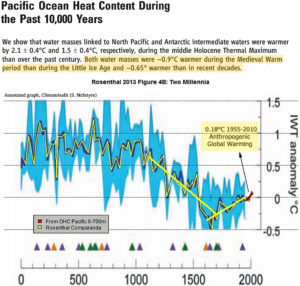
Because CO2 concentrations changed very modestly during the pre-industrial Holocene (approximately ~25 ppm in 10,000 years), climate models that are predicated on the assumption that CO2 concentration changes drive ocean temperatures, ice sheet melt, and sea level rise necessarily simulate a very stable Holocene climate.

In contrast, changes in ocean temperatures, ice sheet melt, and sea level rise rates were far more abrupt and variable during the Holocene than during the last 100 years.

Modern ocean changes are barely detectable in the context of natural variability

Image Source(s): Rosenthal et al., 2013Climate Audit

Henrik Svensmark: Force Majeure – The Sun’s Role In Climate Change (PDF)

in GWPF, March 11, 2019


London, 11 March: A new report from the Global Warming Policy Foundation reveals that the solar influence on climate is is much larger than is generally recognised.

The report, by Professor Henrik Svensmark of the Danish National Space Institute, outlines some of the remarkable correlations between solar activity and past climate changes. It also shows that the output of the Sun alone – the so-called total solar irradiance – cannot explain them.

“Changes in total solar irradiance are actually quite small”, says Professor Svensmark. “They would have to be nearly 10 times larger to explain how the oceans warm and cool over the 11-year solar cycle.”

New research suggests that other mechanisms can amplify the effect of solar activity. The New report reviews the possible candidates, concluding that the most likely of these is the effects of galactic cosmic rays on cloud formation. This idea is plausible in theory and has received substantial empirical support in recent years.

However, Professor Svensmark says that insufficient attention is being paid to this research area:

“Galactic cosmic rays seem to be very important drivers of the Earth’s climate. But they are mostly being ignored at the moment because they are seen as distracting from conventional global warming research. Science needs to do better if we want to make progress in understanding the actual impact of natural factors of climate change.”

Henrik Svensmark: Force Majeure – The Sun’s Role In Climate Change (PDF)

About the author
Prof Henrik Svensmark is a physicist and a senior researcher in the Astrophysics and Atmospheric Physics Division of the National Space Institute (DTU Space) in Lyngby, Denmark. Svensmark presently leads the Sun–Climate Research group at DTU Space.

CHINA AND THE PAUSE

by GWPF, March 8, 2019


Chinese climate scientists are clearly off-message. They keep referring to the global warming hiatus which so many scientists and activists – those who shout on twitter and prowl the comment sections of off-colour articles on the subject – know has been trounced and discredited again and again. They clearly ought to have a word with the emerging science powerhouse that is China.

Writing recently in “Science of The Total Environment,” Li and Zha of Nanjing Normal University, say the global hiatus has played a prominent role in their thinking and they see it reflected in China. Using satellite data they found a hiatus in China between 2001-15. They found warming in western and southern China and a 15-year cooling trend in northern China. For China as a whole they estimate that the warming rate is just -0.02°C per decade. The conclude that, “there is a regional warming hiatus, a pause or slowdown in China, and (it) implies that greenhouse gas induced warming is suppressed by other natural forcing in the early 21st century.”

There is also Li et al writing in Climate Dynamics who are a little more forceful saying, “since the late 1990s, the global warming has ground to a halt, which has sparked a rising interest among the climate scientists. The hiatus is not only observed in globally average surface air temperature, but also in the China winter air temperature trend, which turns from warming during 1979-1997 to cooling during 1998-2013.” They attribute the effect to the melting of Arctic sea ice.

Gan et al (Lanzhou University and South Dakota State University), reporting in Earth and Space Science say that the hiatus, if not cooling, is seen over the Northern Hemisphere finding that the daily temperature minimum experienced an “obvious” decline in North America during the warming slowdown period. They relate the changes in daily temperature minimum to the Atlantic Multi-decadal Oscillation.

Global Warming off the hook? Alien species are primary cause of recent global extinctions

by University College London, March 3, 2019 in WUWT


Alien species are the main driver of recent extinctions in both animals and plants, according to a new study by UCL researchers.

They found that since 1500, alien species have been solely responsible for 126 extinctions, 13% of the total number studied.

Of 953 global extinctions, 300 happened in some part because of alien species, and of those 300, 42% had alien species alone listed as the cause of their demise.

The study, published today in Frontiers in Ecology and the Environment, used data from the 2017 IUCN Red List on the total numbers of species that are considered to have gone extinct globally since 1500.

In total, 261 out of 782 animal species (33.4%) and 39 out of 153 plant species (25.5%) listed aliens as one of their extinction drivers. In contrast, native species impacts were associated with only 2.7% of animal extinctions and 4.6% of plant extinctions.


2019 GLOBAL TEMPS PREDICTION: THE ENTRIES ARE IN

by GWPF, March 6, 2019


The Met Office says it’s going to get warmer this year. GWPF readers reckon not.

Back in early February, we invited readers to submit their entries for our 2019 global temperature prediction competition. The GWPF posse had soundly beaten the Met Office in last year’s competition, and you certainly seemed encouraged by your success, as there were 250 entries this time round, more than double last year’s entry.

For 2019, the Met Office have once again pushed the boat out on their predictions, suggesting that we might see a temperature rise of 0.19°C by the year end.

As you can see from the graph below, GWPF readers are a lot more cautious. The graph is a histogram of the entries, so the height of each blue bar is the number of readers making a particular prediction, the temperatures being given in terms of anomalies from the 1961-1990 average. The most common prediction was therefore for a slight decline in temperature over the course of the year, down to to 0.55°C from last year’s 0.6°C. The Met Office prediction is the grey band – they have given a single value this time round, rather than the range given in previous years.