Tous les articles par Alain Préat

Full-time professor at the Free University of Brussels, Belgium apreat@gmail.com apreat@ulb.ac.be • Department of Earth Sciences and Environment Res. Grp. - Biogeochemistry & Modeling of the Earth System Sedimentology & Basin Analysis • Alumnus, Collège des Alumni, Académie Royale de Sciences, des Lettres et des Beaux Arts de Belgique (mars 2013). http://www.academieroyale.be/cgi?usr=2a8crwkksq&lg=fr&pag=858&rec=0&frm=0&par=aybabtu&id=4471&flux=8365323 • Prof. Invited, Université de Mons-Hainaut (2010-present-day) • Prof. Coordinator and invited to the Royal Academy of Sciences of Belgium (Belgian College) (2009- present day) • Prof. partim to the DEA (third cycle) led by the University of Lille (9 universities from 1999 to 2004) - Prof. partim at the University of Paris-Sud/Orsay, European-Socrates Agreement (1995-1998) • Prof. partim at the University of Louvain, Convention ULB-UCL (1993-2000) • Since 2015 : Member of Comité éditorial de la Revue Géologie de la France http://geolfrance.brgm.fr • Since 2014 : Regular author of texts for ‘la Revue Science et Pseudosciences’ http://www.pseudo-sciences.org/ • Many field works (several weeks to 2 months) (Meso- and Paleozoic carbonates, Paleo- to Neoproterozoic carbonates) in Europe, USA (Nevada), Papouasia (Holocene), North Africa (Algeria, Morrocco, Tunisia), West Africa (Gabon, DRC, Congo-Brazzaville, South Africa, Angola), Iraq... Recently : field works (3 to 5 weeks) Congo- Brazzaville 2012, 2015, 2016 (carbonate Neoproterozoic). Degree in geological sciences at the Free University of Brussels (ULB) in 1974, I went to Algeria for two years teaching mining geology at the University of Constantine. Back in Belgium I worked for two years as an expert for the EEC (European Commission), first on the prospecting of Pb and Zn in carbonate environments, then the uranium exploration in Belgium. Then Assistant at ULB, Department of Geology I got the degree of Doctor of Sciences (Geology) in 1985. My thesis, devoted to the study of the Devonian carbonate sedimentology of northern France and southern Belgium, comprised a significant portion of field work whose interpretation and synthesis conducted to the establishment of model of carbonate platforms and ramps with reefal constructions. I then worked for Petrofina SA and shared a little more than two years in Angola as Director of the Research Laboratory of this oil company. The lab included 22 people (micropaleontology, sedimentology, petrophysics). My main activity was to interpret facies reservoirs from drillings in the Cretaceous, sometimes in the Tertiary. I carried out many studies for oil companies operating in this country. I returned to the ULB in 1988 as First Assistant and was appointed Professor in 1990. I carried out various missions for mining companies in Belgium and oil companies abroad and continued research, particularly through projects of the Scientific Research National Funds (FNRS). My research still concerns sedimentology, geochemistry and diagenesis of carbonate rocks which leads me to travel many countries in Europe or outside Europe, North Africa, Papua New Guinea and the USA, to conduct field missions. Since the late 90's, I expanded my field of research in addressing the problem of mass extinctions of organisms from the Upper Devonian series across Euramerica (from North America to Poland) and I also specialized in microbiological and geochemical analyses of ancient carbonate series developing a sustained collaboration with biologists of my university. We are at the origin of a paleoecological model based on the presence of iron-bacterial microfossils, which led me to travel many countries in Europe and North Africa. This model accounts for the red pigmentation of many marble and ornamental stones used in the world. This research also has implications on the emergence of Life from the earliest stages of formation of Earth, as well as in the field of exobiology or extraterrestrial life ... More recently I invested in the study from the Precambrian series of Gabon and Congo. These works with colleagues from BRGM (Orléans) are as much about the academic side (consequences of the appearance of oxygen in the Paleoproterozoic and study of Neoproterozoic glaciations) that the potential applications in reservoir rocks and source rocks of oil (in collaboration with oil companies). Finally I recently established a close collaboration with the Royal Institute of Natural Sciences of Belgium to study the susceptibility magnetic signal from various European Paleozoic series. All these works allowed me to gain a thorough understanding of carbonate rocks (petrology, micropaleontology, geobiology, geochemistry, sequence stratigraphy, diagenesis) as well in Precambrian (2.2 Ga and 0.6 Ga), Paleozoic (from Silurian to Carboniferous) and Mesozoic (Jurassic and Cretaceous) rocks. Recently (2010) I have established a collaboration with Iraqi Kurdistan as part of a government program to boost scientific research in this country. My research led me to publish about 180 papers in international and national journals and presented more than 170 conference papers. I am a holder of eight courses at the ULB (5 mandatory and 3 optional), excursions and field stages, I taught at the third cycle in several French universities and led or co-managed a score of 20 Doctoral (PhD) and Post-doctoral theses and has been the promotor of more than 50 Masters theses.

Plate tectonics may have driven ‘Cambrian Explosion’

by University of Exeter, June 19, 2019 in ScienceDaily/from Nature


A team of scientists have given a fresh insight into what may have driven the “Cambrian Explosion” — a period of rapid expansion of different forms of animal life that occurred over 500 million years ago.

While a number of theories have been put forward to explain this landmark period, the most credible is that it was fuelled by a significant rise in oxygen levels which allowed a wide variety of animals to thrive.

The new study suggests that such a rise in oxygen levels was the result of extraordinary changes in global plate tectonics.

During the formation of the supercontinent ‘Gondwana’, there was a major increase in continental arc volcanism — chains of volcanoes often thousands of miles long formed where continental and oceanic tectonic plates collided. This in turn led to increased ‘degassing’ of CO2 from ancient, subducted sedimentary rocks.

This, the team calculated, led to an increase in atmospheric CO2and warming of the planet, which in turn amplified the weathering of continental rocks, which supplied the nutrient phosphorus to the ocean to drive photosynthesis and oxygen production.

If “Greenland is catastrophically melting”, how do alarmists explain NASA’s growing Greenland glacier?

by A. Watts, June19, 2019 in WUWT


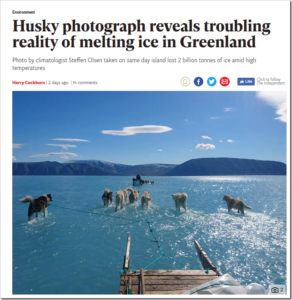
It turned out to be a weather event, unrelated to “climate change”. The next year, there was no “insta-melt“.

In fact. we’d not even know about the melting in Greenland before satellites came on the scene. So how many times in the history of the Earth has Greenland has a quick melt spike? I’m guessing hundreds of thousands of times.

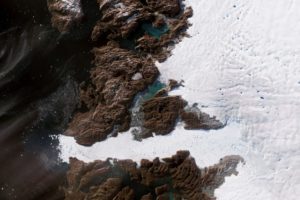
Jakobshavn Glacier in western Greenland is notorious for being the world’s fastest-moving glacier. It is also one of the most active, discharging a tremendous amount of ice from the Greenland Ice Sheet into Ilulissat Icefjord and adjacent Disko Bay—with implications for sea level rise. The image above, acquired on June 6, 2019, by the Operational Land Imager (OLI) on Landsat 8, shows a natural-color view of the glacier.

Jakobshavn has spent decades in retreat—that is, until scientists observed an unexpected advance between 2016 and 2017. In addition to growing toward the ocean, the glacier was found to be slowing and thickening. New data collected in March 2019 confirm that the glacier has grown for the third year in a row, and scientists attribute the change to cool ocean waters.

June 6th, 2019 Jakobshavn Glacier in western Greenland . Image acquired on June 6, 2019, by the Operational Land Imager (OLI) on Landsat 8, shows a natural-color view of the glacier.

Consensus? 200+ New 2019 Papers Support A Skeptical Position On Climate Alarmism

by K. Richard, June17, 2019 in NoTricksZone


In the first 5½ months of 2019, over 200 scientific papers have been published that cast doubt on the position that anthropogenic CO2 emissions function as the climate’s fundamental control knob…or that otherwise serve to question the efficacy of climate models or the related “consensus” positions commonly endorsed by policymakers and ²²²²mainstream media sources.


These 200+ new papers affirm the position that there are significant limitations and uncertainties inherent in our understanding of climate and climate changes, emphasizing that climate science is not settled.

More specifically, the papers in this compilation support these four main skeptical positions — categorized here as N(1) – N(4) — which question climate alarm.

Dry Hot North German Summers Were More Common 1000 Years Ago, Scientists Report

by P. Gosselin, June 19, 2019 in NoTricksZone


Dry Summers Like 2018 Were Common in the Middle Ages

THE FUTILITY OF WESTERN DE-CARBONISATION

by Ed. Hoskins, June 18, 2019  in GWPF


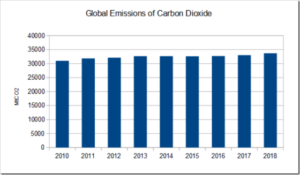
It is clear that CO2 emissions are continuing to grow incrementally in the Developing World.  This should be anticipated to continue indefinitely.

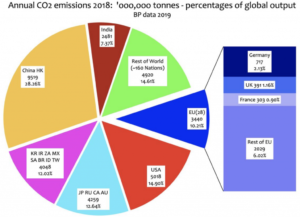
2018 Global CO2 emissions

The following calculations and graphics are based on information on worldwide CO2 emissions published by BP in June 2019 for the period from 1965 up until the end of 2018.

The pie diagram above shows the proportion of CO2 emissions as of the end of 2018.

The previous post for the end of 2017 is available here

The data showing the progress of CO2 emissions by 2018 in the Developed and Developing worlds can be summarised as follows:

Earth system models underestimate carbon fixation by plants in the high latitudes

by From Nature Communications, June 18 in WUWT


Abstract

Most Earth system models agree that land will continue to store carbon due to the physiological effects of rising CO2 concentration and climatic changes favoring plant growth in temperature-limited regions. But they largely disagree on the amount of carbon uptake. The historical CO2 increase has resulted in enhanced photosynthetic carbon fixation (Gross Primary Production, GPP), as can be evidenced from atmospheric CO2 concentration and satellite leaf area index measurements. Here, we use leaf area sensitivity to ambient COfrom the past 36 years of satellite measurements to obtain an Emergent Constraint (EC) estimate of GPP enhancement in the northern high latitudes at two-times the pre-industrial CO2 concentration (3.4 ± 0.2 Pg C yr−1). We derive three independent comparable estimates from CO2 measurements and atmospheric inversions. Our EC estimate is 60% larger than the conventionally used multi-model average (44% higher at the global scale). This suggests that most models largely underestimate photosynthetic carbon fixation and therefore likely overestimate future atmospheric CO2 abundance and ensuing climate change, though not proportionately.

CO2, GLOBAL WARMING, CLIMATE AND ENERGY

by Allan M.R. MacRae, B.A.Sc., M.Eng., P.Eng., June 2019 in WUWT


ABSTRACT

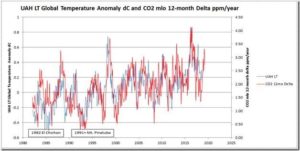
Global warming alarmism, which falsely assumes that increasing atmospheric CO2 causes catastrophic global warming, is disproved – essentially, it assumes that the future is causing the past. In reality, atmospheric CO2 changes lag global temperature changes at all measured time scales.

Nino34 Area Sea Surface Temperature changes, then tropical humidity changes, then atmospheric temperature changes, then CO2 changes.

The velocity dCO2/dt changes ~contemporaneously with global temperature changes and CO2 changes occur ~9 months later (MacRae 2008).

The process that causes the ~9-month average lag of CO2 changes after temperature changes is hypothesized and supported by observations.

The ~9-month lag, +/- several months, averages 1/4 of the full-period duration of the variable global temperature cycle, which averages ~3 years.

Based on the above observations, global temperatures drive atmospheric CO2 concentrations much more than CO2 drives temperature.

Climate sensitivity to increasing atmospheric CO2 must be very low, less than ~1C/(2*CO2) and probably much less.

There will be no catastrophic warming and no significant increase in chaotic weather due to increasing CO2 concentrations.

Increasing atmospheric CO2 clearly causes significantly improved crop yields, and may cause minor, beneficial global warming.

Atmospheric CO2 is not alarmingly high, it is too low for optimal plant growth and alarmingly low for the survival of carbon-based terrestrial life.

Other factors such as fossil fuel combustion, deforestation, etc may also increase atmospheric CO2. The increase of CO2 is clearly beneficial.

“Green energy” schemes are not green and produce little useful (dispatchable) energy, primarily because of the fatal flaw of intermittency.

There is no widely-available, cost-effective means of solving the flaw of intermittency in grid-connected wind and solar power generation.

Electric grids have been destabilized, electricity costs have soared and Excess Winter Deaths have increased due to green energy schemes.

HYPOTHESIS AND CONCLUSIONS

Fig.1a – The very close relationship of dCO2/dt (red) vs global temperature (blue) is clearly apparent. Major volcanoes disrupt the relationship.
Total a commencé à exploiter le supercalculateur Pangea III à Pau

by AFP, 18 juin 2019 in ConnaissanceDesEnergies


Total a annoncé mardi qu’il avait commencé à exploiter à Pau son supercalculateur Pangea III, le plus puissant ordinateur du monde dans l’industrie avec une puissance de calcul de 25 petaflops (millions de milliards d’opérations par seconde).

Pangea III est onzième au classement toute catégories des ordinateurs, derrière des machines installées dans de grands centres de recherche aux États-Unis, en Chine, au Japon ou en Europe. Le groupe pétrolier a investi “plusieurs dizaines de millions de dollars” dans ce troisième supercalculateur, a confirmé une source proche du dossier à l’AFP.

La machine porte la puissance de calcul totale du groupe à 31,7 petaflops (soit 170 000 ordinateurs portables). Elle triple sa capacité de stockage à 76 petaoctets (près de 50 millions de films en HD).

Climate change puts pressure on Europe’s energy system

by European Environment Agency, June 18, 2019


All parts of Europe’s energy system, from availability of energy sources to energy consumption, are potentially vulnerable to climate change and extreme weather events, according to a European Environment Agency report, published today. To secure reliable supply of clean energy, Europe’s energy system needs to adapt and become more climate resilient, the report states.

The EEA assessment ‘Adaptation challenges and opportunities for the European energy system’ analyses the needs for climate change adaptation and climate resilience in Europe’s energy system now and in the future. This assessment supports the clean energy transition, which involves a massive expansion of renewable energy sources, many of which are sensitive to climate factors.

The new assessment warns that climate change and extreme weather events increasingly affect all parts of the European energy system. The most important changes include increases in mean and extreme air and water temperatures, and changes in water availability, extreme climate‑related events, and coastal and marine hazards. These changes will affect the availability of primary energy sources — especially renewable energy sources — as well as the transformation, transmission, distribution and storage of energy, and energy demand.

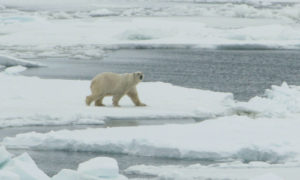
Polar bear habitat update at mid-June: more than enough for survival

by Polar Bear Science, June 16, 2019


Here we are at the middle of June, when most polar bears are pretty much done with hunting seals for the season. And despite hand-wringing from some quarters, sea ice extent is down only marginally from average at this time of year and certainly not enough to impact polar bear survival.

Given the large expanse of open water in the Southern Beaufort so early in the season, one resident pessimist insists those polar bears are “challenged” by the lack of ice. If he is right, there should be reports of dozens upon dozens of skinny and dying bears along the coast of Alaska this summer. If not, he will pretend he never suggested any such thing.

So far, despite the early loss of ice in some regions, there have been no reports of polar bears ashore unusually early. Hudson Bay still has lots of thick first year ice, so despite the overall reduced Arctic ice coverage, none of the three Hudson Bay polar bear populations are facing the earlier-than-usual sea ice breakup this year as we keep being promised will show up. In fact, there hasn’t been a significantly early breakup in Western Hudson Bay since 2010 (see previous posts here and here).

Without Mining, There Is No ‘Green Revolution’

by S. Moore A. & Bridges, June17, 2019 in ClimateChangeDispatch


The recent threats by Beijing to cut off American access to critical mineral imports has many Americans wondering why our politicians have allowed the United States to become so overly-dependent on China for these valued resources in the first place.

Today, the United States is 90 percent dependent on China and Russia for many vital “rare earth minerals.”

The main reason for our over-reliance on nations like China for these minerals is not that we are running out of these resources here at home. The U.S. Mining Association estimates that we have at least $5 trillion of recoverable mineral resources.

The U.S. Geological Survey reports that we still have up to 86 percent or more of key mineral resources like copper and zinc remaining in the ground, waiting to be mined.

These resources aren’t on environmentally sensitive lands, like national parks, but on the millions of acres of federal, state and private lands.

The mining isn’t happening because of extremely prohibitive environmental rules and a permitting process that can take 5-10 years to open a new mine. Green groups simply resist almost all new drilling.

What they may not realize is that the de facto mining prohibitions jeopardize the “Green Energy Revolution” that liberals so desperately are seeking.

How is this for rich irony: To make renewable energy at all technologically plausible, will require massive increases in the supply of rare earth and critical minerals.

Will Climate Change Drive a Million Species Extinct?

by Vijay Jayaraj, June 3, 2019 Townhall


A million species threatened by “climate change”? Well, climate change as defined by the UN Framework Convention on Climate Change (“a change of climate that is attributed directly or indirectly to human activity that alters the composition of the global atmosphere and that is in addition to natural climate variability observed over comparable time periods”) isn’t likely to bring about any warming exceeding that of the warm periods mentioned above.

Which of course means it’s not likely to drive millions of species extinct. In fact, it will be a miracle if the gradual change in climate causes any alarming extinctions at all.

Only illegal hunting and habitat destruction (despite protection by governments) continue to threaten endangered species. Even in the worst case, they won’t cause species extinctions in the millions.

Vijay Jayaraj (M.Sc., Environmental Science, University of East Anglia, England), Research Associate for Developing Countries for the Cornwall Alliance for the Stewardship of Creation, lives in Bangalore, India.

Wind Energy Woes: German Expansion “Collapses To Near Zero” …”2019 Threatens To Be A Disaster”

by P. Gosselin, June 11, 2019 in NoTricksZone


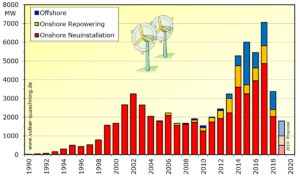
Despite all the talk about the need to transition over to green energies, Germany’s progress — in especially wind energy — has ground to a complete halt.

German news site iwr.de here reports that the expansion of wind energy in Germany has “come the a stop” as the government has scaled back subsidies and enacted stricter permitting laws.

“As in April 2019, only nine new wind turbines went into operation nationwide in May,” IWR reported. “The year 2019 threatens to be a disaster for the wind industry in Germany.”

The IWR reported further: “In the first five months of 2019, only around 60 new onshore wind turbines went into operation nationwide. This is the result of an IWR evaluation of data from the market master data register of the Federal Network Agency (BNetzA).”

“A catastrophe” for wind power

At Twitter green energy activist Prof. Volker Quaschning called the collapse a “catastrophe”, tweeting that the expansion of wind power “collapsed completely”. He added that “it will be impossible to meet the CO2 reduction targets” and that 40,000 jobs in the wind industry are “on the brink”.

Extremes

by Judith Curry, June14, 2019 in WUWT


Politics versus science in attributing extreme weather events to manmade global warming.

If you follow me on twitter, you may have noticed that I was scheduled to testify before the House Oversight and Reform Committee on Jun 12 [link].  The subject of the Hearing is Contending with Natural Disasters in the Wake of Climate Change.

Late on Jun 10, I received an email telling me that the Hearing is postponed (as yet unscheduled).  Apparently the Committee finds it more urgent to have a Hearing related to holding the Attorney General and Secretary of Commerce in contempt of Congress [link].  Interesting to ponder that Congressional procedural issues are deemed to be more important than Climate Change.

So I spent all last week working on my testimony (which is why there have been no new blog posts).  I hope the Hearing will eventually happen (Michael Mann is also scheduled to testify).

Hurricanes and climate change constitute a major portion of my testimony.  You may recall my recent series  on Hurricanes & climate change [link].  Specifically with regards to detection and attribution, my bottom line conclusion was:

“In summary, the trend signal in hurricane activity has not yet had time to rise above the background variability of natural processes. Manmade climate change may have caused changes in hurricane activity that are not yet detectable due to the small magnitude of these changes compared to estimated natural variability, or due to observational limitations. But at this point, there is no convincing evidence that manmade global warming has caused a change in hurricane activity.”

La croissance du CO2 dans l’atmosphère est-elle exclusivement anthropique? (1/2) et Effet Suess

by J.C. Maurin, 13 juin 2019 in ScienceClimatEnergie


Une croissance du COatmosphérique qui serait exclusivement anthropique est contradictoire avec les observations du carbone 13 dans l’atmosphère (ici). Cet article en 2 parties va montrer qu’il existe également des contradictions avec les observations du carbone 14. Celui-ci  est utilisé à des fins de datation jusqu’à 50 000 ans BP  (Before Present)et on dispose de nombreuses études (pour calibration) sur son évolution dans l’atmosphère.  


La première partie s’intéresse, non pas aux datations, mais à la dilution du carbone 14 que provoque l’ajout de COanthropique (effet SUESS)  avant les essais thermonucléaires de 1952-1963.
Dans la seconde partie nous verrons que l’évolution du carbone 14 après 1963 est aussi en contradiction avec une croissance du COexclusivement anthropique.

1. Le carbone dans l’atmosphère [1] [5]

Le carbone existe habituellement sous 3 formes isotopiques : 12C pour ≈ 98.9% , 13C pour ≈ 1.1 % et 14C à l’état de traces (Fig. 1a).

Figure 1a.  La seule différence entre COanthropique et COatmosphérique réside dans les proportions du mélange des isotopes: le COanthropique est appauvri en 13C et 14C.  L’ajout de COanthropique va modifier, au fil des années, les proportions du mélange isotopique dans l’atmosphère.

A Second Look At Radiation Versus Temperature

by Willis Eschenbach, June 14, 2019 in WUWT


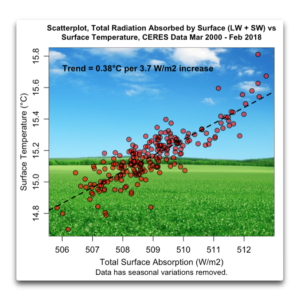
I kept going back and looking at the graphic from my previous post on radiation and temperature. It kept niggling at me. It shows the change in surface temperature compared to the contemporaneous change in how much energy the surface is absorbing. Here’s that graphic again:


Figure 1. From my previous post. It is a scatterplot showing the dependence of temperature on the total downwelling radiation (longwave plus shortwave) absorbed by the surface.

What I found botheracious were the outliers at the top of the diagram. I knew what they were from, which was the El Nino/La Nina of 2015-2016.

After thinking about that, I realized I’d left one factor out of the calculations above. What the El Nino phenomenon does is to periodically pump billions of cubic meters of the warmest Pacific equatorial water towards the poles. And I’d left that advected energy transfer out of the equation in Figure 1. (Horizontal transfer of energy from one place on earth to another is called “advection”).

And it’s not just advection of energy caused by El Nino. In general, heat is advected from the tropics towards the poles by the action of the ocean and the atmosphere. Figure 2 shows the average amount of energy exported (plus) or imported (minus) around the globe.

Statistical Review of World Energy

by BP, June 15, 2019


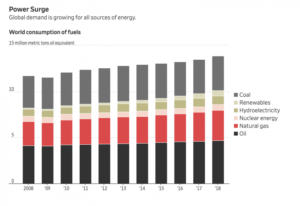
Global primary energy consumption grew rapidly in 2018, led by natural gas and renewables. Nevertheless, carbon emissions rose at their highest rate for seven years

Energy developments

  • Primary energy consumption grew at a rate of 2.9% last year, almost double its 10-year average of 1.5% per year, and the fastest since 2010.
  • By fuel, energy consumption growth was driven by natural gas, which contributed more than 40% of the increase. All fuels grew faster than their 10-year averages, apart from renewables, although renewables still accounted for the second largest increment to energy growth.
  • China, the US and India together accounted for more than two thirds of the global increase in energy demand, with US consumption expanding at its fastest rate for 30 years.


Carbon emissions

  • Carbon emissions grew by 2.0%, the fastest growth for seven years.

Hydrogen station explodes, Toyota halts sales of fuel cell cars, is this the end?

by Fred Lambert, June11, 2019 in Electrek


A hydrogen refueling station exploded in Norway on Monday and the company operating the station has suspended operation at its other locations following the explosion.

Now, Toyota and Hyundai are both halting sales of fuel cell vehicles in the country.

Does this spell the end of fuel cell hydrogen vehicles as a “zero-emission” alternative?

The Uno-X hydrogen station in Sandvika in Bærum exploded on Monday and resulted in two injuries in a nearby non-fuel cell vehicle.

According to the police, the explosion was strong enough that it activated the airbags in the vehicle without any impact.

The cause of the explosion is currently unknown and the rest of the refueling network is being shut down.

THE WORLD RETURNS TO COAL

by Graham Hill, June 13, 2019 in GWPF/TheAustralian


Global coal production (up 4.3 per cent) and consumption (up 1.4 per cent) has increased at their fastest rate for five years.

Average global greenhouse gas emissions are rising at double the rate of Australia’s, exposing the mismatch between the “hope and reality” of meeting Paris Agreement goals, a report has found.

A major report by energy giant BP said the world was returning to coal, and without shale gas from the US and LNG exports from Australia the emissions reduction picture would be much worse.

Massive investments in renewable energy were needed but would not be enough to satisfy increasing demands for power, most notably in China and India.

BP said global emissions overall were up 2 per cent last year as the unexpected return to coal gathered pace.

Study: Cattle Methane is a moooot point in global climate

by Anthony Watts, June 12, 2019 in WUWT


Via No Tricks Zone: Agrobiologist and scientific researcher Dr. Albrecht Glatzle, author of over 100 scientific papers and two textbooks, has published research that shows:

“…there is no scientific evidence, whatsoever, that domestic livestock could represent a risk for the Earth’s climate” and the “warming potential of anthropogenic GHG [greenhouse gas] emissions has been exaggerated.”

Glatzle, 2018

Domestic Livestock and ItsAlleged Role in Climate Change

Abstract:

“Our key conclusion is there is no need for anthropogenic emissions of greenhouse gases (GHGs), and even less so for livestock-born emissions, to explain climate change. Climate has always been changing, and even the present warming is most likely driven by natural factors.

The warming potential of anthropogenic GHG emissions has been exaggerated, and the beneficial impacts of manmade CO2 emissions for nature, agriculture, and global food security have been systematically suppressed, ignored, or at least downplayed by the IPCC (Intergovernmental Panel on Climate Change) and other UN (United Nations) agencies.

Furthermore, we expose important methodological deficiencies in IPCC and FAO (Food Agriculture Organization) instructions and applications for the quantification of the manmade part of non-CO2-GHG emissions from agro-ecosystems.

However, so far, these fatal errors inexorably propagated through the scientific literature.

Finally, we could not find a clear domestic livestock fingerprint, neither in the geographical methane distribution nor in the historical evolution of mean atmospheric methane concentration.”

Multiple NASA Studies Confirm Bedrock Heat Flow Behind Melting Polar Ice, Not Global Warming

by James E. Kamis, August 7, 2018 in ClimateChangeDispatch

In what amounts to dissension from National Aeronautics and Space Administration (NASA) climate change policy, a series of just-released studies by working-level scientists prove that geological and not atmospheric forces are responsible for melting of Earth’s polar ice sheets.


NASA Greenland Study August 1, 2018

The results of this research study illustrated in Figure 2 confirm the very high geothermal bedrock heat-flow from Greenland’s massive subglacial Mantle Plume, which was originally documented in four previous research studies (see herehere, here, and here).

A geothermal heat-flow cause for the melting of Greenland’s ice sheet has been the focus of numerous Climate Change Dispatch articles (see here, here, here, and here).


ENERGY SUPERPOWER USA: SHALE OIL & GAS HIT RECORD PRODUCTION LEVELS IN 2018

by GWPF, June 12, 2019 in TheWallStreetJournal


World-wide energy demand grew at its fastest rate since 2010

The shale revolution powered U.S. oil and gas production in 2018 to the largest annual increases ever recorded by any country, according to energy giant BP PLC .

Surging global energy demand is fueling the production boom, even as oil and gas prices rise and economic growth slows, said BP’s annual statistical review published Tuesday.

World-wide demand for energy grew 2.9% in 2018, its fastest rate since 2010.

Unusual weather spurred some of the stronger-than-expected growth, as a greater number of extremely hot and cold days drove up air conditioning and heating use around the world, particularly in China, the U.S. and Russia, the company said.

In the U.S., energy consumption rose by 3.5% in 2018, with oil at 20.5 million barrels a day and a total of 817 billion cubic meters of gas consumed during the year.


Ouragans en Atlantique : prévisions pour la saison 2019

by Regis Crepet, 2 juin 2019 in LaChaîneMétéo


Ces deux dernières années ont été marquées par une activité cyclonique supérieure aux moyennes statistiques en Atlantique Nord, notamment en 2017 avec des phénomènes puissants tels Irma et Maria dans les Caraïbes. Cette année, alors que la saison démarre officiellement le 1er juin, nos prévisions sont plus rassurantes avec la perspective d’une activité cyclonique légèrement plus faible que la moyenne.


En ce début d’été météorologique, la saison cyclonique débute dans l’Atlantique nord (les ouragans). Cette saison s’étend officiellement du 1er juin au 30 novembre, avec un pic d’activité d’août à octobre. Il est donc l’heure pour les différents organismes météo de la planète et les météorologues et climatologues de La Chaîne Météo de se pencher sur les prévisions de cette saison à venir.

En 2017, la saison dans l’océan Atlantique nord a figuré parmi les plus actives depuis le début des relevés, avec des phénomènes dévastateurs (Harvey, Irma ou encore Maria dans les Caraïbes). Comme 2017, la saison 2018 s’est située au-dessus des moyennes (calculées par la NOAA d’après la période 1981/2010). Cette dernière saison a présenté, pour l’Atlantique nord, 15 phénomènes cycloniques, avec 8 ouragans dont 2 qui ont atteint la catégorie 3 sur 5, qualifiés alors de “majeurs”.

Ending Fossil Fuels Would Bring The World Back To The Dark Ages

by Washington Times, June11, 2019 in ClimateChange Dispatch


German engineering, as good as it is, has not been able to eliminate the effect of “green” politics, which would replace fossil and nuclear power with renewables. The result is 172,000 localized blackouts in Germany in 2017.

Poverty was a constant companion of humanity until modern times. The proportion of people worldwide living in poverty was cut in half between 1990 and 2010, according to the World Bank, an achievement unprecedented in human history.

It was the result of a rapid boost in global energy production — up 43 percent during that period, according to the U.S. Energy Information Administration. Nearly 81 percent of that power was generated by fossil fuels, such as oil and gas.

A billion people around the globe still suffer extreme energy poverty, with no access to electricity. Everyone gets a hint of what that means when storms knock out the power, and everything in the house stops.

Fumbling occasionally for candles is a mere inconvenience, but life beyond carbon — entirely dependent on sunshine and a breeze — would be insanity.

Why Climate Models Can’t Predict The Future (And Never Have)

by Jay Lehr, June 11, 2019 in Climate ChangeDispatch


SEE ALSO: Climate Models Of Incompetence

Consider the following: we do not know all the variables that control our climate, but we are quite sure they are likely in the hundreds.

Just take a quick look at ten obviously important factors for which we have limited understanding:

1- Changes in seasonal solar irradiation;

2- Energy flows between ocean and atmosphere;

3- Energy flow between air and land;

4- The balance between Earth’s water, water vapor, and ice;

5- The impacts of clouds;

6- Understanding the planet’s ice;

7- Mass changes between ice sheets, sea level and glaciers;

8- The ability to factor in hurricanes and tornadoes;

9- The impact of vegetation on temperature;

10- Tectonic movement on ocean bottoms.

Yet, today’s modelers believe they can tell you the planet’s climate decades or even a century in the future and want you to manage your economy accordingly.

Dr. Willie Soon of the Harvard-Smithsonian astrophysics laboratory once calculated that if we could know all the variables affecting climate and plugged them into the world’s largest computer, it would take 40 years for the computer to reach an answer.