Archives de catégorie : climate-debate

The New Pause Lengthens to 7 Years 10 Months

by C. Monckton of Brenchley, July 2, 2022 in WUWT


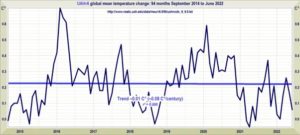
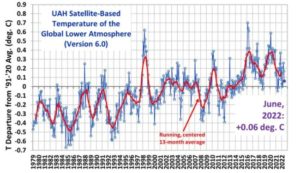
The New Pause paused last month because I was ill. Many apologies for the interruption. Now, however, it resumes – and it has lengthened from 7 years 7 months to the end of April 2022. To the end of June 2022, the New Pause is now 7 years 10 months in length:


This Pause, like its predecessor, which was an impressive 18 years 8 months (UAH), or 18 years 9 months (HadCRUT4), is, as always, not cherry-picked. It is derived from the UAH monthly global mean lower-troposphere temperature anomalies as the period from the earliest month starting with which the least-squares linear-regression trend to the most recent month for which data are available does not exceed zero. Whatever the data show, I show. Or, in the immortal words of Dr Roy Spencer, speaking of his dataset, “It is what it is”. In that splendid dictum speaks all true science.

The least-squares trend, which Professor Jones at the University of East Anglia used to recommend as the simplest and most robust method of deriving global-temperature trends, takes due account of all monthly values, not merely of the starting and ending values.


See also here

The NOT melting glacier

by T. Ciccone & J. Lehr, May 31, 2022 in CFact

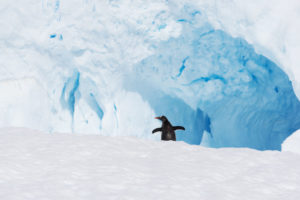
beautiful white icy hill with cave in antarctic


Could Antarctica’s ‘Doomsday Glacier’ meet its doom within 3 years?

Time is melting away for one of Antarctica’s biggest glaciers, and its rapid deterioration could end with the ice shelf’s complete collapse in just a few years,” alarmist researchers warned at a virtual press briefing on Dec. 13, 2021 at the annual meeting of the American Geophysical Union (AGU)–a once outstanding professional society, but now a shill for the left.

Above is the first sentence of the article titled Antarctica’s ‘Doomsday Glacier’ could meet its doom within 3 years,not what we would expect to see from a once reputable source, the AGU. It warns us that in a few years, the world’s largest glacier, about the size of Florida, will melt and raise ocean levels by up to 3 meters (about 10 ft). It then tells us that the glacier is melting from below because the surrounding ocean waters have been warmed thanks to human-induced climate change.Finally, it tells us that a team of more than 100 scientists from the USA and the UK have been studying the Thwaites glacier and sharing their findings with scientists worldwide.

The article then explains that the Thwaites is not melting from above, but the melting is coming from below,from the warmed-up oceans that have been warmed by human-made CO2 and the greenhouse effect. The bulk of the article then proceeds to detail the forecasted consequences around the world:

This team may not have even been communicating with each other. Almost a decade earlier, geologists were seeing evidence of volcanoes in a known active tectonic plate boundary, buried under the glacier and the oceans. Before 2017, at least 47 volcanoes were found in western Antarctica and around the area of the Thwaites glacier. In 2017 the Guardian reported that an additional 91 volcanoes had been found along the western shores of Antarctica, with some sitting under the Twaites glacier itself. See the article Scientists discover 91 volcanoes below Antarctic ice sheet.

New Study Affirms Temperatures Determine Greenhouse Gas Forcing Trends, Not The Other Way Around

by Singh H  & Polvani L, Jun 30, 2022 in NoTricksZone


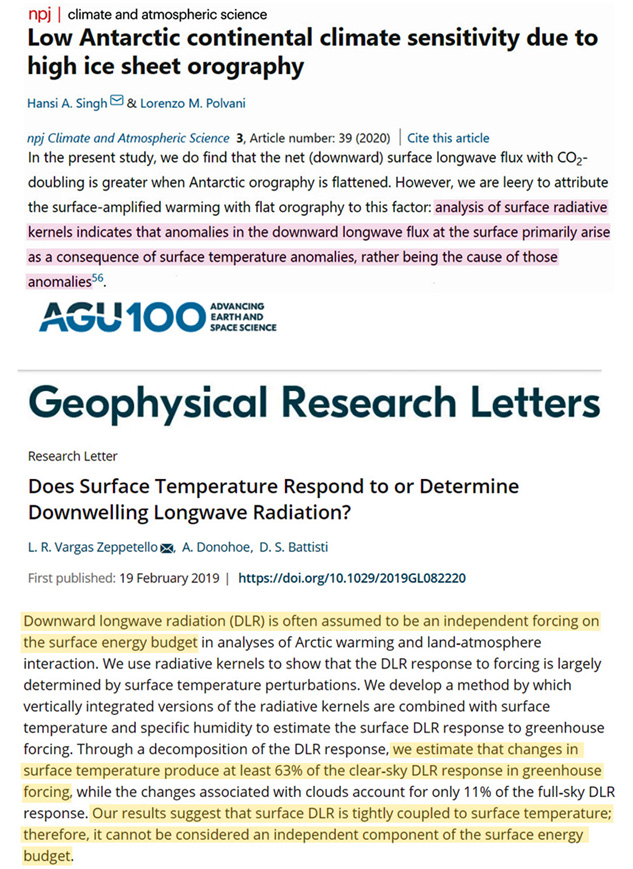
CO2 and water vapor greenhouse effect impacts are not independent climate forcings . A new study affirms the “variance in the radiance in these channels is primarily controlled by…temperature” and “atmospheric absorption is strongly saturated in these [CO2, water vapor] channels”.

It has previously been established that greenhouse gas (water vapor, CO2) forcing “cannot be considered an independent component of the surface energy budget” because “anomalies in the downward longwave flux at the surface primarily arise as a consequence of surface temperature anomalies, rather than being the cause of those anomalies” (Singh and Polvani, 2020, Zeppetello et al., 2019).

Image Source: Singh and Polvani, 2020, Zeppetello et al., 2019

Feldman et al. (2015) admit they had to “construct” model-based spectra to simulate a CO2 signal in their seminal paper purporting to show CO2 changes cause temperature changes. This is because the temperature and water vapor levels primarily determine the overall longwave forcing (clear-sky) trends.

Code Red For Sanity – The Credibility Crisis At The IPCC

by R. Barmby, Jun23, 2022 in ClimateChangeDispatch


When speaking about the Intergovernmental Panel on Climate Change (IPCC) report Climate Change 2021: The Physical Sciences Basis, UN Secretary-General António Guterres declared it a “code red for humanity.”

He further stressed, “The alarm bells are deafening, and the evidence is irrefutable.” [bold, links added]

But a person who reads the report dispassionately and thoroughly will recognize that there is no code red for humanity and that the evidence is indeed refutable. It would be more accurate to say the report is a code red for sanity.

Classical science observes what is; that’s the evidence. A political agenda persuades what should be done; that’s the alarm bells.

Let’s turn off the alarm the IPCC pulled by examining Climate Change 2021: The Physical Science Basis (referred to from this point as “the report”).

You’ll discover that while the report contains some scientific evidence, much of it is hidden, manipulated, or contradicted.

Because of this, we’ll refute the so-called evidence in the report by explaining how the science has been misrepresented.

Let’s bring sanity back to science.

The report has four major themes where the political agenda has overrun classical science.

Theme 1: Climate history was altered.

The IPCC would like you to believe that the Earth’s temperature has been constant for thousands of years and that the approximate 1°C of warming is unprecedented.

The report offers this figure to support that view:

Study: Tropical Cyclone Frequency Decreasing As Earth Mildly Warms

by S. Chand et al., Jun 28, 2022 in ClimateChangeDispatch


Assessing the role of anthropogenic warming from temporally inhomogeneous historical data in the presence of large natural variability is difficult and has caused conflicting conclusions on the detection and attribution of tropical cyclone (TC) trends. [bold, links added]

Here, using a reconstructed long-term proxy of annual TC numbers together with high-resolution climate model experiments, we show robust declining trends in the annual number of TCs at global and regional scales during the twentieth century.

The Twentieth Century Reanalysis (20CR) dataset is used for reconstruction because, compared with other reanalyses, it assimilates only sea-level pressure fields rather than utilizing all available observations in the troposphere, making it less sensitive to temporal inhomogeneities in the observations.

It can also capture TC signatures from the pre-satellite era reasonably well.

The declining trends found are consistent with the twentieth-century weakening of the Hadley and Walker circulations, which make conditions for TC formation less favorable.

Human activities are estimated to have caused ~1.0 °C of global warming above pre-industrial levels, with most of the warming occurring since the mid-twentieth century1.

‘A Significant And Robust Cooling Trend’ In The Southern Ocean From 1982–2020 Defies Climate Models

by K. Richard, June 27, 2022 in NoTricksZone


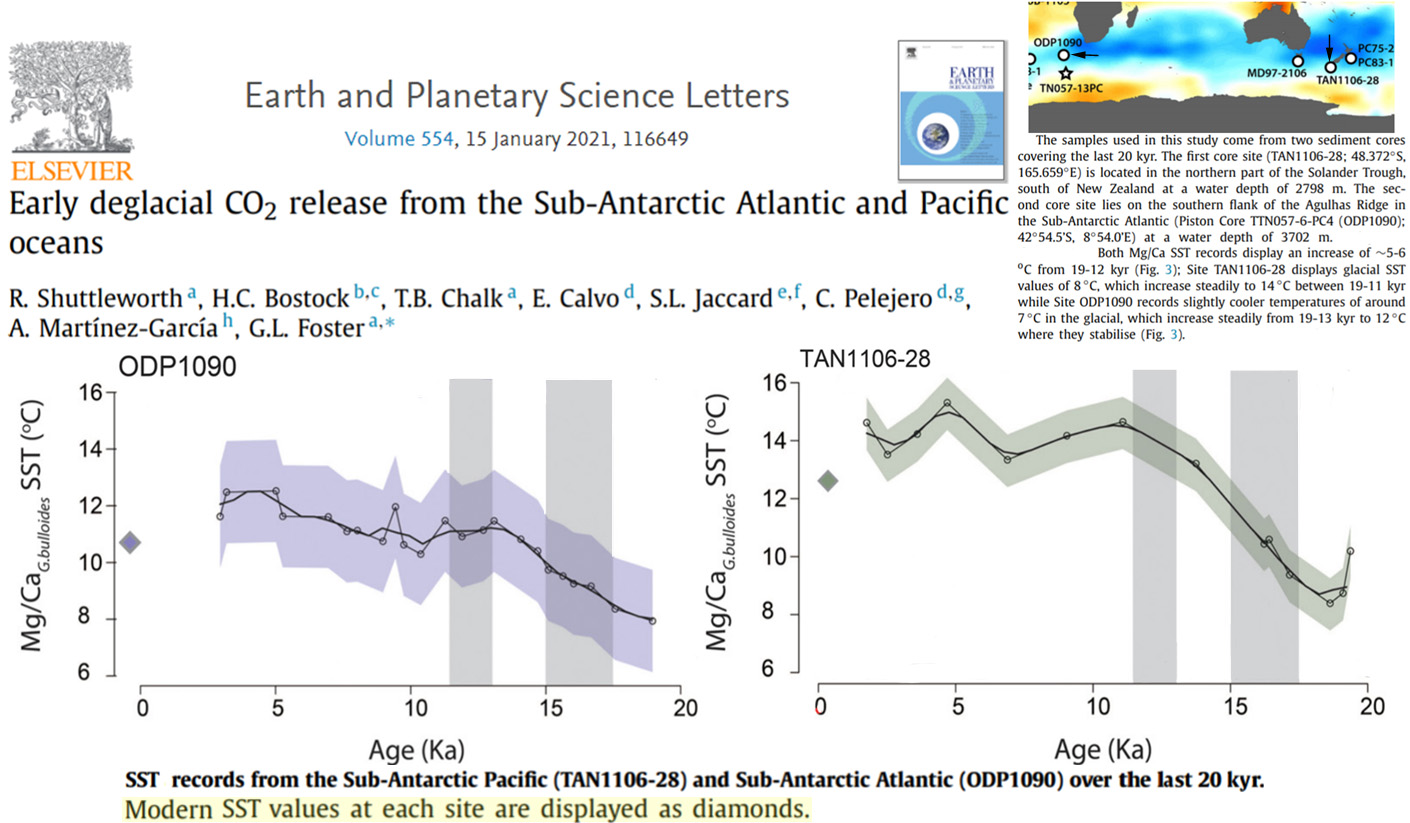
A new study reports there has been a -0.3°C cooling in the Southern Ocean since 1982 per multiple observational data sets. The authors detail the “failure of CMIP5 models in simulating the observed SST cooling in the Southern Ocean.”

The Southern Ocean is today about 1-2°C colder than it has been for nearly all of the last 10,000 years (Shuttleworth et al., 2021, Civel-Mazens et al., 2021, Ghadi et al., 2020).

Image Source: Shuttleworth et al., 2021

ON SATURDAY, GREENLAND’S SURFACE MASS BALANCE GAINED A RECORD-SMASHING 7 GIGATONS…

by Cap Allon, June 20, 2022 in Electroverse


If you want proof of mainstream media manipulation and agenda driving drivel, you need look no further than the “official” reporting of the Greenland ice sheet–the poster child for anthropogenic global warming. If today’s intensifying energy crisis wasn’t rooted in said obfuscations, all of this would be laughable.

Impressive surface mass balance (SMB) readings –a calculation to determine the ‘health’ of a glacier– have been posted across the Greenland ice sheet all season. But the cherry, at least for me, is taken by Saturday’s record-smashing 7 Gigaton GAIN–particularly when you consider the glacier should be losing mass at this time of year.

The MSM appears to love dumb, decontextualized headlines to advance their AGW narrative. So here’s one for them:

Greenland’s Recent SMB Gains Enough To Bury Central Park, New York City Under 7,833 Feet Of Ice… (it’s true, do the math).

Cheers! ‘Climate backtracking’: Germany Pushes for G-7 Reversal on Fossil Fuels in Climate Blow – ‘U-turn in global efforts to fight climate change’

by Bloomberg, June 25, 2022 in Climate Depot


Germany is pushing for Group of Seven nations to walk back a commitment that would halt the financing of overseas fossil fuel projects by the end of the year, according to people familiar with the matter. That would be a major reversal on tackling climate change as Russia’s war in Ukraine upends access to energy supplies.

A draft text shared with Bloomberg would see the G-7 “acknowledge that publicly supported investment in the gas sector is necessary as a temporary response to the current energy crisis.”

The caveat in the proposal is that such funding is done “in a manner consistent with our climate objectives and without creating lock-in effects.”

The text remains under debate and could change before G-7 leaders hold their summit in the Bavarian Alps starting Sunday hosted by Chancellor Olaf Scholz. The UK opposes the proposal, two of the people said. A German government spokesman declined to comment.

EU Leaders Brace for Hard Winter as Russia Tightens Gas Grip

A person familiar with the discussions said Italy wasn’t actively opposing the German proposal. Italy, like Germany, is highly dependent on Russian gas. On Friday, speaking during a press conference in Brussels, Prime Minister Mario Draghi said Italy has managed to reduce Russian gas imports from 40% last year to 25% at the moment. This has been possible also by signing new gas deals in countries including Congo, Algeria and Angola.

Germany has responded to the cuts by reviving coal plants and providing financing to secure gas supplies, while continuing with plans to phase out nuclear energy. The World Nuclear Association, an industry lobby group, is urging the G-7 to boost access to nuclear technologies.

What the media won’t tell you about U.S. heat waves

by R. Pielke Jr, June 16, 2022 in TheHonestBroker


It’s hot. Real hot. Heat waves in the United States surely must be the most visible and impactful sign of human caused climate change, right? Well, actually no. Let’s take a look at what the U.S. National Climate Assessment and the Intergovernmental Panel on Climate Change say about heat waves in the United States. What they say may surprise you.

Before proceeding, let me emphasize that human-caused climate change is real and significant. Aggressive policies focused on both adaptation and mitigation make very good sense. So too does being accurate about current scientific understandings. The importance of climate change does not mean that we can ignore scientific integrity — actually the opposite, it makes it all the more important. So let’s take a close look at recent assessment reports and what they say about U.S. heat waves.

The figure below comes out of the most recent U.S. National Climate Assessment(NCA). It shows the frequency (top) and intensity (bottom) of heat waves in the U.S. since 1900. The bottom figure is actually based on a paper that I co-authored in 1999, which serves as the basis for an official indicator of climate change used by the Environmental Protection Agency.

..

German Physicist: Human CO2 Emissions Responsible For 0.05°C Of The Global Warming Since 1750

by H. Harde, June 20,2022 in NoTricksZone


Professor Herman Harde, an environmental physicist, has authored a new position paper on the follies of assuming humans significantly impact the climate.

As detailed in his 2017 paper, Dr. Harde concludes the “anthropogenic contribution to the actual CO2 concentration is found to be 4.3% [a figure derived from IPCC AR5], its fraction to the CO2 increase over the Industrial Era is 15% and the average residence time 4 years.”

The IPCC overestimates the thermal effect of doubling CO2 by a factor of 5, as the consequent surface air temperature increase for a 120 ppm increase in CO2 is less than 0.3°C.

“Since only about 15% of the global CO2 increase is of anthropogenic origin, just 15% of 0.3°C, i.e., less than 0.05°C remains, which can be attributed to humans in the overall balance.”

“Changes of our climate can be traced back to natural interaction processes that exceed our human influence by orders of magnitude.”

As Climate Screamers Spread Alarm, Germany’s Long-Term Forest Fire Trend Has Declined

by P.   Sommer, June 22, 23022 in NoTricksZone


It’s become an annual ritual. Every summer, when there has been little rain for a long time and unreasonable people set fire to forests, whether through intent or negligence, a solution comes into play: wind turbines.

There are people who obstruct wind turbines, supposedly in order to protect forests. But the opposite is true. Every obstructed wind turbine fires up the climate crisis with heat, drought and forest fires.”

(Image: Screenshot Twitter)

Old military grounds pose huge hazard to fire fighters

Of course, this is exactly what is happening with the current forest fire in Treuenbrietzen in Brandenburg, alarmists like Quaschning say. But, if you look very closely you will see that once again a forest area burned that had previously served as a military training area for several decades. Such areas are not easy to extinguish because firefighters put themselves in serious danger as remnants of ammunition are lying around everywhere. So the fire has an easy time when it can only be extinguished from a distance. Or, to put it another way, in forests without remnants of ammunition, firefighters would have fires under control quickly.

Nothing to do with temperature

What would help the forest is precipitation. Temperature is not the determining factor for forest fires, but the absence of rain. The forest would also be helped if people stopped handling fire in the forest during times of drought.

Yet we will read and hear the call for more wind power in the forests every time there is a forest fire from the likes of Big Wind lobbyists Volker Quaschning – and of course, without them addressing the forest floor contaminated with munitions. This has always been the case in recent years and has also been a topic in this blog. By the way, with the same protagonist as this year and almost word-same tweets.

Long-term downward trend


There are people who obstruct wind turbines, supposedly in order to protect forests. But the opposite is true. Every obstructed wind turbine fires up the climate crisis with heat, drought and forest fires.”

Old military grounds pose huge hazard to fire fighters

Of course, this is exactly what is happening with the current forest fire in Treuenbrietzen in Brandenburg, alarmists like Quaschning say. But, if you look very closely you will see that once again a forest area burned that had previously served as a military training area for several decades. Such areas are not easy to extinguish because firefighters put themselves in serious danger as remnants of ammunition are lying around everywhere. So the fire has an easy time when it can only be extinguished from a distance. Or, to put it another way, in forests without remnants of ammunition, firefighters would have fires under control quickly.

Nothing to do with temperature

What would help the forest is precipitation. Temperature is not the determining factor for forest fires, but the absence of rain. The forest would also be helped if people stopped handling fire in the forest during times of drought.

Yet we will read and hear the call for more wind power in the forests every time there is a forest fire from the likes of Big Wind lobbyists Volker Quaschning – and of course, without them addressing the forest floor contaminated with munitions. This has always been the case in recent years and has also been a topic in this blog. By the way, with the same protagonist as this year and almost word-same tweets.

Long-term downward trend

The Guardian: Global Warming is GOOD for Rare Coral?

by E. Worall, May 28, 2022 in WUWT


A rare Guardian good news climate change story.

One of UK’s rarest corals set to expand its range as climate change warms seas

Pink sea fan, at risk from bottom-trawling, predicted to spread northwards around coast up to Scotland as sea temperatures rise

Karen McVeigh @karenmcveigh1 Fri 27 May 2022 21.00 AEST

It is one of Britain’s rarest and most threatened species, primarily due to bottom-trawling fishing, but researchers have found that the pink sea fan coral could expand its range in the climate crisis.

A slow-growing coral found in shallow waters from the western Mediterranean to north-west Ireland and south-west England and Wales, the pink sea fan (Eunicella verrucosa) is classified as vulnerable by the International Union for Conservation of Nature.

But a study by researchers from Exeter University found that the species is likely to spread northwards – including further around the British coast as far as Scotland – by 2100 as global temperatures rise.

Dr Tom Jenkins, from Exeter University, said: “We built models to predict the current and future habitat of pink sea fans across an area covering the Bay of Biscay, the British Isles and southern Norway.”

Using a global heating model called RCP 8.5, the researchers predicted that by 2100 there would be suitable habitats for pink sea fans north of the current range. Successful colonisation, the study found, would depend on several factors, including dispersal and competition.

Read more: https://www.theguardian.com/environment/2022/may/27/one-of-uks-rarest-corals-set-to-expand-its-range-as-climate-change-warms-seas

Bringing order to the chaos of sea level projections

by Royal Netherlands Institute for Sea Research, May 18, 2022 in ScienceDaily


In their effort to provide decisionmakers with insight into the consequences of climate change, climate researchers at NIOZ, Deltares and UU are bringing order to the large amount of sea level projections, translating climate models to expected sea level rise. Their new overview study was published in the scientific journal Earth’s Future. “These results offer tools for decision making on the shorter and longer term.”

Aimée Slangen is a climate scientist at NIOZ and co-author of the IPCC climate report. Together with climate adaptation experts Marjolijn Haasnoot and Gundula Winter from Deltares and Utrecht University, both also IPCC authors, Slangen investigated the similarities and differences between the many sea level projections published in recent years.

Eight families of projections

“We found that the set of more than 80 different projections can be reduced to eight ‘families’,” says Slangen. “Within each of the families of projections that we identified, researchers have often used similar data, but they have for instance used different model approaches. As a result, every new publication resulted in different amounts of projected sea level rise, depending on whether the publication focused on the shorter term or the longer term, or depending on the models used to estimate the processes causing a potentially large contribution of accelerated melting of the Antarctic ice sheet.”

These details are interesting for scientists, but make it more difficult for users to maintain overview. Slangen: “This can be an issue when you have to decide as a government what you are going to do to protect your coasts from rising sea levels. Decision makers can’t adjust their policies with every new publication.”

Half a meter rise before the end of the century

The researchers hope to dispel this doubt, as all families paint a similar picture for the first 50 cm of sea level rise. Slangen: “We will see the first half-meter rise before the end of this century, even if we start reducing greenhouse gas emissions on a large scale. For this period, it therefore makes little difference which family you use for sea level projections.”

According to adaptation expert Haasnoot, this therefore means that we can already start adapting to the consequences of sea level rise now. “Those who have to make the climate-proof decisions can already get started. However, it is important to take into account the uncertainty of the future. If you plan cleverly, you make sure that what you are doing now for a half meter sea level rise can be adjusted later for one meter. That will save a lot of money and effort.”

Models and emission scenarios

Radiosonde Temps Show Northern Hemisphere, Tropical Warming Has Mostly Paused Since 1998

by K. Richard, May 22, 2022 in NoTricksZone


A new study indicates nearly all the Northern Hemisphere and Tropical warming in the last 40 years occurred by the late 1990s.

CO2 has risen by about 50 ppm since 1998 (367 to 418 ppm).

Interestingly, upper-air measurements of temperature from balloon-borne sensor radiosonde data, shown below in the image from a new study (Madonna et al., 2022), suggest there was more warming from the early 1980s to late 1990s – when CO2 only rose about 25 ppm (341 to 367 ppm) – than there has been this century.

Radiosonde measurements appear to depict mostly flat temperatures trends since 1998 in both the Northern Hemisphere (25°N to 70°N) and tropics (25°S to 25°N).


….

Image Source: Madonna et al., 2022


La Nina is Not Going Away. What Does This Mean for This Summer’s Weather?

by C. Mass, May 16, 2022 in WUWT


It is now clear that La Nina is not going away, and may hang around into next winter.  

Cold water is entrenched over the central and eastern tropical Pacific (the definition of La Nina) and the latest forecast model runs suggest a continuation into fall.

Several of you have asked:   what does this imply for our summer weather?

Let me tell you.

But first, the bottom line:   the summer effects of La Nina are modest, but will push the western side of our region towards cooler than normal conditions.

The Impacts

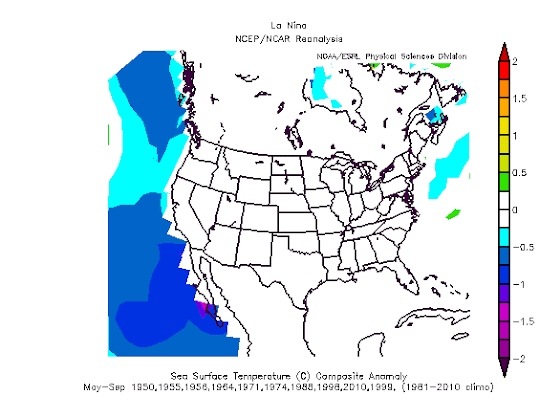
During La Nina years, sea surface temperatures off the West coast are usually cooler than normal, and those cooling effects spread inland.

To illustrate, here is the sea surface temperate difference from normal for the summer months (May through September) for La Nina years.    Blue colors are cooler than normal.

Global Sea Surface Temperature Records Suggest Only Modest Warming In The 20th And 21st Centuries

by Dieng et al., 2017 in NoTricksZone


According to Dieng et al., 2017, global sea surface temperatures (SST) cooled slightly (-0.006°C/decade) from 2003 to 2013. This reduced the overall 1950-2014 warming rate to 0.059°C per decade.

Sea and land surface temperatures, ocean heat content, Earth’s
energy imbalance and net radiative forcing over the recent years.

The NCAR/HadCRUT4 global SST record from buoys and ARGO floats also show only modest warming in the last 3 decades. The natural 2015-’16 Super El Nino event is mostly responsible for the overall increasing rate.

Why IPCC Climate Forecasts Are So Dodgy

by R. Barmy, May 5, 2022 in ClimateChangeDispatch


This is the fourth in a series of articles on the IPCC’s AR6 WG1 report. –CCD ed.

Margaret Thatcher helped create the United Nations Intergovernmental Panel on Climate Change (IPCC) in 1988. As an Oxford-trained chemist, she understood scientific principles and was concerned that we “… do not live at the expense of future generations.”

By 2002, the Iron Lady turned against global warming extremism by stating in her book Statecraft: Strategies for a Changing World, “What is far more apparent is that the usual suspects on the left have been exaggerating the dangers and simplifying solutions in order to press their agenda…” [bold, links added]

Thatcher’s comments of exaggeration and simplification were a prescient critique of the IPCC report Climate Change 2021: The Physical Sciences Basis.

The IPCC uses computer simulations to predict climate dangers and test solutions. An important step in the computer simulation of a real-world physical process is making sure the simulator can replicate the known history of that physical process.

If a computer model can accurately replicate a significant history of a known process, called hindcasting, it lends credibility that the correct equations are being used and will be able to predict future events.

The Global Warming Scare Is Most Certainly Overheated

by Edidorial Board, May 10, 2022 in Issue&Insight


Does anyone wonder where all the global warming destruction is? After all, the media are unrelenting in telling us how much climate change caused by man is affecting us. Yet no existential threat has emerged. There’s something off with the story.

The climate alarmists have based their predictions of doom on computer models that have been projecting global temperature increases, the likes of which, they tell us, are unsustainable. We must cut our carbon dioxide emissions, even if (actually, especially if) it hurts developed world economies.

This is the narrative we’re bombarded with on a daily basis. And it’s wrong.

Those models that have been used to fuel the fright are, without a doubt, unreliable. According to a recent story published in Nature magazine written by a group of climate modelers, “a subset of the newest generation of models are ‘too hot’ and project climate warming in response to carbon dioxide emissions that might be larger than that supported by other evidence.”

The authors, though, are careful to preserve the narrative, warning that “​​whereas unduly hot outcomes might be unlikely, this does not mean that global warming is not a serious threat.” They can’t help themselves.

While the modelers in the Nature article point specifically to problems with “a subset of the newest generation of models,” it’s obvious that the older models are no better. Last fall we covered a ScienceDaily report which noted that some researchers had concluded “a possible flaw in climate models” had been exposed, as the models failed to reproduce an observed event.

“When the history of climate modeling comes to be written in some distant future,” economist Robert L. Bradley Jr. wrote some months ago for the American Institute for Economic Research, “the major story may well be how the easy, computable answer turned out to be the wrong one, resulting in overestimated warming and false scares from the enhanced (man-made) greenhouse effect.”

Sea Level: Rise and Fall – Slowing Down to Speed U

by Kip Hansen, Mai 3,2022 in WUWT


Yes, I do know that acceleration, technically, means just a change in velocity.  But, in every day English, we use acceleration to mean an increase in velocity – speeding up — and deceleration as a decrease in velocity – slowing down.  I mention acceleration and deceleration because one of the major talking points of IPCC reported findings about sea level rise, the incessant media mantra, is that “Sea Level Rise is Accelerating”.  (here, here, here, here, here and hundreds more here)

Is sea level rising?  Yes, of course it is.  It has been rising since about 1750-1775, coinciding with the end of the Little Ice Age.  This is widely accepted as shown below:


How do we know?  The important aspect of sea level is how it affects the land at the edges of the oceans.  The water level there is measure by tide gauges at the ports and harbors of the world.  The levels recorded by tide gauges are of local Relative Sea Level (RSL) – the level at which the sea surface hits the land.  This measurement includes both the actual rise in the sea surface height (think: distance from the center of the Earth) plus any vertical movement (VLM) of the tide gauge itself, either up or down.  In many locations the land mass itself is subsiding (sinking) due to glacial isostatic adjustment (GIA) as the land mass readjusts itself for the melting of the glaciers of the last great  Ice Age and at most tide gauge locations, the structure to which the tide gauge tself is attached, such as a pier or dock or sea wall, is also itself subsiding due to compaction of the soil underneath and the fact that many such locations are built on man-made filled substrate.  To see if sea level is rising, it is only necessary to look at high quality tide gauge records for whom the VLM is known to be relatively constant.  The linearity of these graphs is typical, there are many, many more.

Facts About the Arctic in May 2022

by J. Hunt, Apr 30, 2022 in TheGreatWhite Con


There’s a few things to note at first glance. The ice floe continued to decrease in thickness into November. It’s thickness then started to increase, but is currently still less than 2 meters. Also the snow depth has gradually been increasing, and (apart from some data glitches!) is now ~38 cm. Finally, for the moment at least, the ice surface temperature has been slowly warming since mid February and is now ~-11 °C.


Predicting Atlantic Hurricanes Using Machine Learning

by V. Herrera et al., Apr 2002, in AtmosphereMPDI


Every year, tropical hurricanes affect North and Central American wildlife and people. The ability to forecast hurricanes is essential in order to minimize the risks and vulnerabilities in North and Central America. Machine learning is a newly tool that has been applied to make predictions about different phenomena. We present an original framework utilizing Machine Learning with the purpose of developing models that give insights into the complex relationship between the land–atmosphere–ocean system and tropical hurricanes. We study the activity variations in each Atlantic hurricane category as tabulated and classified by NOAA from 1950 to 2021. By applying wavelet analysis, we find that category 2–4 hurricanes formed during the positive phase of the quasi-quinquennial oscillation. In addition, our wavelet analyses show that super Atlantic hurricanes of category 5 strength were formed only during the positive phase of the decadal oscillation. The patterns obtained for each Atlantic hurricane category, clustered historical hurricane records in high and null tropical hurricane activity seasons. Using the observational patterns obtained by wavelet analysis, we created a long-term probabilistic Bayesian Machine Learning forecast for each of the Atlantic hurricane categories. Our results imply that if all such natural activity patterns and the tendencies for Atlantic hurricanes continue and persist, the next groups of hurricanes over the Atlantic basin will begin between 2023 ± 1 and 2025 ± 1, 2023 ± 1 and 2025 ± 1, 2025 ± 1 and 2028 ± 1, 2026 ± 2 and 2031 ± 3, for hurricane strength categories 2 to 5, respectively. Our results further point out that in the case of the super hurricanes of the Atlantic of category 5, they develop in five geographic areas with hot deep waters that are rather very well defined: (I) the east coast of the United States, (II) the Northeast of Mexico, (III) the Caribbean Sea, (IV) the Central American coast, and (V) the north of the Greater Antilles.

Science Advice Under Pressure

by R. Pielke Jr, Apr 27, 2022 in TheHonestBroker


This week, I’m grateful for the opportunity to participate in a conference in Brussels on “science advice under pressure,” organized by the European Commission’s Science Advisory Mechanism (it is streaming online if you’d like to join in today and tomorrow). I am on a panel today with Anne Glover (former science advisor to the European Commission), Matthew Flinders (University of Sheffield) and Lara Pivodic (Vrije Universiteit Brussels). Our moderator has asked us to begin today’s conversation by answering the following question:

What are your experiences (either personal or among colleagues) of coming under pressure and facing hostility a result of being a prominent science advisor giving advice in public?

As I have considered this question, my first response was: Have a seat, grab a cup of coffee, and how much time do you have?

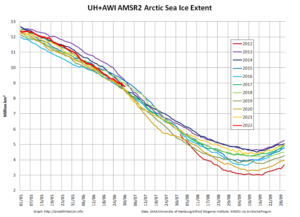
Arctic Sea Ice Stabilizes, No Trend Reduction In More Than 10 Years As Solar Cycle Starts Off Weakly

by P. Gosselin, Apr 27, 2022 in NoTricksZone


The Copernicus program offers very interesting data on Arctic ice.

While sea ice has been declining off the Greenland Sea (east of the island), the Chucki Sea (eastern Siberia) shows a very different trend in sea ice extent over the past year. Such deviations have occurred repeatedly since the year 2000.

Overall, the 2021 extent was very close to the 1991-2020 mean and well above the lowest value in 2012 and also above what was recorded in the year 2020