Archives de catégorie : climate-debate

Media Blame Isaias On Climate Change – As Hurricane Numbers Decline

by H.S. Burnett, August 10, 2020 in ClimateChangeDispatch


Hurricane Isaias hadn’t even made landfall in the United States before the media began proclaiming Isaias was the result of human-caused climate change.

Not only is there no evidence for such a claim, but hurricane numbers have been declining as global temperatures modestly warm.

Also, even the United Nations Intergovernmental Panel on Climate Change (IPCC) disputes any connection between global warming and hurricanes.

Large Increase In Number Of Sunshine Hours Likely Behind Warming, Glacier Retreat In Alps Since 1980

by P. Gosselin, August 9, 2020 in NoTricksZone

Today global warming alarmists insist blaming climate change on man-made CO2 emissions. Yet, everywhere we look it’s difficult to find any correlation between CO2 and warming. Pre-industrial history shows that changes in CO2 in fact followed temperature changes.

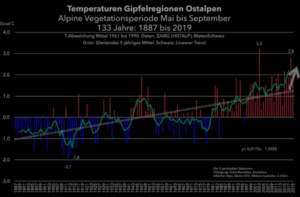
Today we look at some climate charts of the European upper Ostalpen to look for hints what may be behind the warming since the late 20th century. We know glaciers there have been receding over the recent decades.

First is a mean temperature chart of the region for the May to September period going back 133 years:


Chart cropped from video “Die Alpengletscher im Klimawandel: Status quo“, by Günther Aigner


New Study: A Southern Ocean Site Has Just Cooled To Ice Age-Era Temperatures – 2°C Colder Than 20,000 Years Ago

by K. Richard, August 10, 2020 in NoTricksZone


A new temperature reconstruction indicates today’s sea surface temperatures are colder than all but a few millennia out of the last 156,000 years.

A Southern Ocean site analyzed in a new study (Ghadi et al., 2020) has averaged 1-2°C during glacials and 4°C during interglacials. Today, with a 410 ppm CO2 concentration, this location has again plummeted to glacial/ice age levels (2°C).

The site was 2°C warmer than now when CO2 concentrations were 180 ppm about 20,000 years ago, or during the peak of the last ice age. During the Early Holocene (10,000 to 8,000 years ago), summer sea surface temperatures were also 2°C warmer than today.

There is no indication that CO2 concentration changes are in any way correlated with temperature changes throughout this entire 156,000-year epoch.

by Cap Allon, August 7, 2020 in Electroverse


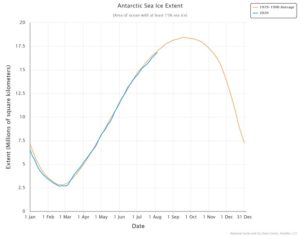
According to official government data from the National Snow & Ice Data Center (NSIDC), 2020’s Antarctic Sea Ice Extent is tracking the 1979-1990 average.

Climate alarmists take note, the ice locked within Antarctica is far more important to your hokey climate theories than that contained in its northern cousin the Arctic.

The Antarctic contains 90% of our planet’s ice, and, therefore, if Antarctica isn’t melting then any potential sea-level rise will be severely limited.

And Antarctica isn’t melting.

According to the latest NSIDC data, sea ice extent around the southern pole has been tracking the 1979-1990 average ALL YEAR:

[nsidc.org/arcticseaicenews/charctic-interactive-sea-ice-graph]

In addition, August 2020’s extent is currently greater than it was in the 1980s:

First Time In 70 Years No Pacific Typhoon Forms In July… Alarmists Alarmed Typhoon Trend Falling!

by P. Gosselin, Ausgust 1, 2020 in NoTricksZone


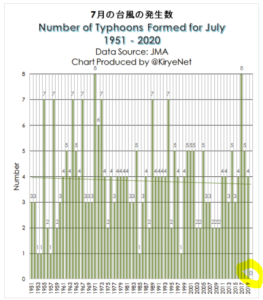
This year is the first time since 1951 the Pacific sees no typhoons in the month of July. Typhoons have seen downward trend since 1951. 

Global warming alarmists like to claim that tropical storms will intensify and become more frequent unless people stop using fossil fuels.

And recently these alarmists have had our attention steered to the Atlantic basin, where tropical storms this year have seen quite an active season thus far.

Another reason the focus has been on the Atlantic is because very little has been happening in terms of Pacific typhoons, and the alarmists don’t want to talk about that.

In fact this July is the first July to have seen no typhoons formed in the Pacific at all since statistics on this began in 1951, according to the data from the Japan Meteorological Agency (JMA).

Data source: JMA, here and here

Normally between 3 to 4 typhoons form in the Pacific in July. Up to 8 have formed in the past, e.g. on 2017 and 1971. But this year July failed to see a single typhoon form – the first time this has occurred since 1951.

Satellite survey shows California’s sinking coastal hotspots

by Arizona State University, August 2, 2020 in WUWT


A majority of the world population lives on low lying lands near the sea, some of which are predicted to submerge by the end of the 21st century due to rising sea levels.

The most relevant quantity for assessing the impacts of sea-level change on these communities is the relative sea-level rise – the elevation change between the Earth’s surface height and sea surface height. For an observer standing on the coastland, relative sea-level rise is the net change in the sea level, which also includes the rise and fall of the land beneath observer’s feet.

Now, using precise measurements from state-of-the-art satellite-based interferometric synthetic aperture radar (InSAR) that can detect the land surface rise and fall with millimeter accuracy, an Arizona State University research team has, for the first time, tracked the entire California coast’s vertical land motion.

They’ve identified local hotspots of the sinking coast, in the cities of San Diego, Los Angeles, Santa Cruz and San Francisco, with a combined population of 4 to 8 million people exposed to rapid land subsidence, who will be at a higher flooding risk during the decades ahead of projected sea-level rise.

“We have ushered in a new era of coastal mapping at greater than 1,000 fold higher detail and resolution than ever before,” said Manoochehr Shirzaei, who is the principal investigator of the NASA-funded project. “The unprecedented detail and submillimeter accuracy resolved in our vertical land motion dataset can transform the understanding of natural and anthropogenic changes in relative sea-level and associated hazards.”

The results were published in this week’s issue of Science Advances (DOI link here).

NASA “CLIMATE PROPHET” JAMES HANSEN SAID THE ARCTIC WOULD BE “FREE OF SUMMER ICE” BY 2018

by Cap Allon, August 2, 2020 in Electroverse


Bolstered by the sycophantic-praise he received following his 1988 Congressional testimony on man-made global warming, NASA climate scientist/activist James Edward Hansen continued his prophesies well into the 2000s–despite his ever-growing list of climate fails.

“The greenhouse effect is here,” pronounced doomsayer Hansen back on June 23, 1988.

“We’re [still] toast,” he repeated with a straight face 20 years later, in 2008.

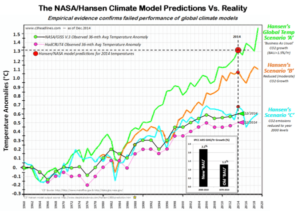
in preparation for his 1988 Congressional testimony, scientists/activist Hansen produced three potential scenarios regarding the future trend for global average temperatures:

A) “Business As Usual” — if human’s did nothing regarding rising CO2 levels.

B) If we “moderately” reduced CO2 emissions.

C) If atmospheric carbon dioxide was reduced to year 2000 levels.


Real-world observations reveal Hansen’s projections were way off. Scenarios A and Bsignificantly over-predict the warming trend. And digging into the data, A overstates CO2 and other greenhouse gas growth and rejects against the observations; Scenario B slightly understates CO2 growth, overstates methane and CFCs and zeroes-out other greenhouse gas growth, and it too significantly overstates the warming.

The scenario that best-matches the observations is C — the one where Hansen has CO2 topping-out at 368 ppm in 2000 but then sees it fixed at that level thereafter–something that obviously didn’t happen. It’s this drastic “halt the industrial revolution” scenario that ended up with a warming trend most like the real-world observations.

Here is one thought, proposed by climate scientist John Christy:

Suppose Hansen had offered a Scenario D, in which greenhouse gases continue to rise, but after the 1990s they have very little effect on the climate. That would play out similarly in his modeled Scenario C, and it would match the data — this hypothetical Scenario D is the reality we’re living today.

James Edward Hansen is still considered a “climate prophet” by many, but his 1988 scenarios simply DO NOT FIT THE DATA–speaking of which, let’s look at his Arctic sea ice predictions.


A snapshot of melting Arctic sea ice during the summer of 2018

by C. Rotter, July 30, 2020 in WUWT


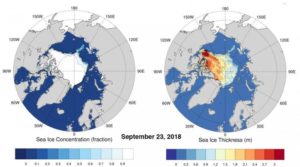
IMAGE: THIS FIGURE SHOWS THE SEA ICE CONCENTRATION AND THICKNESS IN THE ARCTIC ON SEPTEMBER 23RD 2018. view more CREDIT: JUHI YADAV

As sea ice in the Arctic retreats further and melts faster every decade, scientists are racing to understand the vulnerabilities of one of the world’s most remote and unforgiving places. A study appearing July 29 in the journal Heliyon details the changes that occurred in the Arctic in September of 2018, a year when nearly 10 million kilometers of sea ice were lost over the course of the summer. Their findings give an overview at different timescales of how sea ice has receded over the 40 years of the satellite era and show how the summer’s extensive decline is linked to global atmospheric processes as far south as the tropics.

At the peak of its melting season, in July 2018, the Arctic was losing sea ice at a rate of 105,500 square kilometers per day–an area bigger than Iceland or the state of Kentucky. “On the ground, I am sure it would have looked like an excellent summer month in the Arctic, in general, but over the past four decades, September sea-ice loss has accelerated to a rate of 12.8% per decade and 82,300 square kilometers per year,” says co-author Avinash Kumar, a senior scientist at the National Centre for Polar and Ocean Research (NCPOR) in India.

EARTH’S ATMOSPHERE HAS NO “WALLS” OR “LID” — GREENHOUSE GAS THEORY IS BOTH MATHEMATICALLY AND PHYSICALLY WRONG

by Cap Allon, July 30, 2020 in Electroverse


“The CO2 greenhouse effect of the Earth’s atmosphere is a pure fiction of people who like to use large computers, without physical bases.” — Gerhard Gerlich ph.D.

Over the years, scientific paper after scientific paper has contended the entire foundation of the man-made global-warming theory is wrong. However, those in control of the agenda selectively choose which papers/theories the public can hear about, and, in turn, which get swept under the rug.

One such paper the ill-informed street-sheep have likely never heard of is that published in the journal “Environment Pollution and Climate Change” back in 2017–the “door-opener to a new paradigm,” former IPCC reviewer Nils-Axel Mörner is quoted as calling it (Mörner left the UN after realizing it was not truly interested in science).

New Insights on the Physical Nature of the Atmospheric Greenhouse Effect Deduced from an Empirical Planetary Temperature Model” argues that concentrations of CO2 and other supposed “greenhouse gases” in the atmosphere have virtually no effect on the earth’s temperature — it concludes the entire greenhouse gas theory is incorrect.

As reported by wnd.com, the prevailing theory on the earth’s temperature is that heat from the Sun enters the atmosphere, and then greenhouse gases such as CO2, methane, and water vapor trap part of that energy by preventing it from escaping back into space.

That theory, which underpins the anthropogenic global-warming hypothesis and the climate models used by the United Nations, was first proposed and developed in the 19th century.

New evidence that an extraterrestrial collision 12,800 years ago triggered an abrupt climate change for Earth

by C. Rotter, July 27, 2020 in WUWT


Christopher R. Moore, University of South Carolina

What kicked off the Earth’s rapid cooling 12,800 years ago?

In the space of just a couple of years, average temperatures abruptly dropped, resulting in temperatures as much as 14 degrees Fahrenheit cooler in some regions of the Northern Hemisphere. If a drop like that happened today, it would mean the average temperature of Miami Beach would quickly change to that of current Montreal, Canada. Layers of ice in Greenland show that this cool period in the Northern Hemisphere lasted about 1,400 years.

This climate event, called the Younger Dryas by scientists, marked the beginning of a decline in ice-age megafauna, such as mammoth and mastodon, eventually leading to extinction of more than 35 genera of animals across North America. Although disputed, some research suggests that Younger Dryas environmental changes led to a population decline among the Native Americans known for their distinctive Clovis spear points.

A collision from space would leave its mark on Earth. Vadim Sadovski/Shutterstock.com

What would an Earth impact leave behind?

Peter Ridd loses, we all lose

by J. Marohasy, July 23, 2020 in TheSpectator


On 2 May 2018, Professor Peter Ridd was sacked by James Cook University for serious misconduct. It all started when he called-out his colleague Terry Hughes for falsely claiming healthy inshore coral reefs were dead from climate change and deteriorating water quality.

Ignoring the first censure in April 2016, Professor Ridd went on television in August 2017 and explained in an interview with Alan Jones and Peta Credlin why so much said and written about the Great Barrier Reef, including by scientists at the Australian Institution of Marine Science, is ‘untrustworthy’.

The interview was to promote a book that I edited, Climate Change: The Facts 2017. The book, published by the Institute of Public Affairs, begins with a chapter about the Great Barrier Reef in which the orthodoxy on Great Barrier Reef science is challenged, in particular reporting on coral calcification rates. In that interview – that contributed directly to Peter Ridd’s sacking – the main argument was, and continues to be, for better quality assurance of coral reef science.

It is a fact that the Australian Institute of Marine Science refuses to release 15 years of coral growth data – because it contradicts the claims of high-profile activists that coral growth rates are in decline. They are not. But the false claims are central to their fundraising strategy. Never mind the truth.

Also: from GWPF, July 27 2020

Climate Hysteria Has Killed Academic Freedom

Censorship Universities May Not Receive Bail Out Funding

Greenpeace Cofounder: ‘There Is No Climate Catastrophe – It’s A Lie’

by 21Wire, July 24, 2020 in ClimateChangeDispatch


Power Hour host Alex Epstein  discusses the alleged ‘climate catastrophe’ with Dr. Patrick Moore, ecologist and co-founder of Greenpeace. 

Incredibly, Moore completely eviscerates the concept of “climate catastrophism,” and dismantles the claim that man-made CO2 levels are warming the planet beyond a tipping point of human survival.

Moore makes a number of strong arguments that debunk the IPCC’s increasingly problematic pseudo-scientific and anti-human narrative which is being parroted by climate change activists and the likes of Greta Thunberg.

He explains:

  • Why Moore left Greenpeace.

  • The beginnings of the climate catastrophe movement.

  • Why Moore believes human beings would not only survive but survive better at far higher average temperatures (which would be concentrated toward the poles).

  • Why Moore believes that contrary to being in a Sixth Extinction, we are actually at an unprecedented time of biodiversity with no end in sight.

  • Why Moore believes “ocean acidification” claims are totally meritless.

  • The commonality among the opposition to plastics, GMOs, nuclear energy, and fossil fuels.

  • Moore’s unrefuted theory that human beings actually saved life on Earth from a terminal decline in CO2 levels.

Watch this highly informative interview:

Modern Ancient Temperatures

by W. Eschenbach, July 24, 2020 in WUWT


OK, no need to torture me, I confess it—I’m a data junkie.

And when I see a new (to me at least) high-resolution dataset, my knees get weak. Case in point? The temperature dataset of the Colle Gnifetti ice core. It has a two-year resolution thanks to some new techniques. Better, it stretches clear back to the year 800. And best, it extends up to near the present, 2006. This lets us compare it to modern datasets. The analysis of the ice core dataset is described in Temperature and mineral dust variability recorded in two low-accumulation Alpine ice cores over the last millennium by Pascal Bohleber et al.

Let me start with where Colle Gnifetti is located. Unusual among ice core records, it’s from Europe, specifically in the Alps on the border of Switzerland and Italy.

Figure 1. Location of the ice cores in the study.

This is good because some of the longest thermometer-based temperature records are in Europe.

One interesting thing about the site is that usually, ice core drilling occurs at the literal ends of the earth, in Antarctica and Greenland and the like. But this site is not far from the foot of the Margherita Hut, which is at over 4500 metres elevation.


Further Reading: It’s instructive to compare the listed temperatures with the data in A Chronological Listing of Early Weather Events.

Persistent warm Mediterranean surface waters during the Roman period

by Margaritelli G. et al., June20, 2020 in Nature OPEN ACESS


Abstract

Reconstruction of last millennia Sea Surface Temperature (SST) evolution is challenging due to the difficulty retrieving good resolution marine records and to the several uncertainties in the available proxy tools. In this regard, the Roman Period (1 CE to 500 CE) was particularly relevant in the socio-cultural development of the Mediterranean region while its climatic characteristics remain uncertain. Here we present a new SST reconstruction from the Sicily Channel based in Mg/Ca ratios measured on the planktonic foraminifer Globigerinoides ruber. This new record is framed in the context of other previously published Mediterranean SST records from the Alboran Sea, Minorca Basin and Aegean Sea and also compared to a north Hemisphere temperature reconstruction. The most solid image that emerges of this trans-Mediterranean comparison is the persistent regional occurrence of a distinct warm phase during the Roman Period. This record comparison consistently shows the Roman as the warmest period of the last 2 kyr, about 2 °C warmer than average values for the late centuries for the Sicily and Western Mediterranean regions. After the Roman Period a general cooling trend developed in the region with several minor oscillations. We hypothesis the potential link between this Roman Climatic Optimum and the expansion and subsequent decline of the Roman Empire.

See also  Roman Warm Period Was 3.6°F Warmer Than Today, New Study Shows

 See also here (GWPF)

Latest Polar Bear Scare Shredded By Susan Crockford

by P. Homewood, July 22, 2020 in NotaLotofPeopleKnowThat


Apparently, a prediction that polar bears could be nearly extinct by 2100 (which was first suggested back in 2007) is news today because there is a new model. As for all previous models, this prediction of future polar bear devastation depends on using the so-called ‘business as usual’ RCP8.5 climate scenario, which has been roundly criticized in recent years as totally implausible, which even the BBC has mentioned. This new model, published today as a pay-walled paper in Nature Climate Change, also did something I warned against in my last post: it uses polar bear data collected up to 2009 only from Western Hudson Bay – which is an outlier in many respects – to predict the response of bears worldwide. The lead author, Peter Molnar, is a former student of vocal polar bear catastrophist Andrew Derocher – who himself learned his trade from the king of polar bear calamity forecasts, Ian Stirling. Steven Amstrup, another co-author of this paper, provided the ‘expert opinion’ for the failed USGS polar bear extinction model featured in my book, The Polar Bear Catastrophe That Never Happened.

Well, these authors and their supporters got the headlines they crave, including coverage by outlets like the BBC and New York Times (see below) but I have to say that the combination of using out-of-date Western Hudson Bay information on when polar bears come ashore in summer and leave for the ice in fall (only to 2009) to make vague projections (‘possible’, ‘likely’, ‘very likely’) about all other subpopulations in addition to depending on the most extreme and now discredited RCP8.5 climate scenario (Hausfather and Peters 2020) for this newest polar bear survival model is all that’s needed to dismiss it as exaggerated-fear-mongering-by-proxy. Why would anyone believe that the output of this new model describes a plausible future for polar bears?

Meanwhile, polar bear populations worldwide continue to thrive despite declines in sea ice. And as I have pointed out on numerous occasions, the ice free period for WH has not continued to decline since 1998 but rather has remained stable (with yearly variation) at about 3 weeks longer than it was in the 1980s (Castro de la Guardia et al 2017). Moreover, for the last five years at least, including this one, the ice-free season for WH bears has been better (only 1-2 weeks longer than the 1980s), although no official data on this phenomenon has yet been published. Oddly, this more recent data for Hudson Bay was not used for the Molnar model.


Susan’s full account is here.

The Dutch have decided: Burning biomass is not sustainable

by D. Janssen, July 21, 2020 in Euractiv


The Netherlands should phase out the use of biomass for generating electricity as soon as possible, the advisory board of the Dutch government said in a report presented earlier this month.

Biomass is an “indispensable” resource for the circular economy, but burning it is wasteful.

That is the main message of the report issued on 8 July by the Socio-Economic Council (SER), an independent advisory board of the Dutch government consisting of entrepreneurs, employees and independent experts.

In the chemical industry, the building sector and agriculture, biological materials are crucial for the transition to a circular economy, the council writes. But sustainably produced biomass is too scarce to keep using it for the production of heat or electricity, for which other low-carbon and renewable alternatives exist, the report states.

Accordingly, the billions worth of subsidies that were intended for biomass combustion plants should be phased out as well, the advisors say, calling however for measures to preserve “investment security” when designing a phase-out plan.

This means compensation should be handed out to companies who stand to lose out from the abrupt end of bioenergy subsidies.

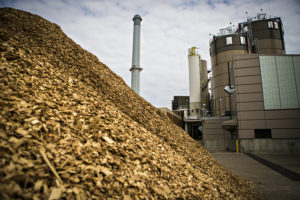
EU member states are increasingly turning their coal plants into biomass plants in an effort to cut carbon emissions. [Mizzou CAFNR / Flickr]

How climate change alarmists are actually endangering the planet

by Bjorn Lomborg, July 11, 2020 in CO2Coalition


“You’ll die of old age, I’ll die of climate change,” reads a typical poster held by teenagers in climate rallies across the world. The media, activists and even politicians are unabashedly indulging in climate alarmism, stoking the fears of millions.

Books on the impending implosion of civilization due to climate change line shelves in bookstores across the world. Media outlets have changed the name of climate change, calling it the “climate emergency” or even “climate breakdown.” The cover of Time magazine tells us: “Be worried. Be very worried.”

Unsurprisingly, this causes most of us to brood about a future that we’re being told will be calamitous. Children are growing up terrified, with six in ten American teenagers now afraid of climate change. The scaremongering has reached such a crescendo that now half the world’s population really believes climate change will likely end the human race.

This alarmism is not only false but morally unjust. It leads us to make poor decisions based on fear, when the world not only has gotten better, but will be even better over the century.

Remember that the world today is much better in almost every measurable way. In 1900, the average life expectancy was 32. Today, it has more than doubled to 72. The disparity in health between the rich and poor has reduced, the world is much more literate, child labor has been dropping and we are living in one of the most peaceful times in history. Indoor air pollution, previously the biggest environmental killer, has halved since 1990. Four out of five people were extremely poor in 1900 and today — despite the intense impact of the coronavirus — less than one in five is.

The UN Climate Panel’s middle-of-the-road estimate for the end of the century is that we will be even better off. There will be virtually no one left in extreme poverty, everyone will be much better educated, and the average income per person in the world will be 450 percent of what it is today. Yet, because climate is a real challenge, it will leave us less well off. Based on three decades of studies, the UN and the world’s only Nobel climate economist estimate global warming will reduce the 21st century welfare increase from 450 percent to “only” 434 percent of today’s income.


Continuer la lecture de How climate change alarmists are actually endangering the planet

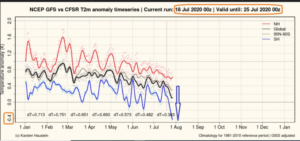
NCEP Analysis: Northern Hemisphere Surface Temperature Falls 1°C Since February

by P. Gosselin, July 18, 2020 in NoTricksZone


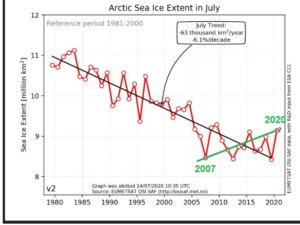
Also the Danish Meteorological Institute (DMI) projects a sturdy Arctic sea ice extent for this July, meaning no falling summer ice extent trend since 2007! The climate alarms are being muffled. 

Snowfan here gives us the latest on global mean temperature and Arctic sea ice.

After the year’s low in June 2020, with an anomaly of +0.48°C from the 1981-2010 WMO climate mean, the global 2-meter temperatures (black line) depicted below shows the July 16, 2020 analysis and forecast up to July 23.

Source: here


Source: DMI

A surprising DMI forecast was issued on July 14, 2020 which projects strong growth of Arctic sea ice areas for July 2020. If this expert forecast is correct, it would mean there’s been a strongly positive summer trend since 2007 – instead of the ridiculous Al Gore complete meltdown.

NOAA Bureaucrats Falsely Claim ‘Extraordinary’ Sea Level Rise

by H.S. Burnett, July 18, 2020 in ClimateRealism


The National Oceanic and Atmospheric Administration, which relies on perpetuation of the Climate Delusion to maintain high funding, is falsely claiming there has been “extraordinary” sea level rise since 2000. Fox News and other media outlets are devoting substantial attention to the assertion by NOAA bureaucrats. However, there is simply nothing extraordinary about recent sea level rise.

According to Fox News, NOAA claims “Communities in coastal areas of the U.S. saw record-setting high-tide flooding last year, part of a trend of rising seas … [and an] ‘extraordinary’ rise in high-tide flooding since 2000.”

“Damaging floods that decades ago happened only during a storm now happen more regularly, even without severe weather,” Nicole LeBoeuf, acting assistant administrator for NOAA’s National Ocean Service, told reporters in a conference call.

Even if high-tide flooding has increased in recent years, natural factors are the primary cause.

As detailed in Climate at a Glance: Sea Level Rise: Data shows global sea level has been rising at a relatively steady pace of approximately one foot per century since at least the mid-1800s, which was long before coal power plants and SUVs. Moreover, the United Nations Intergovernmental Panel on Climate Change (IPCC) confirms here has been no significant recent acceleration.

Global sea level has risen approximately 400 feet since the beginning of the end of the most recent ice age—approximately 20,000 years ago. The rate of sea level rise has risen and fallen at various times since then, slowing and increasing on the order of tens, hundreds, and thousands of years over the past 20,000 years. All of that variance had  nothing to do with human activities. Indeed, as NASA reports, sea level always rises between ice ages as ice sheets retreat. During the last interglacial period between ice ages, seas were four to six meters higher than we are experiencing today….

More Proof That Geologic Forces Are Melting Thwaites and Pine Island Glaciers

by J.E. Kamis, July 20, 2020 in ClimateChangeDispatch


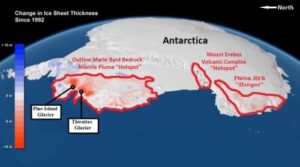
As previously explained before, increased melting/ice loss of Antarctica’s Pine Island and Thwaites glaciers is the result of geologically induced heat flow emitted from underlying bedrock “hotspots,” not climate change (Figure 1).

All but a very minor amount of Antarctica’s glacial ice melting occurs in the western portion of this continent. The most rapid and greatest ice mass loss areas are in West Antarctica.

They are positioned directly above geographically extensive and high heat flow geological features. This association is thought to be strong evidence of a cause and effect relationship.

Discussion of evidence supporting the contention that the melting of Pine Island and Thwaites glaciers is the result of bedrock heat flow begins with a review of the regional geology (refer to Figure 1).

The Pluton Rich “hotspot” is a 61,000-thousand-square-mile area that is home to numerous high-heat-flow lava pockets that are bounded and fueled by deep earth reaching faults.

Several detailed research studies document the existence and configuration of this area. This lies along the West Antarctic Rift.

The Mount Erebus Volcanic Complex “Hotspot” is the most geologically active portion of Antarctica. It is a 25,000-square-mile high-heat-flow area, much of which is absent of glacial ice.

The absence of glacial ice across a huge portion of West Antarctica is extremely unusual and exceedingly difficult to explain by invoking global warming.

Figure 1. NASA map of Antarctica’s ice sheet thickness 1992-2017. Greatest ice thickness losses shaded red. The outline of three regional sub-glacial geological Hotspots” are outlined in red (Image by NASA, most labeling by J. Kamis).

Environmental Facts Vs. Environmental ‘Fact-Checkers’

by C Rossiter, July 17, 2020 in ClimateChangeDispatch


Stacey Abrams, who ran for governor of Georgia, and Tom Steyer, who ran for president of the United States, are now trying to run me out of town.

Abrams, Steyer, and the leaders of 17 large environmental lobbies recently asked Facebook to ban a research group that I direct—the CO2 Coalition, made up of 55 climate scientists and energy economists.

The annual budgets of these lobbies total over half a billion dollars, and Steyer alone is worth $1.6 billion.

Their alarmist view of our supposedly impending environmental doom predominates in mainstream media, centering on the impact on the earth of emissions of carbon dioxide—a non-polluting, mild-warming gas, and an important source of plant and plankton food.

By contrast, the CO2 Coalition’s annual budget is half a million dollars. Like all scientists and economists who ask for any proof of the looming apocalypse, we are excluded from the mainstream-media discussion.

You might wonder: how did the Steyer-Abrams crowd even notice us, let alone conclude that we posed a threat to their enforced consensus, which calls for an end to the affordable, reliable energy that powers over 80 percent of the world?

The answer is found in the work of a Silicon Valley computer entrepreneur named Eric Michelman, who became fabulously wealthy creating a modification of the computer mouse.

For more than a decade now, Michelman has devoted his wealth to squelching media debate on climate change—a successful dry run for the cancel culture that we see engulfing many other issues today.

In 2016, Michelman was the founding and lead funder of a group called Climate Feedback, whose purpose is to “fact-check” and label as “false” any and all deviant thoughts about fossil-fueled climate catastrophe.

The group has been certified as an unbiased source on climate issues by the Poynter Institute for Media Studies, which was founded by the Tampa Bay Times and operates the left-leaning PolitiFact.

At some point, Facebook turned its censorship oversight over to the Poynter Institute’s International Fact-Checking Network.

That’s when our organization’s problems started.

In September 2019, a “false” label appeared on Facebook when the Washington Examiner posted an article I had written there with Dr. Patrick Michaels, our senior fellow and a former president of the American Association of State Climatologists.

The op-ed described the poor performance of climate models that had projected alarming increases in future temperatures. The “false” label triggered a wave of censorship from Facebook’s algorithms, blocking reposting and advertising.

Climate Predictions “Worse Than We Thought”

by P.J. Michaels, July 14, 2020 in RealClearEnergy


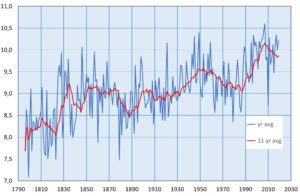
As the temperature of the eastern U.S. normally reaches its summer maximum around the last week of July, every year at this time we are bombarded with tired “climate change is worse than we thought” (WTWT) stories. These stories take time to produce, from imagination to final copy to editing to publication, so they have usually been submitted well in advance of the summer peak. Hence, orchestrated fear.

For once, I’m in agreement about the WTWT meme, but it’s about the climate models, not the climate itself.

Climate Models: No Warming For 30 Years – Possibly

by Maher et al., May 12, 2020 in GWPF


A new study demonstrates how a prolonged warming pause or even global cooling may happen in coming years despite increasing levels of atmospheric greenhouse gases — caused by natural climatic variability.

Natural climatic variability has always been a topic that contains a lot of unknowns, but it has been rarely explicitly stated just how little we know about it. Such variability has been habitually underplayed as it was “obvious” that the major driver of global temperature was the accumulation of greenhouse gasses in the atmosphere, with natural variability a weaker effect.

But the global temperature data of this century demonstrate that natural variability has dominated in the form of El Ninos. ‘Doesn’t matter’, came the reply, ‘just wait and the signal of greenhouse warming will emerge out of the noise of natural climatic variability.’ How long will we have to wait for that signal? Quite a long time, according to some researchers as more papers acknowledge that natural climatic variability has a major, if not a dominant influence on global temperature trends.

With the usual proviso concerning climatic predictions there seems to be a growing number of research papers suggesting that the global average temperature of at least the next five years will remain largely unchanged. The reason: natural climatic variability.

Only last week the UK Met Office produced figures suggesting that there is only a 1 in 34 chance that the 1.5°C threshold will be exceeded for the next five year period. Now a new paper by climate modellers extends such predictions, suggesting that because of natural variability the average global temperature up to 2049 could remain relatively unchanged – even with the largest increase in greenhouse gas emissions.

Using two types of computer models in a first of its kind study, Nicola Maher of the Max Planck Institute for Meteorology, Hamburg, Germany, and colleagues writing in Environmental Research Letters looked at the 2019-2034 period concluding that,