Archives de catégorie : climate-debate

La hausse du niveau de la mer accélère-t-elle l’érosion des côtes? (1/3)

by Y. Battiau-Queney, 15 août 2019 in ScienceClimatEnergie


Il est courant de lire et d’entendre que la hausse du niveau de la mer, l’une des conséquences les plus manifestes du réchauffement climatique, va accélérer l’érosion de nos côtes, menacer de submersion marine de vastes zones littorales urbanisées et faire disparaître nombre d’îles basses habitées. Ces craintes sont-elles justifiées? Comme un consensus ne vaut pas vérité scientifique, on va essayer de démêler le vrai du faux en partant de l’état des connaissances scientifiques sur la hausse du niveau de la mer et analyser ses effets possibles sur les processus d’érosion des côtes.


1/ Que sait-on de la hausse du niveau de la mer ?

1.1. État des connaissances sur les variations passées et présentes du niveau de la mer à l’échelle mondiale

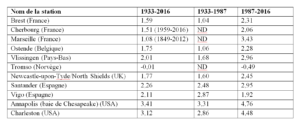
Une bonne synthèse récente sur les causes et l’ampleur de la hausse du niveau de la mer se trouve dans Cazenave et Le Cozannet (2014). On y trouvera une très abondante bibliographie antérieure à 2013. Les méthodes utilisées par les scientifiques pour évaluer la tendance moyenne de l’élévation du niveau de la mer dépendent de la période considérée. A l’échelle du Pléistocène (1 800 000 ans) et de l’Holocène (10 000 ans) on dispose d’archives sédimentologiques (repérage d’anciennes plages “soulevées”, analyse de niveaux tourbeux recouverts de sédiments marins, stratigraphie et datation de récifs coralliens …) et de données archéologiques, particulièrement riches sur les côtes méditerranéennes. On sait qu’à plusieurs reprises, pendant les phases interglaciaires du Pléistocène, le niveau de la mer a été supérieur à l’actuel de 5 à 10 m au moins (Planton et al., 2015). À partir du milieu du 19ème siècle, on utilise les données souvent précises des marégraphes installés principalement dans les ports de l’hémisphère nord. Elles fournissent les altitudes relatives du niveau de la mer par rapport aux terres émergées. Depuis 1993, les données satellitaires fournissent des altitudes absolues du niveau de la mer par rapport à l’ellipsoïde terrestre de référence et permettent d’avoir une vision beaucoup plus globale des variations du niveau des océans à toutes les latitudes et longitudes.

Tableau 1 : variations du niveau de la mer indiquées par les marégraphes (sources: SONEL et GLOSS; Wöppelmann et al., 2014 pour Marseille) (ND= non documenté). Les données dans les colonnes sont exprimées en mm/an.

MOSCOW ON TRACK FOR COLDEST AUGUST ON RECORD IN BOOKS DATING BACK 150+ YEARS

by Cap Allon, August 13, 2019 in Electroverse


Eastern Europe has been experiencing a miserable summer so far, with temperatures holding well-below average for the majority of the season. And now, following a cold and wet June and July (in which many new daily low temperature records were set), Moscow is currently on course for it’s coldest August in recorded history.

The first week of August in Moscow was pretty chilly, with an average air temperature of just 13C (55.4F) — some 5C below the norm.

The city’s coldest August on record was way back in 1884, when the average daily air temperature for the month was some 4C below the norm. In fact, that August turned out to be colder than the May.

According to www.hmn.ru, the beginning of August in Moscow has been characterized by unusual weather in terms of not only the cold, but also of abundant rainfall and a lack of sunshine.

After the first 7 days, precipitation is already at average levels for the entire month, while the chronic lack of sunshine is within touching distance of Aug 2001’s record-low 181 hours (avg. sun hours for the month of August are 238 hours).

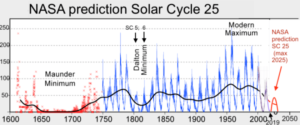
The cold times are returning, clouds are nucleating, all in line with historically low solar activity:


Why A ‘Super’ Grand Solar Minimum Is Upon Us

by Cap Allon, November 19, 2018 in PrincipiaScientificInternational


Professor Valentina Zharkova explains and confirms why a “Super” Grand Solar Minimum is upon us: “If the world was looking for an Epiphany moment, this should be it.”

Professor  Zharkova gave a presentation of her Climate and the Solar Magnetic Field hypothesis at the Global Warming Policy Foundation in October, 2018. Even if you believe the IPCC’s worst case scenario, Zharkova’s analysis blows any ‘warming’ out of the water.

Lee Wheelbarger sums it up: even if the IPCC’s worst case scenarios are seen, that’s only a 1.5 watts per square meter increase. Zharkova’s analysis shows a 8 watts per square meter decrease in TSI to the planet.

The information she unveiled should shake/wake you up. Zharkova was one of the few that correctly predicted solar cycle 24 would be weaker than cycle 23 – only 2 out of 150 models predicted this. Her models have run at a 93% accuracy and her findings suggest a SuperGrand Solar Minimum is on the cards beginning 2020 and running for 350-400 years.

Greenland’s ‘Record Temperature’ denied – the data was wrong

by Anthony Watts, August 12, 2019 in WUWT


From the “But, but, wait! Our algorithms can adjust for that!” department comes this tale of alarmist woe. Greenland’s all-time record temperature wasn’t a record at all, and it never got above freezing there.


First, the wailing from news media:

NYT: https://www.nytimes.com/2019/08/02/climate/european-heatwave-climate-change.html

WAPO: https://www.washingtonpost.com/news/capital-weather-gang/wp/2016/06/10/greenland-witnessed-its-highest-june-temperature-ever-recorded-on-thursday/

Climate Progress: https://thinkprogress.org/greenland-hits-record-75-f-sets-melt-record-as-globe-aims-at-hottest-year-e34e534e533e/

Polar Portal: http://polarportal.dk/en/news/news/record-high-temperature-for-june-in-greenland/


Now from the Danish Meteorological Institute (DMI), via the news website The Local, the cooler reality:

Ten Causes of Warming: The Layperson’s Checklist

by Jim Steele, August 8, 2019 in WUWT


All temperatures are not created equally. Rising temperatures have many causes. Good science demands we explore alternative hypotheses before reaching any conclusions. Below is a list of common causes of warming trends and heat events that everyone should consider in addition to any possible increased greenhouse effect.

1. Heat trapping surfaces: Asphalt and cement not only heat up much faster than natural habitat during the day, those materials hold the heat longer, increasing temperatures at weather stations situated near buildings and near asphalt. More asphalt, more warming, more record temperatures.

2. Loss of Vegetation: During the summer the temperature of a dry dirt road can be 60°F higher at noon, than ground shaded by trees. That’s why our pets instinctively seek the shade. Plants also bring moisture from below the ground that cools the air by evaporative cooling. Increasing deforestation or lost vegetation due to landscape changes cause regional warming trends.

3. Transport of heat: Natural climate oscillations alter air and ocean circulation patterns that can drive more heat from the tropics towards the poles. Europe’s recent heat wave was largely caused by air heated over the baking Sahara Desert and then driven into Europe. Similarly, the latest research finds variations in Arctic sea ice has been dominated by transport of warm Atlantic water heated in the tropics and transported northward via the Gulf Stream.

4. Less cloud cover: Recent research suggests a trend of less cloud cover resulted in increased solar heating of land and oceans. The added solar energy normally reflected by clouds was 2 times greater than what’s believed to be added by increasing carbon dioxide. Two decades of declining cloud cover was similarly shown to cause Greenland’s rapid ice melt between 1995 and 2012.

5. Less Cooling: Windy conditions cool the oceans. The unusually warm ocean conditions that occurred in the northwestern Pacific Ocean, known as the Blob, were caused by decreased winds that reduced normal cooling.

6-10: ….

….

AccuWeather Founder/CEO: No Evidence Heatwaves More Common From ‘Climate Change’

by Dr. J. N. Myers, Auhsut 8, 2019 in ClimateChangeDispatch


First, and most importantly, we warn people all the time in plain language on our apps and on AccuWeather.com about the dangers of extreme heat, as well as all hazards.

Furthermore, that is the reason we developed and patented the AccuWeather RealFeel® Temperature and our recently expanded AccuWeather RealFeel® Temperature Guide, to help people maximize their health, safety and comfort when outdoors and prepare and protect themselves from weather extremes.

The AccuWeather RealFeel Temperature Guide is the only tool that properly takes into account all atmospheric conditions and translates them into actionable behavior choices for people.

Second, although average temperatures have been higher in recent years, there is no evidence so far that extreme heatwaves are becoming more common because of climate change, especially when you consider how many heatwaves occurred historically compared to recent history.

New York City has not had a daily high temperature above 100 degrees since 2012, and it has had only five such days since 2002.

However, in a previous 18-year span from 1984 through 2001, New York City had nine days at 100 degrees or higher.

STRANGE CORAL SPAWNING IMPROVING GREAT BARRIER REEF’S RESILIENCE

by University of Queensland, August 7, 2019 in GWPF


The discovery was made by University of Queensland and CSIRO researchers investigating whether corals that split their spawning over multiple months are more successful at spreading their offspring across different reefs.

Dr Karlo Hock, from UQ’s School of Biological Sciences, said coral mass spawning events are one of the most spectacular events in the oceans.

“They’re incredibly beautiful,” Dr Hock said.

“On Australia’s Great Barrier Reef, all coral colonies typically spawn only once per year, over several nights after the full moon, as the water warms up in late spring.”

Study co-author Dr Christopher Doropoulos from the CSIRO Oceans & Atmosphere said sometimes however, coral split their spawning over two successive months.

“This helps them synchronise their reproduction to the best environmental conditions and moon phases,” he said.

“While reproductive success during split spawning may be lower than usual because it can lead to reduced fertilisation, we found that the release of eggs in two separate smaller events gives the corals a second and improved chance of finding a new home reef.”

The research team brought together multi-disciplinary skills in modelling, coral biology, ecology, and oceanography, simulating the dispersal of coral larvae during these split spawning events, among the more than 3800 reefs that make up the Great Barrier Reef.

Malfeasant Omissions? German Flagship ARD Broadcasting One-Sided, Drama-Making Sea Level Reporting

by Dr. S. Lüning, August 9, 2019 in NoTricksZone


What follows is another example of the tricks the mainstream media use to produce fake drama and urgency concerning sea level rise and climate change – namely omissions – and how geologist Sebastian Lüning held their feet to the fire.

Dr. Sebastian Lüning wrote a complaint to German ARD public broadcasting concerning its December 2, 2018, one-sided reporting of the Indian island of Ghoramara and the sea level rise it is allegedly experiencing. The €6.9 billion euro publicly funded, 22,612-employee ARD is the German equivalent to the UK’s BBC.

What follows is the exchange between Lüning and the ARD editorial staff:

Evidence that ERA5-based Global Temperatures Have Spurious Warming

by Dr. Roy Spencer, August 6, 2019 in GlobalWarming


“Reading, we have a problem.”

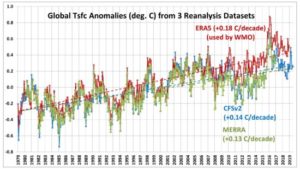
As a followup to my post about whether July 2019 was the warmest July on record (globally-averaged), I’ve been comparing reanalysis datasets since 1979. It appears that the ERA5 reanalysis upon which WMO record temperature pronouncements are made might have a problem, with spurious warmth in recent years.

Here’s a comparison of the global-average surface air temperature variations from three reanalysis datasets: ERA5 (ECMWF), CFSv2 (NOAA/NCEP), and MERRA (NASA/GSFC). Note that only CFSv2 covers the full period, January 1979 to July 2019:

ERA5 has a substantially warmer trend than the other two. By differencing ERA5 with the other datasets we can see that there are some systematic changes that occur in ERA5, especially around 2009-2010, as well as after 1998:

With Sea-Level Rise, Climate Science Meets Reality

by J. Weatherall, August 6, 2019 in ClimateChangeDispatch


Numerous satellites utilized by Australian agencies and research bodies are able to take a measure of sea level by way of an altimeter. However, according to the CSIRO, it should not be overlooked that the signal to do so requires

# A satellite in an orbit which repeats the same ground track very closely (within about 1 kilometer)

# A radar system to measure the distance from the satellite to the sea surface to high accuracy. TOPEX/Poseidon and Jason-1 use two radar frequencies, Ku band (13.6GHz) and C band (5.3Ghz).

# A tracking system capable of locating the satellite vertically at any time to within a few centimeters. Some of the components of such a system are:

1/ Systems (usually a combination of GPS, satellite laser ranging and the French DORIS system) to locate the satellite

2/ A high-quality gravity model

3/ A model of the drag from solar wind and the atmosphere

4/ Suitable software to combine all of the above

Other corrections to correct the range:

On the satellite:

1/ A water vapor radiometer to measure the amount of water vapor between the satellite and the sea surface (the water vapor slows down the radar pulse, causing the raw measurement to be too long)

2/ Measurement of the range at two frequencies to estimate the “ionospheric correction” — that is, the degree to which the radar pulse is slowed down by free electrons in the ionosphere

3/ The troughs of waves contribute more to the radar reflection than the crests, so we need correction for this. This is estimated from the wind speed and the wave height, both of which can be estimated from the characteristics of the returned radar pulse.

On the ground:

1/ Ocean tide models to convert the raw altimeter measurement to “de-tided”

2/ Estimates (from a model) of the atmospheric pressure. This is used to calculate a correction to the radar range to compensate for the atmosphere slowing down the radar pulse

3/ A correction for the “inverse barometer” effect, where sea level is depressed in areas of high atmospheric pressure, and vice versa.

No one besmirches the accomplishments of the engineering and technology involved.

However, it is a basic truism that the greater the number of separate corrections needing to be applied, the greater the risk of miscalculation.


 

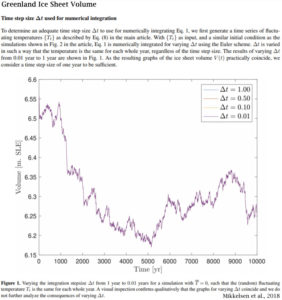
For Most Of The Last 10,000 Years, Greenland Ice Sheet and Glacier Volume Was Smaller Than Today

by K. Richard, August 5, 2019 in NoTricksZone


A new paper (Axford et al., 2019) reveals NW Greenland’s “outlet glaciers were smaller than today from ~9.4 to 0.2 ka BP” (9,400 to 200 years before 1950), and that “most of the land-based margin reached its maximum Holocene extent in the last millennium and likely the last few hundred years.”

The authors conclude:

“We infer based upon lake sediment organic and biogenic content that in response to declining temperatures, North Ice Cap reached its present-day size ~1850 AD, having been smaller than present through most of the preceding Holocene.”

Furthermore, the authors assert Greenland was 2.5°C to 3°C warmer than modern on average during the Holocene Thermal Maximum, and peak temperatures were 4°C to 7°C warmer.


Image Source: Mikkelson et al., 2018

Why You Shouldn’t Draw Trend Lines on Graphs

by Kip Hansen,  August 6, 2019 in WUWT


What we call a graph is more properly referred to as “a graphical representation of data.”  One very common form of graphical representation is “a diagram showing the relation between variable quantities, typically of two variables, each measured along one of a pair of axes at right angles.”

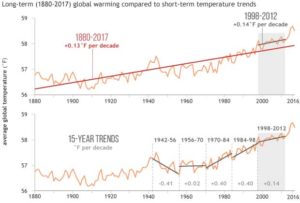
Here at WUWT we see a lot of graphs —  all sorts of graphs of a lot of different data sets.  Here is a commonly shown graph offered by NOAA taken from a piece at Climate.gov called “Did global warming stop in 1998?” by Rebecca Lindsey published on September 4, 2018.


I am not interested in the details of this graphic representation — the whole thing qualifies as “silliness”.  The vertical scale is in degrees Fahrenheit and the entire range change over 140 years shown is on the scale 2.5 °F or about a degree and a half C.   The interesting thing about the graph is the effort of drawing of “trend lines” on top of the data to convey to the reader something about the data that the author of the graphic representation wants to communicate.  This “something” is an opinion — it is always an opinion — it is not part of the data.

The data is the data.  Turning the data into a graphical representation (all right, I’ll just use “graph” from here on….), making the data into a graph has already  injected opinion and personal judgement into the data through choice of start and end dates, vertical and horizontal scales and, in this case, the shading of a 15-year period at one end.  Sometimes the decisions as to vertical and horizontal scale are made by software — not rational humans —  causing even further confusion and sometimes gross misrepresentation.

Anyone who cannot see the data clearly in the top graph without the aid of the red trend lineshould find another field of study (or see their optometrist).  The bottom graph has been turned into a propaganda statement by the addition of five opinions in the form of mini-trend lines.

La localisation temporelle et géographique des stations de mesure de la température pose des problèmes

by Carl-Stéphane Huot, 30 juillet 2019 in ScienceClimatEnergie


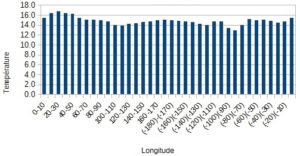
La notion de réchauffement climatique préoccupe bon nombre de gens depuis des années. Cependant, ce réchauffement apparent pourrait être influencé par le déplacement de stations météorologiques vers les zones plus chaudes de la planète, soit plus  près de l’équateur, soit à des altitudes plus basses.  La modélisation du climat est aussi influencée par l’existence de régions sans, ou avec très peu, de stations météorologiques.

Graphique 1 : Température moyenne selon la classe de longitude.

Conclusion

La variation extrêmement élevée du nombre de stations météorologiques servant au calcul de la température mondiale a contribué depuis le début des années 1950 à une partie au moins de l’élévation de  température. La dérive de celles-ci d’une place à l’autre fausse la précision des données que l’on peut en tirer, et contribue à augmenter l’inquiétude de la population. L’emplacement et le nombre de stations à installer posent un certain nombre de problèmes autant scientifiques que techniques et  politiques, et rend, avec d’autres éléments, (par exemple l’effet d’urbanisation, non abordé ici) extrêmement difficile de parler de réchauffement climatique.

Temps far, far below normal across almost the entire territory of European Russia

by Robert, August 4, 2019 in IceAgeNow


We’re talking about record-breaking cold across an area almost half as big as the entire contiguous United States.

2 Aug 2019 – In a number of points in the north-east of the territory, the temperature dropped to record lows. In the capital of the Komi Republic, in Syktyvkar, it dropped to 2.7 degrees, which is 0.3 degrees lower than the previous record held since 1944.

Not only in the northern areas, the temperature also dropped to critical levels. In Voronezh the thermometers showed +7 degrees, leaving behind the previous record of +7.1 degrees in 1971.

Further south, in Saratov, the minimum temperature on the first day of August was 9.6, beating the previous record of 10.4 degrees set in 1948.

The cold also hit Azov. In Tsimlyansk, Rostov Region, on August 1 the temperature fell to 13.3 degrees. The previous record, 13.6, was noted in 1975.

On the first day of August, the average temperature across almost the entire territory of European Russia was 4-6 degrees below normal, and in the Volga region it did not reach the average long-term values ​​of 8 degrees.

Cold weather throughout the territory from the White to the Black Sea will continue for at least another week.

European Russia covers nearly 4,000,000 km2 (1,500,000 sq mi).
Together, the 48 contiguous states and Washington, D.C. occupy a combined area of 8,080,464.3 km2 (3,119,884.69 sq miles).

http://www.hmn.ru/index.php?index=2&nn=62368

July 2019 Was Not the Warmest on Record

by Roy Spencer, August 2, 2019 in GlobalWarming


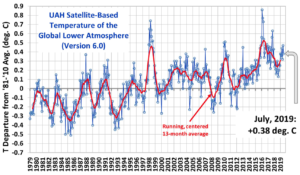
July 2019 was probably the 4th warmest of the last 41 years. Global “reanalysis” datasets need to start being used for monitoring of global surface temperatures. [NOTE: It turns out that the WMO, which announced July 2019 as a near-record, relies upon the ERA5 reanalysis which apparently departs substantially from the CFSv2 reanalysis, making my proposed reliance on only reanalysis data for surface temperature monitoring also subject to considerable uncertainty].


See also here

Greenland Ice sheet Meltdown Scare–Except It’s Not True

by P.  Homewood,  August 1, 2019 in NotaLotofPeopleKnowThat


The same heat dome that roasted Europe and broke national temperature records in five countries last week has shifted to Greenland, where it is causing one of the biggest melt events ever observed on the fragile ice sheet.

By some measures, the ice melt is more extreme than during a benchmark record event in July 2012, according to scientists analyzing the latest data. During that event, about 98 percent of the ice sheet experienced some surface melting, speeding up the process of shedding ice into the ocean.

The fate of Greenland’s ice sheet is of critical importance to every coastal resident in the world, since Greenland is already the biggest contributor to modern-day sea level rise. The pace and extent of Greenland ice melt will help determine how high sea levels climb and how quickly….

The Danish Meteorological Institute tweeted that more than half the ice sheet experienced some degree of melting on Tuesday, according to a computer model simulation, which made it the “highest this year by some distance.”

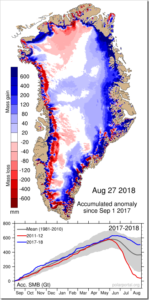
And there is no mention of the fact that the ice sheet grew substantially last year, and also the year before:

The simple fact is that the Greenland ice sheet melts every summer, particularly when the sun shines. That’s what it does. And it grows back again in winter as the snow falls. Indeed, if it did not melt, it would carry on growing year after year.

Inevitably there are some days when the weather is warmer and sunnier than normal, and others when it is colder. To pick an odd day or two is ridiculous and dishonest scaremongering.

See also here and here

Hockey Stick Groundhog Day

by P. Homewood, August, 1, 2019 in NotaLotofPeopleKnowThat


Some ancient history

Fifteen to twenty years ago, Michael Mann and colleagues wrote a few papers claiming that current warming was unprecedented over the last 600 to 2000 years.  Other climate scientists described Mann’s work variously as crap, pathetic, sloppy, and crap.  These papers caught the interest of Stephen McIntyre and this led to the creation of his Climate Audit blog and the publication of paperspointing out the flaws in these hockey stick reconstructions. In particular, Mcintyre and his co-author Ross McKitrick showed that the method used by Mann and colleagues shifted the data in such a way that any data sets that showed an upward trend in the 20th century would receive a stronger weighting in the final reconstruction.  With this method, generation of a hockey-stick shape in the temperature reconstruction was virtually guaranteed, which M&M demonstrated by feeding in random numbers to the method.

Former Award-Winning NOAA scientist Dr. Rex Fleming declares his climate dissent

by Marc Morano, July 30, 2019 in Climate Depot,


Former NOAA Award-Winning Atmospheric Scientist Dr. Rex Fleming joins many former UN IPCC and U.S. government scientists publicly dissenting on man-made climate change. Fleming declares that “CO2 has no impact on climate change.”

“Past climates have been warm and cold and warm and cold with no changes in carbon dioxide. How can that be a cause when there’s no correlation.”

Fleming 8:10 on AMS, AGU, AAAS: “all 3 of those organizations will not support a “denier”..I could not get published in any of those organizations..as a denier..I had to go to Europe to publish a paper..it was peer-reviewed in Europe, it got thru, & it has been very successful”
Quote Tweet

Fleming’s work here: The Rise and Fall of the Carbon Dioxide Theory of Climate Change (2019)


‘Hidden’ NOAA temperature data reveals that 6 of the last 9 months were below normal in the USA – and NOAA can’t even get June right

by Anthony Watts, July 30, 2019 in WUWT


A review of state-of-the-art climate data tells a different story than what NOAA tells the public.

While media outlets scream “hottest ever” for the world in June and July (it’s summer) and opportunistic climate crusaders use those headlines to push the idea of a “climate crisis” the reality is for USA is that so far most of 2019 has been below normal, temperature-wise.

Little known data from the state of the art U.S. Climate Reference Network (which never seems to make it into NOAA’s monthly “state of the climate” reports) show that for the past nine months, six of them were below normal, shown in bold below.

201810 -0.18°F
201811 -2.56°F
201812 2.39°F
201901 0.63°F
201902 -3.15°F
201903 -2.81°F
201904 1.55°F
201905 -1.13°F
201906 -0.14°F

Above: Table 1, U.S. average temperature anomaly from October 2018 to June 2019. Full data file here

Fake “Heatwave for Greenland” Claims

by P. Homewood, July 30, 2019 in NotaLotofPeopleKnowThat


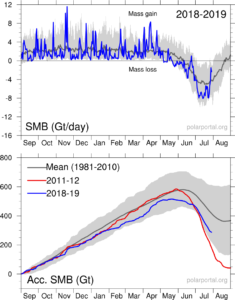
And that Greenland ice? The Surface Mass Balance has been well below normal throughout the winter, because of the dry weather. The rate of summer melt, however, has been pretty much normal, contrary to the fake claims of Ms Nullis.

With only a couple of weeks of melt left, it seems extremely unlikely that, even with the sunshine forecast, that the ice will dip below the 2012 figure (which incidentally is only a “record low” since records began in 1981).

http://polarportal.dk/en/greenland/surface-conditions/

New Record Temperature–But How Much Of It Is Due To UHI?

by P. Homewood, July 30, 2019 in NotaLotofPeopleKnowThat


Cambridge University Botanic Garden measured 38.7C (101.7F) on Thursday beating the previous UK record of 38.5C (101.3F), set in Kent in 2003.

A Met Office official was sent to check the equipment before verifying the new record on Monday.

Staff working at the garden on Thursday tweeted: “No wonder we all felt as if we’d melted.”

Daily temperatures have been measured by the weather station at the site in the south of the city since 1904.

Cambridge University Botanic Garden director, Beverley Glover, said: “We are really pleased that our careful recording of the weather, something that we’ve been doing every day for over 100 years at the Botanic Garden, has been useful to the Met Office in defining the scale of this latest heatwave.

“Our long history of weather recording is very important to researchers analysing climate change.

“However, we can’t help but feel dismay at the high temperature recorded and the implication that our local climate is getting hotter, with inevitable consequences for the plants and animals around us.”

https://www.bbc.co.uk/news/uk-49157898


In fact, Cambridge’s new record tells us very little about “climate change”, but an awful lot about the Urban Heat Island Effect, or UHI.

Shockingly Thick First-Year Ice In Mid-July Between Barents Sea And North Pole

by S.J. Crockford, July29, 2019 in ClimateChangeDispatch


In late June, one of the most powerful icebreakers in the world encountered such extraordinarily thick ice on-route to the North Pole (with a polar bear specialist and deep-pocketed, Attenborough-class tourists onboard) that it took a day and a half longer than expected to get there.

A few weeks later, in mid-July, a Norwegian icebreaker also bound for the North Pole (with scientific researchers onboard) was forced to turn back north of Svalbard when it unexpectedly encountered impenetrable pack ice.

Apparently, the ice charts the Norwegian captain consulted showed ‘first-year ice‘ – ice that formed the previous fall, defined as less than 2 m thick (6.6 ft) – which is often much broken up by early summer.

However, what he and his Russian colleague came up against was consolidated first-year pack ice up to 3 m thick (about 10 ft). Such thick first-year ice was not just unexpected but by definition, should have been impossible.

Ice charts for the last few years that estimate actual ice thickness (rather than age) show ice >2 m thick east and/or just north of Svalbard and around the North Pole are not unusual at this time of year.

This suggests that the propensity of navigational charts to use ice ‘age’ (e.g. first-year vs. multi-year) to describe ice conditions could explain the Norwegian captain getting caught off-guard by exceptionally thick first-year ice.

New Attempts To Erase The MWP & LIA

by P. Homewood, July 29, 2019 in NotaLotofPeopleKnowThat


There have been many attempts to get rid of the Medieval Warming Period and Little Ice Age, and here’s another one:

The science teams reconstructed the climate conditions that existed over the past 2,000 years using 700 proxy records of temperature changes, including tree rings, corals and lake sediments. They determined that none of these climate events occurred on a global scale.

https://www.bbc.co.uk/news/science-environment-49086783

As with the other failed attempts, this latest one claims that the MWP and LIA were only localised phenomena. But nothing could be further from the truth.

These three new studies rely on proxies, but time and again hockey stick studies based on proxies are proven to be fake, based on cherry picked proxies and dodgy statistics.

In fact, we have no need to rely on proxies, because the actual evidence of warm and cold periods is very real and substantial across the world.

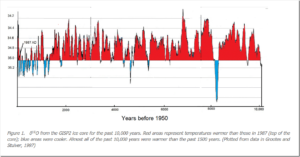
We are all familiar with the evidence from Greenland ice cores, which clearly show both the MWP and LIA:

http://www.kaltesonne.de/temperatures-over-the-past-10000-years/


Anti science L. A. Times hypes propaganda denying global wide Medieval Warm Period and Little Ice Age

by Larry Hamlin, July 28, 2019 in WUWT


The Los Angeles Times is at it again hyping anti science climate alarmist propaganda trying to conceal the global wide Medieval Warm Period and the Little Ice Age that are supported and justified by hundreds of scientific studies.

This climate alarmist propaganda Times article cites a new “study” that ridiculously attempts to deny these clearly established warm and cool periods in our past.

This alarmist hyped new “study” is addressed in a superb article at the JoNova website demonstrating the complete lack of scientific veracity of this studies claims.

There is nothing I can add to show how politically contrived and inane the claims are from this new “study” beyond the excellent presentation in the JoNova article.

Provided below are excerpts from this excellent article which demonstrate the lack of scientific credibility of the new “study” as well as the politically driven anti science climate alarmism bias of the Times.


‘Hidden’ NOAA temperature data reveals that 6 of the last 9 months were below normal in the USA – and NOAA can’t even get June right

by Anthony Watts, July 30 2019 in WUWT


A review of state-of-the-art climate data tells a different story than what NOAA tells the public.

While media outlets scream “hottest ever” for the world in June and July (it’s summer) and opportunistic climate crusaders use those headlines to push the idea of a “climate crisis” the reality is for USA is that so far most of 2019 has been below normal, temperature-wise.

Little known data from the state of the art U.S. Climate Reference Network (which never seems to make it into NOAA’s monthly “state of the climate” reports) show that for the past nine months, six of them were below normal, shown in bold below.


201810 -0.18°F
201811 -2.56°F
201812 2.39°F
201901 0.63°F
201902 -3.15°F
201903 -2.81°F
201904 1.55°F
201905 -1.13°F
201906 -0.14°F

Above: Table 1, U.S. average temperature anomaly from October 2018 to June 2019. Full data file here

Note the below average value for June, 2019 at -0.14°F

Figure 1, U.S. average temperature anomaly from January 2005 to June 2019. Source of graph, NOAA, available here