Archives de catégorie : climate-debate

If “Greenland is catastrophically melting”, how do alarmists explain NASA’s growing Greenland glacier?

by A. Watts, June19, 2019 in WUWT


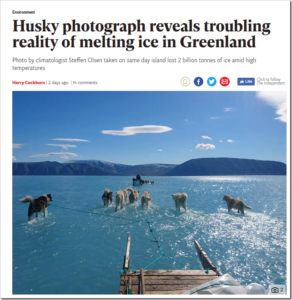
It turned out to be a weather event, unrelated to “climate change”. The next year, there was no “insta-melt“.

In fact. we’d not even know about the melting in Greenland before satellites came on the scene. So how many times in the history of the Earth has Greenland has a quick melt spike? I’m guessing hundreds of thousands of times.

Jakobshavn Glacier in western Greenland is notorious for being the world’s fastest-moving glacier. It is also one of the most active, discharging a tremendous amount of ice from the Greenland Ice Sheet into Ilulissat Icefjord and adjacent Disko Bay—with implications for sea level rise. The image above, acquired on June 6, 2019, by the Operational Land Imager (OLI) on Landsat 8, shows a natural-color view of the glacier.

Jakobshavn has spent decades in retreat—that is, until scientists observed an unexpected advance between 2016 and 2017. In addition to growing toward the ocean, the glacier was found to be slowing and thickening. New data collected in March 2019 confirm that the glacier has grown for the third year in a row, and scientists attribute the change to cool ocean waters.

June 6th, 2019 Jakobshavn Glacier in western Greenland . Image acquired on June 6, 2019, by the Operational Land Imager (OLI) on Landsat 8, shows a natural-color view of the glacier.

Consensus? 200+ New 2019 Papers Support A Skeptical Position On Climate Alarmism

by K. Richard, June17, 2019 in NoTricksZone


In the first 5½ months of 2019, over 200 scientific papers have been published that cast doubt on the position that anthropogenic CO2 emissions function as the climate’s fundamental control knob…or that otherwise serve to question the efficacy of climate models or the related “consensus” positions commonly endorsed by policymakers and ²²²²mainstream media sources.


These 200+ new papers affirm the position that there are significant limitations and uncertainties inherent in our understanding of climate and climate changes, emphasizing that climate science is not settled.

More specifically, the papers in this compilation support these four main skeptical positions — categorized here as N(1) – N(4) — which question climate alarm.

Dry Hot North German Summers Were More Common 1000 Years Ago, Scientists Report

by P. Gosselin, June 19, 2019 in NoTricksZone


Dry Summers Like 2018 Were Common in the Middle Ages

THE FUTILITY OF WESTERN DE-CARBONISATION

by Ed. Hoskins, June 18, 2019  in GWPF


It is clear that CO2 emissions are continuing to grow incrementally in the Developing World.  This should be anticipated to continue indefinitely.

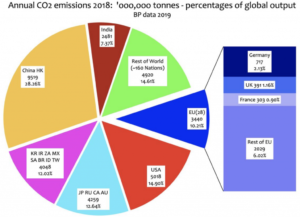
2018 Global CO2 emissions

The following calculations and graphics are based on information on worldwide CO2 emissions published by BP in June 2019 for the period from 1965 up until the end of 2018.

The pie diagram above shows the proportion of CO2 emissions as of the end of 2018.

The previous post for the end of 2017 is available here

The data showing the progress of CO2 emissions by 2018 in the Developed and Developing worlds can be summarised as follows:

Earth system models underestimate carbon fixation by plants in the high latitudes

by From Nature Communications, June 18 in WUWT


Abstract

Most Earth system models agree that land will continue to store carbon due to the physiological effects of rising CO2 concentration and climatic changes favoring plant growth in temperature-limited regions. But they largely disagree on the amount of carbon uptake. The historical CO2 increase has resulted in enhanced photosynthetic carbon fixation (Gross Primary Production, GPP), as can be evidenced from atmospheric CO2 concentration and satellite leaf area index measurements. Here, we use leaf area sensitivity to ambient COfrom the past 36 years of satellite measurements to obtain an Emergent Constraint (EC) estimate of GPP enhancement in the northern high latitudes at two-times the pre-industrial CO2 concentration (3.4 ± 0.2 Pg C yr−1). We derive three independent comparable estimates from CO2 measurements and atmospheric inversions. Our EC estimate is 60% larger than the conventionally used multi-model average (44% higher at the global scale). This suggests that most models largely underestimate photosynthetic carbon fixation and therefore likely overestimate future atmospheric CO2 abundance and ensuing climate change, though not proportionately.

CO2, GLOBAL WARMING, CLIMATE AND ENERGY

by Allan M.R. MacRae, B.A.Sc., M.Eng., P.Eng., June 2019 in WUWT


ABSTRACT

Global warming alarmism, which falsely assumes that increasing atmospheric CO2 causes catastrophic global warming, is disproved – essentially, it assumes that the future is causing the past. In reality, atmospheric CO2 changes lag global temperature changes at all measured time scales.

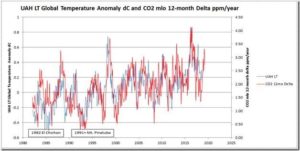
Nino34 Area Sea Surface Temperature changes, then tropical humidity changes, then atmospheric temperature changes, then CO2 changes.

The velocity dCO2/dt changes ~contemporaneously with global temperature changes and CO2 changes occur ~9 months later (MacRae 2008).

The process that causes the ~9-month average lag of CO2 changes after temperature changes is hypothesized and supported by observations.

The ~9-month lag, +/- several months, averages 1/4 of the full-period duration of the variable global temperature cycle, which averages ~3 years.

Based on the above observations, global temperatures drive atmospheric CO2 concentrations much more than CO2 drives temperature.

Climate sensitivity to increasing atmospheric CO2 must be very low, less than ~1C/(2*CO2) and probably much less.

There will be no catastrophic warming and no significant increase in chaotic weather due to increasing CO2 concentrations.

Increasing atmospheric CO2 clearly causes significantly improved crop yields, and may cause minor, beneficial global warming.

Atmospheric CO2 is not alarmingly high, it is too low for optimal plant growth and alarmingly low for the survival of carbon-based terrestrial life.

Other factors such as fossil fuel combustion, deforestation, etc may also increase atmospheric CO2. The increase of CO2 is clearly beneficial.

“Green energy” schemes are not green and produce little useful (dispatchable) energy, primarily because of the fatal flaw of intermittency.

There is no widely-available, cost-effective means of solving the flaw of intermittency in grid-connected wind and solar power generation.

Electric grids have been destabilized, electricity costs have soared and Excess Winter Deaths have increased due to green energy schemes.

HYPOTHESIS AND CONCLUSIONS

Fig.1a – The very close relationship of dCO2/dt (red) vs global temperature (blue) is clearly apparent. Major volcanoes disrupt the relationship.

Polar bear habitat update at mid-June: more than enough for survival

by Polar Bear Science, June 16, 2019


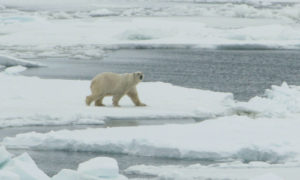
Here we are at the middle of June, when most polar bears are pretty much done with hunting seals for the season. And despite hand-wringing from some quarters, sea ice extent is down only marginally from average at this time of year and certainly not enough to impact polar bear survival.

Given the large expanse of open water in the Southern Beaufort so early in the season, one resident pessimist insists those polar bears are “challenged” by the lack of ice. If he is right, there should be reports of dozens upon dozens of skinny and dying bears along the coast of Alaska this summer. If not, he will pretend he never suggested any such thing.

So far, despite the early loss of ice in some regions, there have been no reports of polar bears ashore unusually early. Hudson Bay still has lots of thick first year ice, so despite the overall reduced Arctic ice coverage, none of the three Hudson Bay polar bear populations are facing the earlier-than-usual sea ice breakup this year as we keep being promised will show up. In fact, there hasn’t been a significantly early breakup in Western Hudson Bay since 2010 (see previous posts here and here).

Extremes

by Judith Curry, June14, 2019 in WUWT


Politics versus science in attributing extreme weather events to manmade global warming.

If you follow me on twitter, you may have noticed that I was scheduled to testify before the House Oversight and Reform Committee on Jun 12 [link].  The subject of the Hearing is Contending with Natural Disasters in the Wake of Climate Change.

Late on Jun 10, I received an email telling me that the Hearing is postponed (as yet unscheduled).  Apparently the Committee finds it more urgent to have a Hearing related to holding the Attorney General and Secretary of Commerce in contempt of Congress [link].  Interesting to ponder that Congressional procedural issues are deemed to be more important than Climate Change.

So I spent all last week working on my testimony (which is why there have been no new blog posts).  I hope the Hearing will eventually happen (Michael Mann is also scheduled to testify).

Hurricanes and climate change constitute a major portion of my testimony.  You may recall my recent series  on Hurricanes & climate change [link].  Specifically with regards to detection and attribution, my bottom line conclusion was:

“In summary, the trend signal in hurricane activity has not yet had time to rise above the background variability of natural processes. Manmade climate change may have caused changes in hurricane activity that are not yet detectable due to the small magnitude of these changes compared to estimated natural variability, or due to observational limitations. But at this point, there is no convincing evidence that manmade global warming has caused a change in hurricane activity.”

La croissance du CO2 dans l’atmosphère est-elle exclusivement anthropique? (1/2) et Effet Suess

by J.C. Maurin, 13 juin 2019 in ScienceClimatEnergie


Une croissance du COatmosphérique qui serait exclusivement anthropique est contradictoire avec les observations du carbone 13 dans l’atmosphère (ici). Cet article en 2 parties va montrer qu’il existe également des contradictions avec les observations du carbone 14. Celui-ci  est utilisé à des fins de datation jusqu’à 50 000 ans BP  (Before Present)et on dispose de nombreuses études (pour calibration) sur son évolution dans l’atmosphère.  


La première partie s’intéresse, non pas aux datations, mais à la dilution du carbone 14 que provoque l’ajout de COanthropique (effet SUESS)  avant les essais thermonucléaires de 1952-1963.
Dans la seconde partie nous verrons que l’évolution du carbone 14 après 1963 est aussi en contradiction avec une croissance du COexclusivement anthropique.

1. Le carbone dans l’atmosphère [1] [5]

Le carbone existe habituellement sous 3 formes isotopiques : 12C pour ≈ 98.9% , 13C pour ≈ 1.1 % et 14C à l’état de traces (Fig. 1a).

Figure 1a.  La seule différence entre COanthropique et COatmosphérique réside dans les proportions du mélange des isotopes: le COanthropique est appauvri en 13C et 14C.  L’ajout de COanthropique va modifier, au fil des années, les proportions du mélange isotopique dans l’atmosphère.

Study: Cattle Methane is a moooot point in global climate

by Anthony Watts, June 12, 2019 in WUWT


Via No Tricks Zone: Agrobiologist and scientific researcher Dr. Albrecht Glatzle, author of over 100 scientific papers and two textbooks, has published research that shows:

“…there is no scientific evidence, whatsoever, that domestic livestock could represent a risk for the Earth’s climate” and the “warming potential of anthropogenic GHG [greenhouse gas] emissions has been exaggerated.”

Glatzle, 2018

Domestic Livestock and ItsAlleged Role in Climate Change

Abstract:

“Our key conclusion is there is no need for anthropogenic emissions of greenhouse gases (GHGs), and even less so for livestock-born emissions, to explain climate change. Climate has always been changing, and even the present warming is most likely driven by natural factors.

The warming potential of anthropogenic GHG emissions has been exaggerated, and the beneficial impacts of manmade CO2 emissions for nature, agriculture, and global food security have been systematically suppressed, ignored, or at least downplayed by the IPCC (Intergovernmental Panel on Climate Change) and other UN (United Nations) agencies.

Furthermore, we expose important methodological deficiencies in IPCC and FAO (Food Agriculture Organization) instructions and applications for the quantification of the manmade part of non-CO2-GHG emissions from agro-ecosystems.

However, so far, these fatal errors inexorably propagated through the scientific literature.

Finally, we could not find a clear domestic livestock fingerprint, neither in the geographical methane distribution nor in the historical evolution of mean atmospheric methane concentration.”

Ouragans en Atlantique : prévisions pour la saison 2019

by Regis Crepet, 2 juin 2019 in LaChaîneMétéo


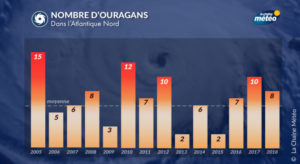
Ces deux dernières années ont été marquées par une activité cyclonique supérieure aux moyennes statistiques en Atlantique Nord, notamment en 2017 avec des phénomènes puissants tels Irma et Maria dans les Caraïbes. Cette année, alors que la saison démarre officiellement le 1er juin, nos prévisions sont plus rassurantes avec la perspective d’une activité cyclonique légèrement plus faible que la moyenne.


En ce début d’été météorologique, la saison cyclonique débute dans l’Atlantique nord (les ouragans). Cette saison s’étend officiellement du 1er juin au 30 novembre, avec un pic d’activité d’août à octobre. Il est donc l’heure pour les différents organismes météo de la planète et les météorologues et climatologues de La Chaîne Météo de se pencher sur les prévisions de cette saison à venir.

En 2017, la saison dans l’océan Atlantique nord a figuré parmi les plus actives depuis le début des relevés, avec des phénomènes dévastateurs (Harvey, Irma ou encore Maria dans les Caraïbes). Comme 2017, la saison 2018 s’est située au-dessus des moyennes (calculées par la NOAA d’après la période 1981/2010). Cette dernière saison a présenté, pour l’Atlantique nord, 15 phénomènes cycloniques, avec 8 ouragans dont 2 qui ont atteint la catégorie 3 sur 5, qualifiés alors de “majeurs”.

Ending Fossil Fuels Would Bring The World Back To The Dark Ages

by Washington Times, June11, 2019 in ClimateChange Dispatch


German engineering, as good as it is, has not been able to eliminate the effect of “green” politics, which would replace fossil and nuclear power with renewables. The result is 172,000 localized blackouts in Germany in 2017.

Poverty was a constant companion of humanity until modern times. The proportion of people worldwide living in poverty was cut in half between 1990 and 2010, according to the World Bank, an achievement unprecedented in human history.

It was the result of a rapid boost in global energy production — up 43 percent during that period, according to the U.S. Energy Information Administration. Nearly 81 percent of that power was generated by fossil fuels, such as oil and gas.

A billion people around the globe still suffer extreme energy poverty, with no access to electricity. Everyone gets a hint of what that means when storms knock out the power, and everything in the house stops.

Fumbling occasionally for candles is a mere inconvenience, but life beyond carbon — entirely dependent on sunshine and a breeze — would be insanity.

Why Climate Models Can’t Predict The Future (And Never Have)

by Jay Lehr, June 11, 2019 in Climate ChangeDispatch


SEE ALSO: Climate Models Of Incompetence

Consider the following: we do not know all the variables that control our climate, but we are quite sure they are likely in the hundreds.

Just take a quick look at ten obviously important factors for which we have limited understanding:

1- Changes in seasonal solar irradiation;

2- Energy flows between ocean and atmosphere;

3- Energy flow between air and land;

4- The balance between Earth’s water, water vapor, and ice;

5- The impacts of clouds;

6- Understanding the planet’s ice;

7- Mass changes between ice sheets, sea level and glaciers;

8- The ability to factor in hurricanes and tornadoes;

9- The impact of vegetation on temperature;

10- Tectonic movement on ocean bottoms.

Yet, today’s modelers believe they can tell you the planet’s climate decades or even a century in the future and want you to manage your economy accordingly.

Dr. Willie Soon of the Harvard-Smithsonian astrophysics laboratory once calculated that if we could know all the variables affecting climate and plugged them into the world’s largest computer, it would take 40 years for the computer to reach an answer.

In Coal We Trust: The Need For Coal Power In Asia

by Tilak Doshi, June 7, 2019 in Forbes


The reigning narrative of impending global environmental catastrophe dominates the airwaves and print media. Short of a drastic reduction in the use of fossil fuels, it is asserted, we are fast approaching the “end of days”. The demonization of fossils fuels in general, and coal in particular, has been wrought under pressure from special interests groups and organized lobbies of the climate-industrial complex where aspects of economic reality are caricatured or presented out of context. Complex trade-offs in energy policy are spun into tales of spurious simplicity, leading to misleading conclusions. Nowhere is this more apparent than in the debate over the role of coal-fueled power generation in Asia.

Opposition to the building of coal power plants in the poorer countries has been justified by environmental activists, banks and multilateral development agencies such as the World Bank in two key ways. The first revolves around the claim that climate change mitigation programs carry “co-benefits” for public health in developing countries. The second utilizes the assertion that renewable energy such as solar and wind power are effective substitutes for centralized grid electricity generated by fossil fuels.

Climate change policy does not help the poor

Central Europe temperature constrained by speleothem fluid inclusion water isotopes over the past 14,000 years

by Affolter et al., June 5, 2019 in ScienceAdvance


Abstract

The reasons for the early Holocene temperature discrepancy between northern hemispheric model simulations and paleoclimate reconstructions—known as the Holocene temperature conundrum—remain unclear. Using hydrogen isotopes of fluid inclusion water extracted from stalagmites from the Milandre Cave in Switzerland, we established a mid-latitude European mean annual temperature reconstruction for the past 14,000 years. Our Milandre Cave fluid inclusion temperature record (MC-FIT) resembles Greenland and Mediterranean sea surface temperature trends but differs from recent reconstructions obtained from biogenic proxies and climate models. The water isotopes are further synchronized with tropical precipitation records, stressing the Northern Hemisphere signature. Our results support the existence of a European Holocene Thermal Maximum and data-model temperature discrepancies. Moreover, data-data comparison reveals a significant latitudinal temperature gradient within Europe. Last, the MC-FIT record suggests that seasonal biases in the proxies are not the primary cause of the Holocene temperature conundrum.

Radiation versus Temperature

by Willis Eschenbach, June 8, 2019 in WUWT


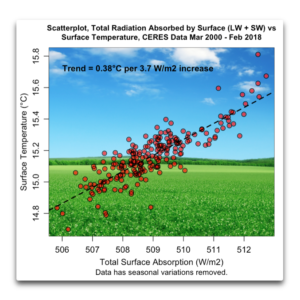
Due to the recent posts by Lord Monkton and Nick Stokes, I’ve been thinking about the relationship between radiation and temperature. So I turned to the CERES dataset. Here is a scatterplot of the monthly global average surface temperature versus the monthly global average downwelling total radiation absorbed by the surface. The total radiation is the sum of the net solar radiation at the surface and the downwelling longwave radiation at the surface. I’ve removed the seasonal variations from the data.

Note that 3.7 W/m2 is the increase in downwelling longwave radiation expected from a doubling of CO2 …

When I saw that, I thought well, maybe the increase is small because there’s a lag between the absorption of the radiation and the warming. To see if that was the case, I did a cross-correlation analysis of the relationship.

‘Skeptical Environmentalist’ Bjorn Lomborg sets fire to the scourge of ‘unbridled climate alarmism’

by Charles the moderator , June 7, 2019 in WUWT


Fear’s a great motivator, right? So what better way to motivate people to care about climate change than to scare the crap out of them? Even if you have to leave out some details to do it?

New York Magazine climate columnist David Wallace-Wells seems to be a student at the School of We’re Hurtling Toward Global Environmental Catastrophe and We’re All Gonna Die. Last night, he shared a short piece by James Dyke, a senior lecturer in global systems at the University of Exeter, explaining some of the horrible things humanity is in for:

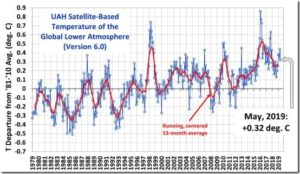
Latest Global Temp. Anomaly (May ’19: +0.32°C) A Simple “No Greenhouse Effect” Model of Day/Night Temperatures at Different Latitudes

by Dr. Roy Spencer, June 7, 2019 in WUWT


Abstract: A simple time-dependent model of Earth surface temperatures over the 24 hr day/night cycle at different latitudes is presented. The model reaches energy equilibrium after 1.5 months no matter what temperature it is initialized at. It is shown that even with 1,370 W/m2 of solar flux (reduced by an assumed albedo of 0.3), temperatures at all latitudes remain very cold, even in the afternoon and in the deep tropics. Variation of the model input parameters over reasonable ranges do not change this fact. This demonstrates the importance of the atmospheric “greenhouse” effect, which increases surface temperatures well above what can be achieved with only solar heating and surface infrared loss to outer space.

PATAGONIA ICE SHEETS THICKER THAN PREVIOUSLY THOUGHT

by GWPF, June 05, 2019


After conducting a comprehensive, seven-year survey of Patagonia, glaciologists from the University of California, Irvine and partner institutions in Argentina and Chile have concluded that the ice sheets in this vast region of South America are considerably more massive than expected.

hrough a combination of ground observations and airborne gravity and radar sounding methods, the scientists created the most complete ice density map of the area to date and found that some glaciers are as much as a mile (1,600 meters) thick. Their findings were published today in the American Geophysical Union journal Geophysical Research Letters.

Glacier National Park Quietly Removes Its ‘Gone by 2020’ Signs

by Roger I. Roots, May 30, 2019 in WUWT


Founder, Lysander Spooner University

May 30, 2019. St. Mary, Montana. Officials at Glacier National Park (GNP) have begun quietly removing and altering signs and government literature which told visitors that the Park’s glaciers were all expected to disappear by either 2020 or 2030.
In recent years the National Park Service prominently featured brochures, signs and films which boldly proclaimed that all glaciers at GNP were melting away rapidly. But now officials at GNP seem to be scrambling to hide or replace their previous hysterical claims while avoiding any notice to the public that the claims were inaccurate. Teams from Lysander Spooner University visiting the Park each September have noted that GNP’s most famous glaciers such as the Grinnell Glacier and the Jackson Glacier appear to have been growing—not shrinking—since about 2010. (The Jackson Glacier—easily seen from the Going-To-The-Sun Highway—may have grown as much as 25% or more over the past decade.)

Montana Glacier National Park Mountains Cracker Lake

How deep-ocean vents fuel massive phytoplankton blooms

by Stanford’s School of Earth, Energy & Environmental Sciences, June 5, 2019 in WUWT


More “settled science” of the carbon cycle~ctm

Stanford study shows how hydrothermal vents fuel massive phytoplankton blooms — and possible hotspots for carbon storage

Researchers at Stanford University say they have found an aquatic highway that lets nutrients from Earth’s belly sweep up to surface waters off the coast of Antarctica and stimulate explosive growth of microscopic ocean algae.

Their study, published June 5 in the journal Nature Communications, suggests that hydrothermal vents – openings in the seafloor that gush scorching hot streams of mineral-rich fluid – may affect life near the ocean’s surface and the global carbon cycle more than previously thought.

Mathieu Ardyna, a postdoctoral scholar and the study’s lead author, said the research provides the first observed evidence of iron from the Southern Ocean’s depths turning normally anemic surface waters into hotspots for phytoplankton – the tiny algae that sustain the marine food web, pull heat-trapping carbon dioxide out of the air and produce a huge amount of the oxygen we breathe. “Our study shows that iron from hydrothermal vents can well up, travel across hundreds of miles of open ocean and allow phytoplankton to thrive in some very unexpected places,” he said.

Kevin Arrigo, a professor of Earth system science and senior author of the paper, called the findings “important because they show how intimately linked the deep ocean and surface ocean can be.”

2019 Atlantic hurricane forecast

by J. Curry and J. Johnstone, June4, 2019 in ClimateEtc.


CFAN predicts an active North Atlantic hurricane season season.

The Atlantic hurricane has begun.  We are off to an early start with one wimpy subtropical storm that lasted less than a day, and a small system that is trying to spin up in the Bay of Campeche.

Other forecast providers have begun issuing forecasts:

  • NOAA predicts a near normal season with 4-8 hurricanes.
  • Tropical Storm Risk predicts slightly below normal activity, with 6 hurricanes and ACE of 88.
  • Colorado State University predicts near normal season:  6 hurricanes and ACE of 100

Climate Forecast Applications Network (CFAN) is going bold, see below. [link] to forecast report.

CFAN’s seasonal forecast

Table 1. Current (May) 2019 hurricane forecasts of North Atlantic ACE, North Atlantic total hurricanes, U.S. landfalling hurricanes. 

….

The major emitters that are meeting their Paris Agreement pledges

by Axios, June 1, 2019


Of top 10 global carbon emitters, not a single one is hitting its climate goals as outlined under the Paris Agreement, per data from the Climate Action Tracker.

Why it matters: Even if every country that’s adopted the Paris Agreement were to meet their pledges, it would not avert the worst effects of climate change.

Driving the news: June 1 marks the 2-year anniversary of President Trump’s announcement that the U.S. would withdraw from the deal. Per the Climate Action Tracker, the U.S., the second-largest world emitter of greenhouse gasses (but top historical emitter), falls under “critically insufficient,” the worst category, in meeting its Paris pledge.

The backdrop: The Paris Agreement’s main goal is to keep global temperature rise this century to “well below 2ºC,” above pre-industrial levels, and pursue efforts to limit the temperature increase to 1.5ºC.

  • Each country determined what it would be willing to do under the agreement. Such commitments are known as intended nationally determined contributions (INDCs).
  • After ratifying the agreement, the INDC would become the country’s first nationally determined contribution.

So far, 185 countries have ratified or adopted the Paris Agreement. All of the NDCs are available here.

New Proxy Data Show Northern Europe Weather Variability In Sync With Natural Factors: Solar Activity, Oceanic Cycles

by J. Goslin in P. Gosselin, June 1, 2019 in NoTricksZone


Another new paper, which of course will be ignored by the government-funded IPCC because it contradicts claims CO2 drives climate, shows that natural factors dominated the earth’s climate variability.

A team of scientists led by Jerome Goslin have published a paper titled Decadal variability of north-eastern Atlantic storminess at the mid-Holocene: New inferences from a record of wind-blown sand, western Denmark in the journal Global and Planetary Change, suggesting climate variability is driven naturally.

Image: NASA, public domain

Climate change driven by solar and oceanic cycles

Not surprisingly, as evidenced by hundreds of other publications (which are entirely ignored by the IPCC), climate variability is indeed tied to solar activity and “internal atmospheric and oceanic modes”.